

Pakistan, Qatar eye strategic tech partnership to expand startup financing, deepen digital cooperation

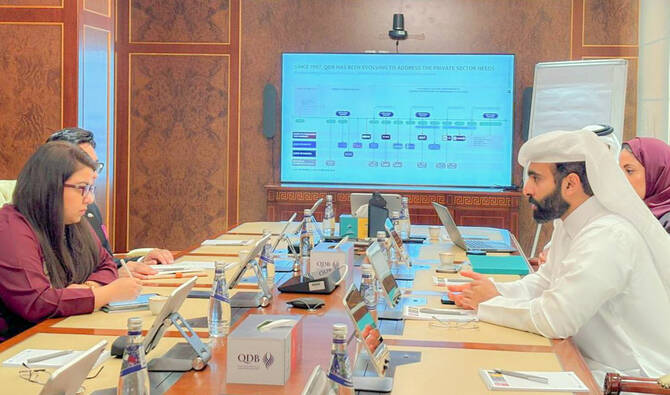
Pakistani IT minister Shaza Fatima Khawaja, meeting with Qatar Development Bank CEO Abdulrahman Al Sowaidi (right) in Doha, Qatar, on November 26, 2025. (IT Ministry)
Short Url
Updated 26 November 2025
Follow

Pakistan, Qatar eye strategic tech partnership to expand startup financing, deepen digital cooperation

  • Pakistan IT chief meets Qatar Development Bank CEO to discuss financing, incubation, investment opportunities for Pakistani startups
  • Both sides agree to deepen cooperation in AI, cloud services, cybersecurity, digital skills and cross-incubation programs

ISLAMABAD: Pakistan has opened talks with Qatar on creating a strategic technology partnership that would expand financing, incubation and investment opportunities for its startups, with IT minister Shaza Fatima Khawaja saying on Wednesday the Qatar Development Bank could play a central role in supporting Pakistan’s digital economy.

Pakistan has one of the world’s youngest tech workforces but faces significant barriers in early-stage funding, international market access and institutional support for digital skills. Meanwhile, Gulf economies including Qatar are rapidly expanding their investments in artificial intelligence, cloud infrastructure, cybersecurity and SME innovation as part of long-term diversification agendas.

As Pakistan seeks to integrate more deeply with these regional tech ecosystems, partnerships with development institutions such as Qatar Development Bank are viewed as critical for unlocking capital, training and cross-border incubation opportunities for Pakistani founders.

“A detailed discussion was held on new opportunities for financing, incubation and investment for Pakistani tech startups,” according to a statement released by the Pakistani IT ministry after Khawaja met Qatar Development Bank CEO Abdulrahman Al Sowaidi in Doha on Wednesday for wide-ranging discussions on strengthening support for Pakistan’s technology sector.

Khawaja told the delegation QDB could play a transformative role in Pakistan’s digital economy and “become a strategic partner for Pakistan’s IT and tech SMEs.”

The talks also covered advanced technology fields where both countries aim to expand cooperation, including artificial intelligence, cloud computing, cybersecurity and digital transformation. The ministry said the two sides also discussed expanding joint innovation and skills development efforts, adding that innovation and digital skill-building programs between Qatar and Pakistan were an important part of the conversation. Khawaja further proposed broadening institutional collaboration to support mobility and training, stating that she had suggested “enhancing institutional cooperation for talent, training and startup exchange programs.”

The meeting also touched on areas critical to industrial modernization, including cooperation on industrial digitalization, IoT testing environments and cross-incubation programs. Industrial digitalization refers to adopting digital tools such as automation and analytics across manufacturing, while IoT testing environments are specialized facilities where connected devices and sensors are evaluated for performance and security. Cross-incubation programs allow startups to access incubation facilities in both countries, enabling mentorship and market entry.

The ministry concluded that the discussion marked a meaningful step toward deepening the technological relationship between Qatar and Pakistan, describing the engagement as “an important step toward further strengthening the bilateral tech partnership.”


Imran Khan not a ‘national security threat,’ ex-PM’s party responds to Pakistan military

Updated 06 December 2025
Follow

Imran Khan not a ‘national security threat,’ ex-PM’s party responds to Pakistan military

  • Pakistan’s military spokesperson on Friday described Khan’s anti-army narrative as a “national security threat”
  • PTI Chairman Gohar Ali Khan says words used by military spokesperson for Khan were “not appropriate”

ISLAMABAD: Former prime minister Imran Khan’s Pakistan Tehreek-e-Insaf (PTI) party on Saturday responded to allegations by Pakistan military spokesperson Lt. Gen. Ahmed Sharif Chaudhry from a day earlier, saying that he was not a “national security threat.”

Chaudhry, who heads the military’s media wing as director general of the Inter-Services Public Relations (ISPR), spoke to journalists on Friday, in which he referred to Khan as a “mentally ill” person several times during the press interaction. Chaudhry described Khan’s anti-army narrative as a “national security threat.”

The military spokesperson was responding to Khan’s social media post this week in which he accused Chief of Defense Forces Field Marshal Asim Munir of being responsible for “the complete collapse of the constitution and rule of law in Pakistan.” 

“The people of Pakistan stand with Imran Khan, they stand with PTI,” the party’s secretary-general, Salman Akram Raja, told reporters during a news conference. 

“Imran Khan is not a national security threat. Imran Khan has kept the people of this country united.”

Raja said there were several narratives in the country, including those that created tensions along ethnic and sectarian lines, but Khan had rejected all of them and stood with one that the people of Pakistan supported. 

PTI Chairman Gohar Ali Khan, flanked by Raja, criticized the military spokesperson as well, saying his press talk on Thursday had “severely disappointed” him. 

“The words that were used [by the military spokesperson] were not appropriate,” Gohar said. “Those words were wrong.”

NATURAL OUTCOME’

Speaking to reporters earlier on Saturday, Pakistan’s Defense Minister Khawaja Asif defended the military spokesperson’s remarks against Khan.

“When this kind of language is used for individuals as well as for institutions, then a reaction is a natural outcome,” he said. 

“The same thing is happening on the Twitter accounts being run in his [Khan’s] name. If the DG ISPR has given any reaction to it, then I believe it was a very measured reaction.”

Khan, who was ousted after a parliamentary vote of confidence in April 2022, blames the country’s powerful military for removing him from power by colluding with his political opponents. Both deny the allegations. 

The former prime minister, who has been in prison since August 2023 on a slew of charges he says are politically motivated, also alleges his party was denied victory by the army and his political rivals in the 2024 general election through rigging. 

The army and the government both deny his allegations.