BRUSSELS: The third and final day of a national strike in Belgium on Wednesday grounded most flights at Brussels Airport and disrupted public transport.
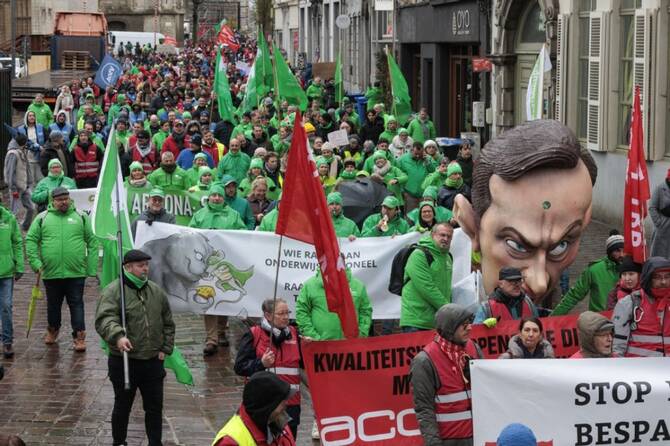
The strike, organized by the country’s main unions, is the latest in a series of protests against the coalition government led by Prime Minister Bart De Wever. Demonstrators oppose the government’s proposed pension and labor market reforms.
Brussels Airport canceled all departing flights as well as 110 of its 203 planned incoming flights.
Belgium’s other main airport Charleroi Airport said on its website that it also expected significant disruption due to staff shortages and would be unable to guarantee scheduled landings and takeoffs.
Local media reported that the final day of the strike was expected to be the most disruptive with schools, public transport, and the private sector affected as well.
A protest is planned in Brussels for Wednesday afternoon. A similar demonstration in October drew about 80,000 participants.
“The budget message from the De Wever government is harsh: work longer and harder for less security regarding pensions, health and purchasing power,” socialist Union ABVV-FGTB said on its website.
Gert Truyens, chair of the ACLVB liberal union, told the Belgian public broadcaster VRT he regretted unions had not been consulted by the national government.
“Agreements are not made in the streets at the picket lines; that happens at the negotiating table, but you need to be given the chance,” Truyens said.
Although the government reached an agreement on next year’s budget on Monday after months of tense negotiations, it did not avert the strike.
The government plans a new tax on banks and tax increases on airplane tickets and natural gas. Together with cuts in spending, this should lower the government deficit by 9.2 billion euros ($10.6 billion) by 2029.
The budget deficit of the euro zone’s sixth-largest economy is set to hit 4.5 percent of gross domestic product this year, with debt of 104.7 percent of GDP, according to the central bank — well above the maximum agreed under EU budget rules.

Belgian national strike disrupts schools, flights and public transport
https://arab.news/24849
Belgian national strike disrupts schools, flights and public transport
- The strike, organized by the country’s main unions, is the latest in a series of protests against the coalition government led by Prime Minister Bart De Wever
Climate change fueled deadly rainstorms in Iberia, Morocco: scientists
- Nine storms across the three countries have killed more than 50 people and forced over 200,000 to flee their homes, mostly in Morocco
- The volume of rainfall in places like Grazalema is “staggering,” said Garcia, a climate scientist
MADRID: Human-driven climate change intensified torrential downpours that killed dozens and forced thousands of people from their homes across Morocco, Spain, and Portugal earlier this year, a network of climate scientists said Thursday.
Precipitation during the region’s wettest days now entail around one-third more rainfall compared with the pre-industrial climate, which was 1.3C cooler, according to a report by the World Weather Attribution (WWA), whose scientists study the link between extreme weather events and climate change.
Nine storms unleashed torrential rain and hurricane-force winds across the three countries from 16 January to 17 February, killing more than 50 people and forcing over 200,000 to flee their homes, mostly in Morocco.
Grazalema, one of the hardest-hit municipalities in southern Spain, saw more than a full year’s expected rainfall in just a few days, according to the WWA.
Videos on social media showed residents breaking through the walls of their homes to drain water and prevent further flooding damage.
The volume of rainfall in places like Grazalema is “staggering,” said David Garcia-Garcia, a climate scientist at the University of Alicante and study co-author, calling it a “massive shock” to infrastructure and soil.
The WWA estimates that rainfall intensity is now about 11 percent higher in northern Portugal and northwestern Spain than in pre-industrial times.
The researchers were unable to quantify the exact impact of climate change on rainfall in southern Iberia and northern Morocco, as the available data show regional variations.
“This is exactly what climate change looks like: weather patterns that used to be more manageable are now turning into more dangerous disasters,” said Friederike Otto, a climate scientist at Imperial College London who also worked on the study.
A “blocked” high-pressure system over Scandinavia and Greenland channelled “storm after storm” toward western Europe, resulting in wetter-than-usual conditions, according to the study.
Abnormally warm Atlantic waters west of the Iberian Peninsula “supercharged” the storms with moisture, it added.
The WWA is a pioneer in attribution science, which uses peer-reviewed methods to quickly assess the possible influence of climate change on extreme weather events.
This allows a comparison of a drought or flood today against simulations that consider the climate before the industrial revolution of the 1800s and the smass foss fuel burning that came with it.
The study looked at weather data — in this case the most extreme one-day rainfall events in the three nations — and extrapolated trends back to the pre-industrial era to see how this type of event has changed over time.


