Belgian national strike disrupts schools, flights and public transport

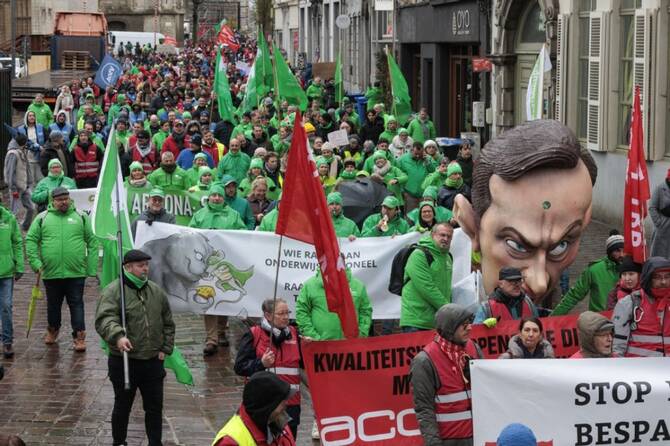
Demonstrators carry an effigy depicting Belgium's Prime Minister Bart De Wever pictured as they march along a street to denounce the consequences of federal government measures during the second day of a 72 hours national strike, in Gent, Belgium. (AFP)
Short Url
Updated 26 November 2025
Follow

Belgian national strike disrupts schools, flights and public transport

  • The strike, organized by the country’s main unions, is the latest in a series of protests against the coalition government led by Prime Minister Bart De Wever

BRUSSELS: The third and final day of a national strike in Belgium on Wednesday grounded most flights at Brussels Airport and disrupted public transport.
The strike, organized by the country’s main unions, is the latest in a series of protests against the coalition government led by Prime Minister Bart De Wever. Demonstrators oppose the government’s proposed pension and labor market reforms.
Brussels Airport canceled all departing flights as well as 110 of its 203 planned incoming flights.
Belgium’s other main airport Charleroi Airport said on its website that it also expected significant disruption due to staff shortages and would be unable to guarantee scheduled landings and takeoffs.
Local media reported that the final day of the strike was expected to be the most disruptive with schools, public transport, and the private sector affected as well.
A protest is planned in Brussels for Wednesday afternoon. A similar demonstration in October drew about 80,000 participants.
“The budget message from the De Wever government is harsh: work longer and harder for less security regarding pensions, health and purchasing power,” socialist Union ABVV-FGTB said on its website.
Gert Truyens, chair of the ACLVB liberal union, told the Belgian public broadcaster VRT he regretted unions had not been consulted by the national government.
“Agreements are not made in the streets at the picket lines; that happens at the negotiating table, but you need to be given the chance,” Truyens said.
Although the government reached an agreement on next year’s budget on Monday after months of tense negotiations, it did not avert the strike.
The government plans a new tax on banks and tax increases on airplane tickets and natural gas. Together with cuts in spending, this should lower the government deficit by 9.2 billion euros ($10.6 billion) by 2029.
The budget deficit of the euro zone’s sixth-largest economy is set to hit 4.5 percent of gross domestic product this year, with debt of 104.7 percent of GDP, according to the central bank — well above the maximum agreed under EU budget rules.


Venezuela aims to boost oil output but sanctions stand in the way, VP says

Updated 4 sec ago
Follow

Venezuela aims to boost oil output but sanctions stand in the way, VP says

  • Sanchez called the recent capture of Nicolas Maduro a “dark day” for the country

DUBAI: Venezuela’s Vice President for Economy Calixto Ortega Sanchez said on Wednesday that his country needed vast foreign investment and sanctions relief to tap its huge oil reserves and restart its ailing economy.

“We know that the reference for Venezuela is that (it is) the country with the biggest oil reserves, and we want to stop being known for this, and we want to be known as one of the countries with the highest production levels,” Sanchez said.

Responding to questions by American journalist Tucker Carlson, Sanchez called the recent capture of Nicolas Maduro a “dark day” for the country but said Venezuela was working to reestablish a relationship with the US, which he described as a “natural partner” for the country.

“The Venezuelan people and authorities have shown that they are ready to peacefully move forward and to build opportunities,” he said during a session at the World Government Summit.

Sanchez, who headed Venezuela’s central bank, said the most pertinent issue facing his country is continued US sanctions.

Despite failing to result in regime change, the sanctions had effectively stifled the economy from growing, he added.

He said the Venezuelan government was now working to reform its laws to allow foreign investment and hoped the US would ease sanctions to aid their work.

“The first decisions that interim President Rodriguez took was to go to the National Assembly and ask for reform to the hydrocarbon law … this law will allow international investors to go to Venezuela with favorable conditions, with legal assurance of their investments,” he added.

“The economy is ready for investment. The economy is ready for the private sector; it is ready to build up a better future for the Venezuelan people.”

Sanchez played down inferences by Carlson that his government had been taken over, insisting that the regime still held authority in the country. He said the country had set up two funds to receive money from oil production that would fund better welfare and social conditions for Venezuelans.

“Allow us to have access to our own assets … we don’t have access to our own money,” he added.

“If you allow us to function like a regular country, Venezuela will show extraordinary improvement and growth.”