

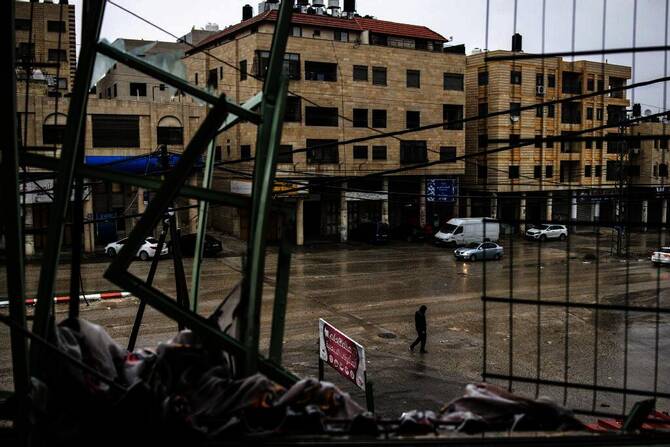

GENEVA: The two-year Gaza war and economic restrictions have triggered an unprecedented collapse in the Palestinian economy, wiping out decades of growth, a United Nations report said on Tuesday.
“Extensive damage to infrastructure, productive assets and public services has reversed decades of socioeconomic progress in the Occupied Palestinian Territory,” according to the report by the United Nations trade and development agency (UNCTAD).
The Palestinian GDP per capita by the end of last year returned to that of 2003, erasing 22 years of development progress, it added. The resulting economic crisis is among the ten worst globally since 1960, the report said.
The scale of the damage in Gaza after the two-year war between Israel and Hamas means the enclave will be reliant on extensive international support and recovery could still take decades, the report said.
The West Bank is also suffering its most severe downturn on record, driven by movement and access restrictions and the loss of opportunities across all sectors of the economy, the UN report said.
Gaza ‘survival’ at stake
The UN report also said that rebuilding the Gaza Strip will cost more than $70 billion and could take several decades.
“The military operations have significantly undermined every pillar of survival,” from food to shelter to health care, “and plunged Gaza into a human-made abyss,” it said.
“The sustained, systematic destruction casts significant doubt on the ability of Gaza to reconstitute itself as a liveable space and society.”
The scale of destruction wrought on the territory has “unleashed cascading crises, economic, humanitarian, environmental and social, propelling (it) from de-development to utter ruin,” UNCTAD’s report said.
Even “in an optimistic scenario of double-digit growth rates facilitated by a significant level of foreign aid, it will take several decades for Gaza to return to pre-October 2023 welfare levels,” it said.
UNCTAD called for a “comprehensive recovery plan,” combining “coordinated international assistance, restoration of fiscal transfers, and measures to ease constraints on trade, movement and investment.”
With Gaza’s entire population facing “extreme, multidimensional impoverishment,” the UN agency is also calling for the introduction of a universal emergency basic income, providing everyone there a renewable and unconditional monthly transfer of cash.
The report showed that Gaza’s economy contracted by 87 percent over the course of 2023-2024, leaving its gross domestic product per capita at just $161 — among the lowest globally.
While the situation was not as bad in the West Bank, the report found that “violence, accelerated settlement expansion and restrictions on worker mobility have decimated the economy” there as well, “resulting in the worst economic decline since UNCTAD began to maintain records in 1972.”


