Dubai’s Mashreq launches Pakistan’s first Islamic-focused digital banking platform

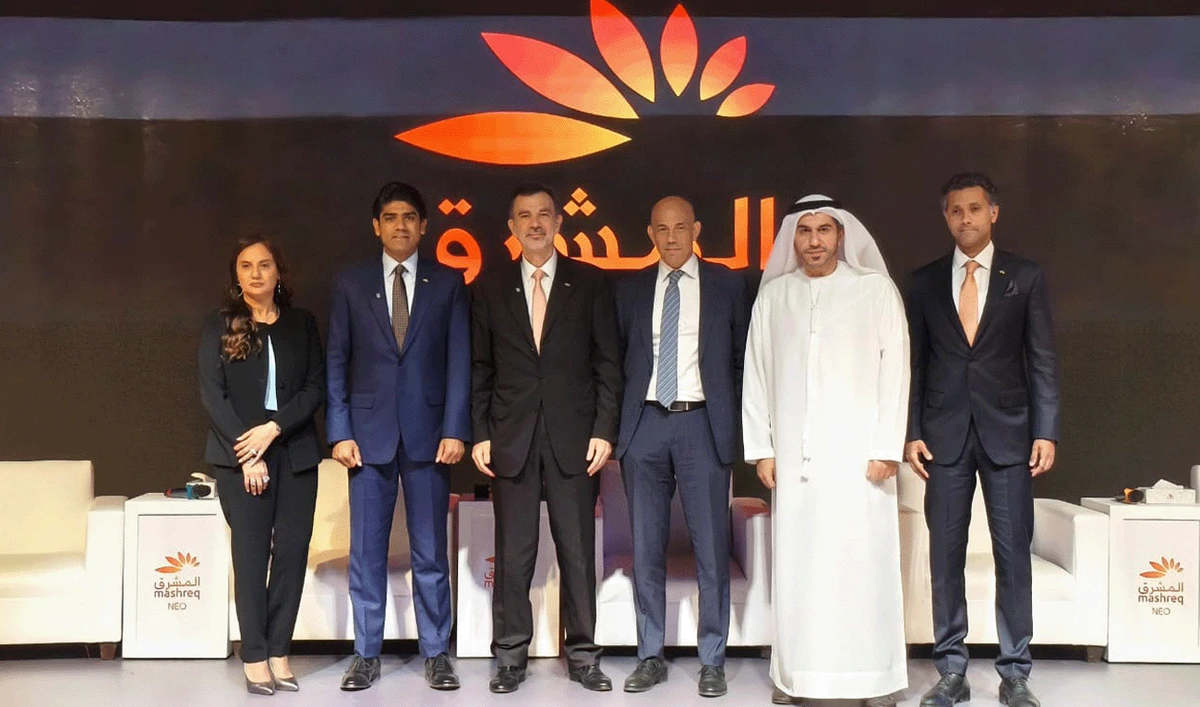
Representatives of Dubai-based Mashreq posing for picture at the launch of Mashreq NEO in Karachi, on November 25, 2025. (Mashreq)
Short Url
Updated 25 November 2025
Follow

Dubai’s Mashreq launches Pakistan’s first Islamic-focused digital banking platform

  • Mashreq NEO to offer Shariah-compliant current, savings accounts with market-first profit rates
  • Bank aims to serve 10 million Pakistanis in five years, including overseas Pakistanis

KARACHI: Dubai-based Mashreq on Tuesday launched Mashreq NEO in Pakistan, introducing what it says is the country’s first fully Islamic-focused digital banking platform as the United Arab Emirates–headquartered lender expands its regional footprint into South Asia’s fast-growing fintech market.

Pakistan’s banking regulator has encouraged digital entrants in recent years in an effort to expand access for millions of unbanked citizens, especially women and freelancers. As of 2023, about 36 percent of adults in Pakistan remain unbanked.

Mashreq’s arrival follows the government’s push to accelerate financial inclusion and digital payments, with the bank positioning its platform as a Shariah-compliant, paperless alternative to traditional banking.

Launched in Karachi under the patronage of Prime Minister Shehbaz Sharif, Mashreq NEO is now fully operational nationwide. The platform offers account opening “in minutes,” free digital transactions, nationwide ATM access and profit-bearing Islamic accounts, including what the bank describes as a “market-first profit rate” of up to 5 percent per annum on remunerative current accounts and up to 10 percent on Islamic savings accounts.

“Mashreq’s mission has always been to advance how people bank, save, and grow,” Fernando Morillo, Group Head of Retail Banking at Mashreq & Chairman of Mashreq Bank Pakistan, said in a statement.

“The launch of Mashreq NEO underscores our long-term commitment to empowering individuals and businesses in one of the world’s most dynamic digital markets with our global innovation legacy.”

Mashreq NEO aims to target salaried professionals, freelancers, women entrepreneurs and Non-Resident Pakistanis (NRPs), offering instant account opening for Pakistanis in the UAE, zero-fee remittances and lifestyle-linked debit card discounts at more than 30,000 outlets nationwide. The digital platform is built on cloud-based infrastructure aligned with State Bank of Pakistan regulations and incorporates international cybersecurity standards, according to the bank.

“Pakistanis have always found a way to adapt, innovate, and move forward. It’s time their banking did the same,” said Muhammad Hamayun Sajjad, CEO Mashreq Bank Pakistan. “Our Islamic-first digital model is designed to make everyday banking simple, transparent, and inclusive to empower customers to bank with trust and ease.”

Mashreq, one of the Middle East’s oldest financial institutions, said it aims to onboard 10 million customers in Pakistan within five years as digital banking adoption accelerates. The bank said NEO’s expansion aligns with Pakistan’s broader transition toward financial technology, secure digital payments and increased participation in the formal economy.



OIC’s COMSTECH stresses academic collaborations across Muslim world in Islamabad meeting

Updated 4 sec ago
Follow

OIC’s COMSTECH stresses academic collaborations across Muslim world in Islamabad meeting

  • COMSTECH holds annual meeting in Islamabad featuring 30 delegates from Iran, Somalia, Palestine, Indonesia and other OIC states
  • Limited pool of skilled professionals one of the foremost challenges facing Muslim world, notes COMSTECH secretary general 

ISLAMABAD: The OIC Standing Committee on Scientific and Technological Cooperation (COMSTECH) called for stronger academic collaboration across Islamic states to secure the future of higher education in the Muslim world, state-run media reported on Saturday. 

COMSTECH’s Coordinator General Prof. Dr. Muhammad Iqbal Choudhary was speaking at the Annual Meeting of the COMSTECH Consortium of Excellence at the organization’s Secretariat in Islamabad. The event brought together vice chancellors, rectors, and senior representatives from leading universities across OIC member and observer states. 

Nearly 30 international delegates representing universities from Iran, Somalia, Palestine, Indonesia, Malaysia, Thailand, Uganda, Bangladesh, Benin, Cameroon, Gabon, Côte d’Ivoire, and Senegal joined their counterparts from several Pakistani institutions at the meeting. Participants attempted to chart a collective path forward for tertiary education in OIC countries.

“Collaborations, knowledge sharing, best practices, exchange of scholars, technology transfer and joint academic programs are vital for overcoming the educational challenges faced across the OIC region,” Choudhary said, according to the state-run Associated Press of Pakistan (APP).

The COMSTECH secretary general noted that one of the foremost developmental challenges facing OIC nations remains the limited pool of skilled professionals and workforce. 

He said this gap can only be bridged through strengthened tertiary education systems and expanded opportunities for knowledge transfer.

Discussions at the event highlighted the urgent need for competency-driven education, modern pedagogical tools, university–industry partnerships and collaborative training programs designed to equip graduates with the skills necessary to address emerging global challenges.

“The Annual Meeting served as a vital platform for reviewing progress achieved over the past year, identifying future priorities, and deepening academic cooperation to promote scientific excellence and sustainable development across the OIC region,” the APP said.