
NEW YORK: The UK has urged swift and full implementation of UN Security Council Resolution 2803, calling it a “pivotal moment” in efforts to end the conflict in Gaza and move toward a sustainable peace.
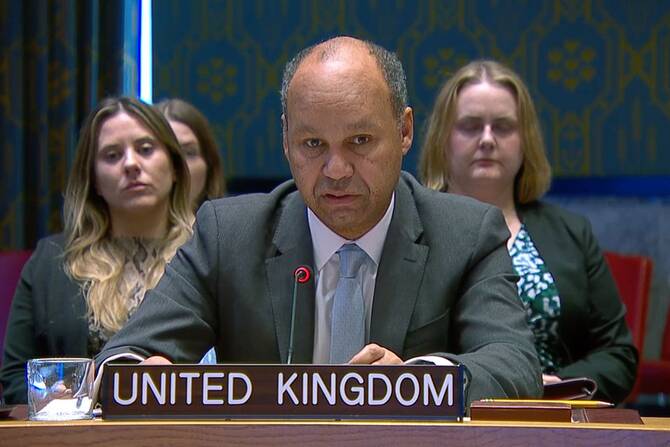
Addressing the Security Council on Monday, ambassador James Kariuki said last week’s adoption of the resolution “sent a powerful message of international support for President Trump’s 20-point plan for Gaza, and the diplomatic efforts of Qatar, Turkiye and Egypt.”
He added: “This marks a pivotal moment after two years of horrendous suffering, and is crucial to cementing the ceasefire and charting a course toward lasting peace.”
Kariuki urged all parties to uphold the fragile truce and added that “Hamas must locate and hand over the bodies of the remaining three deceased hostages.”
The envoy outlined three key points the UK believes must guide the next phase.
“First, Resolution 2803 must be implemented fully, effectively and in accordance with international law,” he said.
That includes the rapid deployment of an International Stabilization Force and trained Palestinian police “to support the ceasefire and avoid a vacuum that Hamas could exploit,” he added.
“Hamas should uphold their commitments under the 20-point plan to disarm and end their governance over Gaza,” he added, highlighting that transitional arrangements “must respect Palestinian sovereignty and self-determination and pave the way for a reformed Palestinian Authority to resume governance in Gaza. Palestine must be run by Palestinians.”
The UK, he said, looks forward to “the urgent formation of a Palestinian Committee alongside the Board of Peace.”
Turning to humanitarian concerns, Kariuki warned that the resolution highlighted the importance of the full resumption of aid deliveries to Gaza, adding that the humanitarian situation remained catastrophic.
“Heavy rains have deepened the misery, worsening shelter needs as winter closes in,” he said, noting UN figures that show more than 1.5 million people are in urgent need of emergency shelter.
“Yet Israel continues to restrict lifesaving aid. Every crossing and route must be opened without delay, and essential items including shelter kits and medical supplies allowed in,” he said.
Kariuki recalled that last winter, at least eight newborns died of hypothermia in fewer than three weeks, deaths he warned were “preventable.”
He said: “Israel must allow aid in now, without delay, and permit the UN, including UNRWA, as well as international NGOs, to operate freely and effectively.”
On the situation in the occupied West Bank, Kariuki said that while the Gaza ceasefire “offers hope,” stability there is “essential to any sustainable peace.”
He said there had been further incidents of settler violence during the olive harvest, and that the OCHA recorded more than 260 such attacks last month.
Kariuki also said that this month there had been arson attacks, including on a mosque, in the West Bank.
“These unacceptable incidents must be thoroughly investigated and those responsible held accountable,” he said.
Kariuki also called on Israel “to end its stranglehold on the Palestinian economy by releasing withheld clearance revenues, protecting correspondent banking arrangements, and facilitating shekel transfers from Palestinian banks,” as well as halting “the expansion of illegal settlements, including the E1 plans.”
He closed by highlighting the urgency of the situation in Gaza.
“This is a pivotal moment for the future of the region. The UK will continue to work with all partners to implement Resolution 2803 and to forge a just and lasting peace for Israelis and Palestinians, anchored in a two-state solution.”