

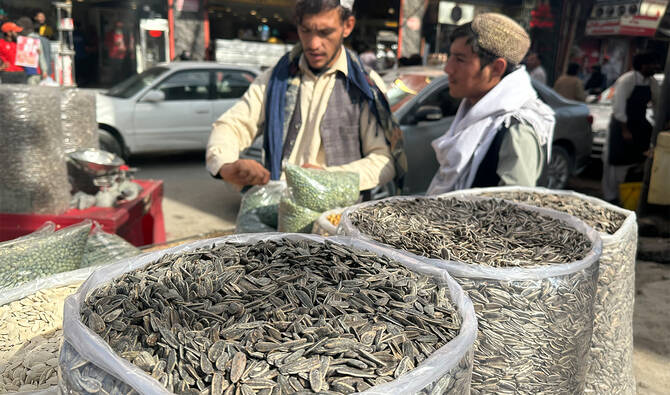

QUETTA: At a dry fruit shop in southwestern Pakistan, mounds of black-and-white striped sunflower seeds lay in large silver containers. The aroma of salted seeds fills the shop as busy customers carefully examine the winter delicacy before buying it.
In Pakistan’s southwestern Balochistan province, sunflower seeds are a popular snack when the biting cold settles in. Typically eaten between November to March, some savor them with green tea while others see the sunflower seeds as the perfect winter snack to munch on to pass the time.
Production, however, has declined in recent years due to water scarcity, with Pakistan’s Meteorological Department last month placing 12 Balochistan districts under drought watch.
Muhammad Arif Baloch, a farmer in Balochistan’s Nushki district located alongside the border with Afghanistan, said his family has been harvesting sunflower seeds for the past five years. He now calls it a “low-profit” fruit.
“Last year, 150 tons of sunflower seeds were harvested in Nushki district and exported to other cities of Pakistan,” Baloch told Arab News.
“For this season, the production has reduced to just 900kg.”
Pakistan imports most of its seeds from China, which farmers say are better in terms of quality. Muhammad Ayoub Maryani, president of the Quetta Chamber of Commerce, says the reduced level of water in Balochistan due by climate change effects has hit production.
“So, people harvest what they can so that they get a profitable crop and their system keeps running,” Maryani said.
Muhammad Younus, a seed farmer from Keshangi town in Nushki, recalled a time when he harvested sunflower seeds, tomatoes, onions and ladyfinger.

Muhammad Sidduqui, a local seeds’ dealer, shows seeds at his shop in Quetta Pakistan on November 10, 2025. (AN Photo)
“But the majority of the farmers have skipped sunflower harvest due to water scarcity and drought,” Younus said, adding that sunflower seeds do not provide “adequate profit” to farmers.
“China has replaced the seeds’ market because the farmers there have complete government support and a suitable environment.”
Maryani agrees, lamenting that Pakistan’s government neither provides banking loans to struggling farmers nor supports them in other ways.
“The thing that used to be produced and exported from here is now being imported due to our mistakes,” he said.
Pakistan imports sunflower seeds each year from China, Romania, Turkiye, Australia and South Africa— mostly for producing edible sunflower oil. It is in Balochistan, however, that sunflower and pumpkin seeds are cherished as winter snacks.
According to a report by the World Integrated Trade Solution (WITS), a private international trade watchdog, Pakistan imported sunflower seeds worth more than $33 million in 2024. Last year, Pakistan imported nearly 3,469 tons of seeds from China.
Abdul Rauf Khan Kakar, director general of agricultural research in Balochistan, admitted that the declining water level in Balochistan was affecting production.
He said the government is producing hybrid sunflower seeds and undertaking efforts to mutiply them as well. Kakar said the government also counsels farmers about which seeds will benefit them and which won’t.
“Actually, the farming community does not have [awareness] about it,” Kakar said. “If they cultivate sunflower then it is a three-month crop. In three months, it gets mature and is harvested as well.
“Landlords should pay attention to it instead of water-intensive crops like tomatoes.”

People checking sunflower seeds in Quetta Pakistan on November 10, 2025. (AN Photo)
’GOOD TIME PASS’
Traders in Balochistan increase the import of sunflower seeds in winter to satiate their customers’ growing thirst for it.
Muhammad Siddiqui, a local wholesaler of sunflower and pumpkin seeds whose family has been in the seed and dry fruit business since 2005, supplies the seeds to districts across the province and even to Afghanistan.
“The seeds’ business runs all year, but the demand increases in winter season,” he said.
The 22-year-old dealer imported 6,440 sacks of sunflower seeds and 920 sacks of pumpkin seeds from China, each weighing 25 kg, for this winter alone.
“We receive the seeds in raw format and then roast them with a mixture of salt, flour, water and lemon so the salt sticks,” Siddiqui explained.
Siddiqui says the seeds he imports from China are “larger, cleaner, and sweeter in taste” those grown in Balochistan are “smaller without proper processing.”
Local sportsman Fahad bin Waseem can’t have his fill of sunflower seeds come winters.
“We enjoy it a lot, especially when we come to play cricket,” Waseem said. “We have a good time pass and it improves the taste in our mouths.”

A local worker roasts sunflower seeds in a large oven in Quetta Pakistan on November 10, 2025. (AN Photo)
Another feature that makes sunflower seeds attractive is the fact that they are quite affordable when compared to expensive dry fruits.
High-quality sunflower seeds, imported from China, are sold for Rs700 ($2.46) per kilogram in Quetta while locally produced seeds are sold for Rs500 ($1.76) per kilogram. Pumpkin seeds are sold for Rs1500 ($5.28) per kilogram.
Almonds imported from Afghanistan are sold at the market for Rs2,600 ($9.15) per kilogram while local dealers import cashews from India and Vietnam for Rs2,900 ($10.21) per kilogram.
Idrees Khan, a resident of Quetta’s Satellite Town area, is of the same opinion.
“They are tasty and affordable if we compare the prices of these seeds with other dry fruits,” Khan said.
“They are also a good source to pass time, especially in Balochistan, where Internet service often remains suspended.”


