

Pakistani halal meat processer eyes expansion into GCC, other markets after Carrefour deal

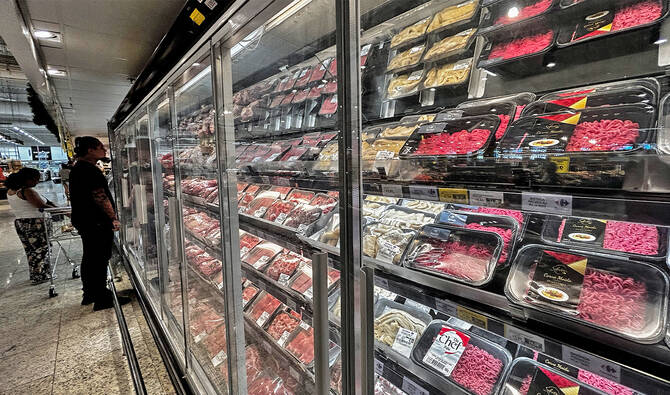
Customers shop in the meat section of the Carrefour supermarket, in Sao Paulo, Brazil, on November 25, 2024. (AFP/File)
Short Url
Updated 22 November 2025
Follow

Pakistani halal meat processer eyes expansion into GCC, other markets after Carrefour deal

  • TOMCL has secured at least four export orders from China, UAE and French retailer Carrefour in Qatar over the last four months
  • The company’s exports rose by 38% to $40 million last year, shares have gone up by more than 47% year-to-date to Rs52.56

KARACHI: The Organic Meat Company Limited (TOMCL), a Pakistani halal meat processor, is targeting the Gulf Cooperation Council (GCC), Chinese, Canadian and Commonwealth of Independent States (CIS) markets to expand its global footprint, the company said this week, following the start of its direct exports to French retail giant Carrefour in Qatar.

The agreement with Carrefour is the fourth business deal the Pakistani halal meat processor has struck with its foreign buyers from the UAE, China and Qatar this year. In August, it became Pakistan’s first meat producer to qualify for direct exports to Carrefour Majid Al-Futtaim Hyper Market operations across the UAE.

In September, the Karachi-based company secured a $7.5 million order for the export of cooked or heat-treated frozen boneless beef to China, followed by a $8.1 million contract it signed with Gold Crest Trading FZE for the export of frozen boneless beef for industrial and household processing to the UAE.

TOMCL’s shares have surged more than 47% year-to-date to close at Rs52.56 per share on Friday, according to Pakistan Stock Exchange (PSX) data. The latest Carrefour Qatar is seen as strengthening of TOMCL’s presence in high-value GCC retail markets as a trusted halal meat supplier.

“We are also pleased to confirm that the first consignment for Carrefour Qatar has been dispatched, formally commencing exports under this new approval,” the company told its shareholders at Pakistan Stock Exchange (PSX) on Nov. 20.

“This progression supports TOMCL’s long-term strategy of increasing export volumes, expanding premium product placements, and enhancing brand visibility across international retail networks.”

The company exports meat to the UAE, Saudi Arabia, China, Oman, Kuwait, Bahrain, Qatar, Hong Kong, Vietnam, Thailand, Azerbaijan, Uzbekistan, Tajikistan, United States, Canada, Italy, Albania, Egypt, Iraq, Maldives and Jordan.

Its exports rose 38 percent to Rs11.2 billion ($40 million) in the last fiscal year that ended in June from Rs8.16 billion ($29 million) a year earlier, according to TOMCL data.

This growth reflected on the meat exporter’s revenues which increased 19 percent to Rs14 billion ($50 million). The company’s sales more than tripled from Rs3.93 billion ($14 million) in 2020-21.

Arab News reached out to Muhammad Faisal Idrees, the group chief financial officer at TOMCL, but he did not respond to the calls.

The company is targeting new markets for all of its products and business lines ranging from exporting pet chews to Canada to boosting sheep and beef casings market and private labeling business in the UAE, Kuwait and the European Union as well as aiming to grow exports to Chinese, Saudi and CIS markets, according to documents seen by Arab News.

Going forward, expansion in product offerings and targeting new markets while expanding exports would be key triggers for the company’s growth, said Shagufta Irshad, an analyst at the JS Global Capital brokerage research firm, citing TOMCL’s corporate briefing last week.

“The management highlighted that fluctuating animal prices domestically, unfavorable currency fluctuations, rising energy cost and loss of livestock from floods along with outbreak of lumpy skin diseases in animals as key challenges going forward,” she said in a recent note to clients.


Pakistan seeks operationalization of World Bank’s $20 billion framework to advance reform priorities

Updated 5 sec ago
Follow

Pakistan seeks operationalization of World Bank’s $20 billion framework to advance reform priorities

  • Pakistan’s finance chief meets World Bank Country Director Bolormaa Amgaabazar in the capital
  • The Bank’s 10-year Country Partnership Agreement for Pakistan was approved in January last year

ISLAMABAD: Pakistan’s Finance Minister Muhammad Aurangzeb on Wednesday called for the operationalization of the World Bank Country Partnership Framework (CPF) to advance the government’s key reform priorities during a meeting with the Bank’s country director, according to a statement.

The Bank’s Board of Directors approved a 10-year CPF deal with Pakistan, indicating $20 billion in financing for Pakistan under the framework. The amount will include public and private financing from the World Bank Group, with roughly half expected to come from private-sector operations led by the International Finance Corporation (IFC).

“The Finance Minister emphasized the importance of effective operationalization of the CPF, particularly in priority areas such as population management and climate change,” the finance ministry said in a statement after Aurangzeb’s meeting with the Bank’s Country Director Bolormaa Amgaabazar.

“He underscored the need for strong coordination between federal and provincial governments to ensure coherence in policy design and implementation.”

Discussions focused on population, human capital development, climate resilience, agricultural reform and energy sector sustainability, it added.

The ministry said both sides exchanged views on enhancing institutional coordination, improving transparency in project design and strengthening monitoring mechanisms to deliver intended outcomes. It highlighted that the World Bank expressed readiness to continue supporting agricultural transformation efforts in collaboration with the IFC.

“Both sides agreed to continue technical-level engagements to explore feasible solutions in line with Pakistan’s reform agenda and fiscal framework,” the finance ministry added.

Climate resilience and population control are major concerns for policymakers in Pakistan, a country whose population exceeds 241 million, making it the world’s sixth-most populous country. Limited infrastructure, health care, and educational opportunities place added strain on public services, contributing to unemployment and poverty.

The South Asian nation is also among the countries most affected by climate change. Unusually heavy monsoon rains in 2022 killed more than 1,700 people and caused over $30 billion in damages. Torrential rains and floods since late June last year have claimed more than 1,000 lives, as authorities continue surveys to assess the full extent of the destruction.