

PCB announces major prize money increases for Pakistan Super League teams

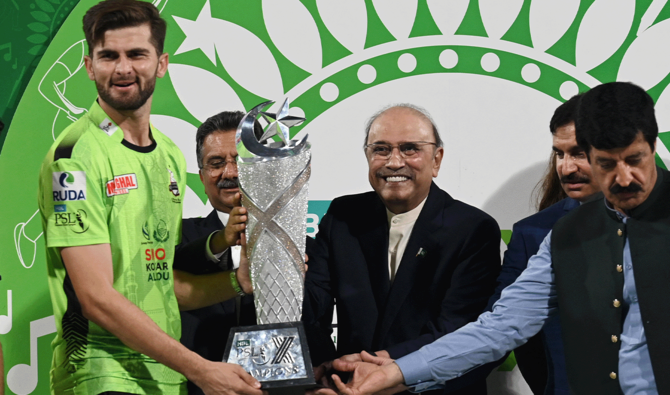
Pakistan's President Asif Ali Zardari (3rd-Right) hands over the trophy to Lahore Qalanders' captain Shaheen Shah Afridi (left) during the victory ceremony at the end of the Pakistan Super League (PSL) Twenty20 final cricket match between Lahore Qalandars and Quetta Gladiators at the Qaddafi Cricket Stadium in Lahore on May 25, 2025. (AFP/File)
Short Url
Updated 21 November 2025
Follow

PCB announces major prize money increases for Pakistan Super League teams

  • The awards are likely to boost the PSL’s reach, offer players greater opportunities
  • The auction for two new Pakistan Super League franchises will be held on January 6

ISLAMABAD: Pakistan Cricket Board (PCB) Chairman Mohsin Naqvi on Friday announced new awards for Pakistan Super League (PSL) teams, ahead of the next season scheduled for April 2026 that will feature two new franchises.

The development comes after the PCB confirmed that the two new PSL teams would be named from Hyderabad, Rawalpindi, Faisalabad, Gilgit, Muzaffarabad and Sialkot.

The PSL is the country’s premier T20 cricket tournament, featuring city-based franchise teams and attracting top international players since 2016.

PSL champions will receive $500,000, runners-up $300,000, and the franchise making the greatest contribution to cricket development will be awarded $200,000.

“Let’s take Pakistan cricket to new heights!” Naqvi said on X, announcing the rewards.

The awards are likely to boost the PSL’s competitiveness and reach, and offer players greater opportunities and a stronger platform to showcase Pakistan’s cricketing talent.

Earlier in the day, the PCB announced that the auction for the two new PSL teams will take place on Jan. 6, while the decision on shortlisted cities will be made after Dec. 5.

The PSL grew to six teams in 2018 after Multan Sultans joined the league. It will now host eight teams from next year.

“This marks a significant milestone in the league’s continued expansion and its commitment to expanding its footprint across Pakistan,” the board said.

“The addition of two new teams will also create fresh commercial, sporting and fan engagement opportunities.”


UNESCO lists Pakistan’s ancient Bareendo instrument as endangered cultural heritage

Updated 9 sec ago
Follow

UNESCO lists Pakistan’s ancient Bareendo instrument as endangered cultural heritage

  • 5,000-year-old Sindhi clay wind instrument placed on UNESCO urgent safeguarding list
  • Only two known practitioners remain as Pakistan launches four-year preservation plan

ISLAMABAD: Pakistan’s 5,000-year-old folk instrument Bareendo has been added to UNESCO’s Intangible Cultural Heritage list for urgent safeguarding, the UN agency said this week, placing it among cultural traditions considered at immediate risk of disappearing.

Believed to originate in the ancient Indus Valley Civilization, the clay wind instrument is the oldest known surviving musical form in the southern Sindh province. Its soft, breath-driven tones have accompanied Sufi devotional gatherings, winter festivals and village ceremonies for generations, forming a core part of Sindh’s musical and spiritual identity.

The inscription was approved at the 20th Session of UNESCO’s Intergovernmental Committee for Intangible Cultural Heritage, which documents vulnerable cultural practices globally, from oral folklore to craftsmanship, to ensure they are preserved and passed on.

UNESCO announced the listing on X on Tuesday:

“New inscription on the Urgent Safeguarding List of Intangible Heritage: Boreendo, Bhorindo: ancient dying folk musical instrument, its melodies, knowledge, and skills.”

Pakistan’s Permanent Delegate to UNESCO, Ambassador Mumtaz Zahra Baloch, welcomed the move, calling it the recognition of a tradition preserved through centuries of community transmission.

“Bareendo is not only an emblem of the Indus Valley’s cultural continuity but also a living expression of Sindh’s artistic and spiritual heritage,” she was quoted as saying by Pakistan’s Embassy in France. 

“This recognition by UNESCO reaffirms Pakistan’s commitment to the protection and promotion of our diverse cultural traditions.”

Only two people are believed to retain full mastery of Bareendo today, musician Ustaad Faqeer Zulfiqar and master potter Allah Jurio, underscoring why the nomination was marked urgent, the embassy said. 

The nomination followed an intensive consultation process between the Sindh government, Pakistan’s Mission to UNESCO and UNESCO headquarters in Keti Mir Muhammad Loond village and led to a four-year safeguarding strategy (2026–2029). Planned measures include a community music school, integration into formal and informal education and digital archiving to open access beyond Sindh’s rural belt.

With this recognition, Bareendo joins existing UNESCO-listed intangible traditions like Suri Jagek (the astronomical knowledge of the Kalash people), Falconry, and Nowruz, the regional spring new year.