JERUSALEM: Israel’s prime minister met with top security officials to discuss a rising tide of Israeli settler violence in the West Bank, an Israeli official said Friday, as fresh allegations surfaced of Israeli settlers hurling rocks at passing Palestinian vehicles in the West Bank village of Hawara.
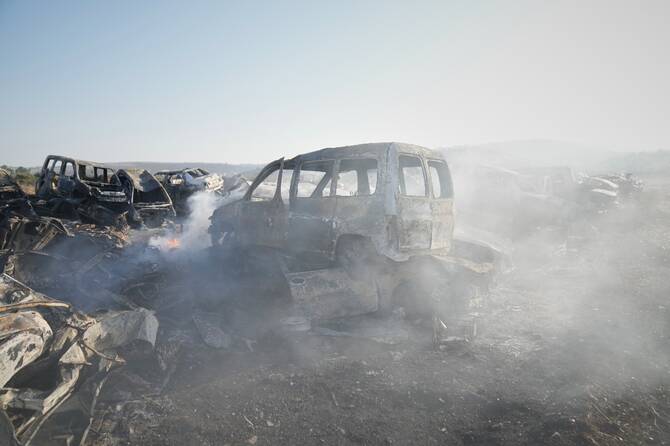
Hawara Mayor Jihad Ouda said the stone throwing was quickly followed by a huge fire at a nearby scrapyard. Flames lit up the evening sky and sent massive columns of smoke into the air, images and video on social media showed. The military said it had reports that Israelis set the fire and that police were investigating.
The UN humanitarian office documented 29 attacks by settlers in the West Bank from Nov. 11-17, UN spokesman Stephane Dujarric told reporters Friday. The attacks caused 11 injuries and damage to 10 homes, two mosques and nearly two dozen vehicles, as well as damage to crops, livestock, and roughly 1,000 trees and saplings, he said.
Israeli forces have killed more than 200 Palestinians in the West Bank so far this year, including 50 children, Dujarric said.
In the latest deaths, the Palestinian Health Ministry said two Palestinian youths aged 18 and 16 were killed by Israeli gunfire overnight. The circumstances of the shootings were not immediately clear. Israeli police did not immediately respond when asked to comment.
At the meeting, Prime Minister Benjamin Netanyahu and officials from the military, the country’s Shin Bet domestic security service and the police discussed the recent spike in violence and proposals on curbing it, according to an Israeli official who spoke on condition of anonymity because they were not permitted to talk about a closed-door gathering. The official said proposals floated at the meeting included getting violent settlers to attend educational programs.
The Prime Minister’s Office did not immediately respond to request for comment about what was discussed. The Israeli official said there would be a follow-up meeting.
Settler attacks ramped up during the Palestinian olive harvest season in October and early November and have continued since. Netanyahu has called the perpetrators “a handful of extremists” and urged law enforcement to pursue them for “the attempt to take the law into their own hands.” But rights groups and Palestinians say the problem is far greater than a few bad apples, and attacks have become a daily phenomenon across the territory.
Stones hurled at Palestinian cars, scrapyard torched
Mohammad Dalal, the owner of the torched Hawara scrapyard, claimed that witnesses told him Israeli settlers were seen throwing rocks Thursday from an overpass at passing Palestinian vehicles below. He said the massive fire began soon after.
He said the Israeli army arrived later to force the perpetrators away.
“If the army had not removed them, they would have done even more,” Dalal said. “These settlers are causing destruction everywhere here. ... Where can we go? We want to remain steadfast on our land, no matter what.”
An Israeli investigation unit of soldiers and border police officers on Friday collected evidence at the scorched scrapyard, according to an Associated Press crew who was asked to leave by the investigators.
Asked about the incident, the Israeli military said it dispatched soldiers to the area after receiving reports that settlers were throwing rocks at Palestinian cars. It also said other reports indicated that “several” Israeli civilians had set fires and damaged property in the area. It said soldiers searched the area but didn’t find any suspects and that the police were now handling the case.
Hawara has been the target of numerous attacks over recent years. In February 2023, scores of Israeli settlers went on a violent rampage there, setting dozens of cars and homes on fire after two settlers were killed by a Palestinian gunman. Palestinian medics said one man was killed and four others were badly wounded.
Settler violence surges
UN humanitarian office figures show 2,920 Israeli settler attacks took place between January and October this year.
Israel’s government is dominated by far-right proponents of the settler movement including Finance Minister Bezalel Smotrich, who formulates settlement policy, and Cabinet minister Itamar Ben-Gvir, who oversees the nation’s police force.
The security cabinet meeting came shortly after Israeli settlers celebrated the creation of a new, unauthorized settlement near Bethlehem.
Israel’s Civil Administration also recently announced plans to expropriate large swaths of Sebastia, a major archaeological site in the West Bank. Peace Now, an anti-settlement watchdog group, said the site is around 1,800 dunams (450 acres) — Israel’s largest seizure of archaeologically important land.
Singapore slaps sanctions on Israeli settlers
Singapore said Friday it will impose targeted financial sanctions and entry bans on four Israeli individuals for what it said was their involvement in violence against Palestinians in the West Bank. Singapore’s Foreign Ministry named the individuals as Meir Ettinger,Elisha Yered, Ben-Zion Gopstein and Baruch Marzel. Some are currently under international sanction by the European Union, the UK and other countries.
In a statement, Singapore’s Foreign Ministry said the settlers have been involved in “egregious acts of extremist violence against Palestinians in the West Bank” and urged the Israeli government to stop the violence and hold the perpetrators accountable.


![]()

Netanyahu convenes cabinet on settler violence in the West Bank that continues unabated
Short Url
https://arab.news/2c7ku
Netanyahu convenes cabinet on settler violence in the West Bank that continues unabated
- Netanyahu and officials from the military, the country’s Shin Bet domestic security service and the police discussed the recent spike in violence and proposals on curbing it
- An Israeli investigation unit of soldiers and border police officers on Friday collected evidence at the scorched scrapyard


Latest updates





© 2026 SAUDI RESEARCH & PUBLISHING COMPANY, All Rights Reserved And subject to Terms of Use Agreement.