

Pakistan business body seeks constitutional fixes for economy as 28th Amendment debate heats up

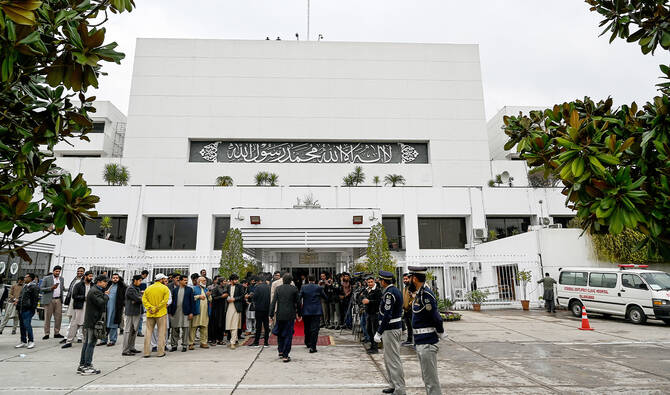
Newly-elected lawmakers arrive before the start of the electoral process to appoint Pakistan's next prime minister at the Parliament House in Islamabad on March 3, 2024. (AFP/File)
Short Url
Updated 21 November 2025
Follow

Pakistan business body seeks constitutional fixes for economy as 28th Amendment debate heats up

  • Proposed amendment would revisit revenue-sharing rules, reshape federal–provincial fiscal powers
  • PBF urges Parliament to embed policy continuity, long-term economic reforms in Constitution 

ISLAMABAD: As debate over a proposed 28th amendment to the Constitution gathers momentum, a major Pakistani business group on Friday warned that the country’s chronic policy instability, high taxes and currency volatility cannot be addressed without anchoring economic reforms directly in the Constitution to restore investor confidence.

The Pakistan Business Forum’s demand that Parliament embed economic reform into the country’s constitutional structure comes as the government considers a 28th Constitutional Amendment that would address long-running tensions between federal and provincial fiscal powers. Central to the debate is Article 160(3A), which says the provinces’ share in the National Finance Commission (NFC) Award “shall not be less than” the previous award.

The government argues the rigid formula has restricted federal fiscal space, while critics warn that altering Article 160(3A) could upend provincial rights guaranteed since the 18th Amendment which devolved power to the provinces. The NFC Award determines how Pakistan divides billions in annual revenue between the center and provinces, making it one of the most consequential fiscal mechanisms in the country.

Against this backdrop, PBF said Pakistan’s economic issues “should be addressed by Parliament through comprehensive legislation, and that the proposed 28th Constitutional Amendment could play an imperative role in restoring investor confidence.”

Forum President Khawaja Mehboob ur Rehman proposed that the amendment should anchor core economic reforms, including:

“Strengthening the national currency, Rationalizing tax rates; Establishing predictable business-friendly policies,” the statement said. 

“Such constitutional clarity … would signal a clear and stable economic direction, something Pakistan has lacked due to frequent shifts in policy.”

Rehman warned that Pakistan’s current tax structure was crippling investment, saying “investment is impossible under the present 40 percent tax regime.” He also questioned the relevance of the Board of Investment “if the government remains unwilling to revise the tax structure,” urging the state to adopt “significant reductions in existing tariffs and tax rates” to revive economic activity.

The business group also linked decades of currency devaluation to structural failures. 

PBF noted that “despite repeated rounds of currency devaluation over the past five decades, neither export competitiveness nor sustainable economic growth has materialized.” 

The forum pointed out that the rupee had fallen “from Rs. 9.99 per dollar to nearly Rs. 284 per dollar by 2025, yet economic fundamentals remain weak.”

Pakistan’s demographic and investment challenges add to the urgency, PBF said, highlighting the country’s population of 256 million, which is projected to reach 266 million by 2027, alongside an investment-to-GDP ratio stuck at 13.8 percent.

Public investment, vital for private-sector confidence, is limited to just 2.9 percent of GDP, the forum added.

The group stressed that Pakistan cannot continue shifting economic frameworks every few years, saying “we must admit Pakistan has experimented with a new economic model after every five years.” 

PBF said structural leakages must be plugged before any future budgets are framed, warning that “meaningful fiscal planning is impossible without addressing structural inefficiencies.”

Rehman said constitutional clarity and long-term planning, rather than short-term fixes, were now essential to rebuild investor trust. 

“Stability, predictability, and coherent long-term planning are essential for rebuilding business confidence and ensuring economic recovery,” he added. 


Peace can only prevail if Afghanistan renounces support for ‘terrorism’— Pakistan defense chief

Updated 04 March 2026
Follow

Peace can only prevail if Afghanistan renounces support for ‘terrorism’— Pakistan defense chief

  • Pakistan’s chief of defense forces visits South Waziristan district bordering Afghanistan
  • Pakistan says has killed 481 Afghan Taliban operatives since clashes began last Thursday

ISLAMABAD: Pakistan’s Chief of Defense Forces Field Marshal Syed Asim Munir said on Wednesday that peace with Afghanistan can only prevail if Kabul renounces support for “terrorism” and “terrorist” organizations, the military’s media wing said as the two countries remain locked in conflict. 

Fighting between the two neighbors, the worst in decades, broke out last Thursday night after Afghan forces attacked Pakistan’s military installations along their shared border. Afghanistan said its attacks were in response to earlier airstrikes by Pakistan against alleged militant hideouts in its country. 

Pakistan accuses Afghanistan of sheltering militant outfits such as the Tehreek-e-Taliban Pakistan (TTP) on its soil who have launched attacks against Pakistani civilians and security forces in recent years. Kabul denies the allegations. 

Munir visited Wana town in Pakistan’s South Waziristan district to review the security situation and troops’ operational preparedness at the Afghan border, the Pakistani military’s media wing said in a statement. 

“The Field Marshal reiterated that peace could only prevail between both sides if the Afghan Taliban renounced their support for terrorism and terrorist organizations,” the Inter-Services Public Relations (ISPR) said. 

The military chief said the use of Afghan soil by militant outfits to launch attacks against Pakistan was unacceptable, vowing that “all necessary measures” would be taken to neutralize cross-border threats. 

During the visit, Munir was briefed by military commanders about ongoing intelligence-based operations and measures being taken by the military to manage the border with Afghanistan.

He was also briefed about “Operation Ghazab Lil Haq” or “Wrath for the Truth,” the name Pakistan has given to its military operation against Afghan forces, the ISPR said. 

The Pakistani military chief spoke to troops deployed in the area, praising their vigilance, professional conduct and high morale, the ISPR said. 

Pakistan’s Information Minister Attaullah Tarar said on Wednesday that the military has killed 481 Taliban operatives, injured more than 690 and destroyed 226 Afghan checkposts since clashes began. 

Arab News has been unable to verify claims by both sides about the damages they claim to have inflicted on each other.

Afghanistan has signaled it is open for dialogue but Pakistan rejected the offer, saying it would continue its military operations till its objectives were achieved. 

Since the conflict began, diplomatic efforts have intensified with several countries, including global bodies such as the European Union and United Nations, urging restraint and calling for talks.

Turkish President Recep Tayyip Erdogan told Pakistani Prime Minister Shehbaz Sharif that ⁠Ankara would help ⁠reinstate a ceasefire, the Turkish Presidency said on Tuesday, as other countries that had offered to mediate have since been hit by the conflict in the Gulf.