


Mona Al-Munajjed

Mona Al Munajjed, "Dreams Come True in Saudi," 2022. Batik on silk. (Supplied)
‘Dreams Come True in Saudi’
The Saudi sociologist and artist has her own section in the “Horizon in Their Hands” exhibition at the King Abdulaziz Center for World Culture (Ithra). The show — which focuses solely on female artists from 13 countries across the Arab world — opened in September, when its curator Rémi Homs told Arab News that the title was intended to “give back agency to a generation of women who have been overlooked.” It will end in mid-February.
Al-Munajjed’s “In Focus” section includes work from the mid-Eighties up to the present day. This 2022 work was created — as are so many of her pieces — by painting on silk. According to the show catalogue, Al-Munajjed’s practice “explores the fertile intersection of art and craft, notably through her mastery of gutta and batik techniques of silk painting.” It adds that she “belongs to a generation of Saudi artists who have tried to document the history of modern Saudi Arabia.”
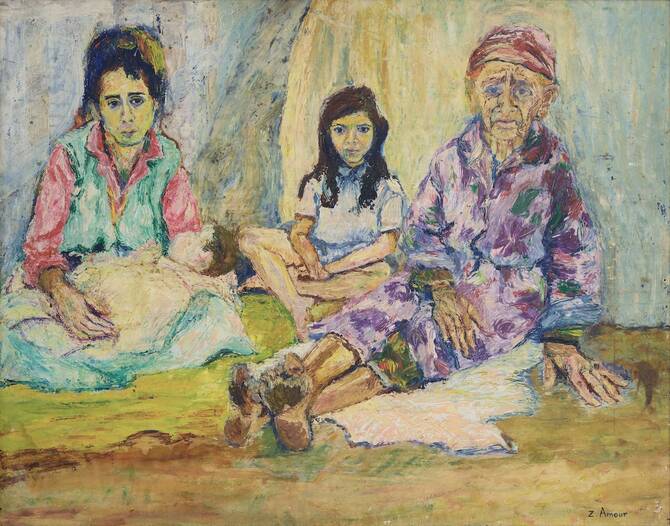
Zina Amour

Zina Amour, "Scène de Famille (Family Scene)," 1967. Oil on wood panel. (Supplied)
‘Family Scene’
The Tunisian artist’s 1967 painting is part of the exhibition’s “Depicting a Swift Modernization” section. “In the mid-20th century, the Arab world underwent significant changes,” the catalogue’s introduction to the section reads. “In the wake of national independence, cities like Cairo and Damascus experienced rapid growth, reshaping social life and the dynamics between urban centers and rural areas. This fast-changing modernization caught the attention of artists, who sought to document its impact on daily life and traditional craftsmanship” and to offer “a visual record of an Arab world in rapid transition.” Amour’s painting leans more toward documenting what was being lost amid the modernization.
Fatima Hassan Asiri

Fatima Hassan Assiri, "Untitled," 2019. Acrylic on wood panel. (Supplied)
‘Untitled’
In its “Al-Qatt Al-Asiri” section, the exhibition celebrates the eponymous Saudi artform originating from the Kingdom’s Asir region — an artform that, in 2017, was inscribed on UNESCO’s List of the Intangible Cultural Heritage of Humanity. “Practiced by women to decorate domestic interiors, it merges art and craft, drawing both from personal imagination and local heritage,” the catalogue states. “Transmitted across generations, it testifies to women’s creative agency and their role in shaping cultural identity.”
Fatima Hassan Asiri is considered a pioneer of the artform, and this 2019 panel, the catalogue says, “showcases the meticulous precision required of the artist.”
Safeya Binzagr

Safeya Binzagr 'Camels - Study.' (Supplied)
‘Camels — Study’
The late Safeya Binzagr is arguably the most influential woman in the history of the Kingdom’s art scene and is widely regarded as the “mother” of modern art in Saudi Arabia, playing, the catalogue states, “a foundational role in nurturing the Kingdom’s emerging arts community,” not just through her own work, but through the gallery, studio, and workshop she founded in the 1990s — Darat Safeya Binzagr.
“A central impulse throughout Binzagr’s work is the desire to document a rapidly vanishing time and place in her native country,” the catalogue states.
Sheikha Ibrahim

Sheikha Ibrahim, "Letter to Homeland," undated. Textile. (Supplied)
‘Letter to Homeland’
“In the wake of national independences, many artists turned to local crafts to reclaim local heritage and challenge dominant artistic hierarchies,” the catalogue states in its introduction to the exhibition’s “Reclaiming Local Craft Practices” section. “By integrating materials and techniques rooted in their surroundings, these artists rejected the Western definition of an artistic modernity conceived from the ground up. Instead, they affirmed ancestral traditions and anchored their practices in the textures of daily life, reimagining craft as a space of both continuity and innovation.” It is in this section that visitors will find Palestinian artist Ibrahim’s undated textile work.
Reda Ahmed

Reda Ahmed, "Wool Yarn Dyeing at the Centre," 2004. Tapestry. (Supplied)
‘Wool Yarn Dyeing at the Center’
The Egyptian “artist weaver” features in the section of the exhibition dedicated to Egypt’s Wissa Wassef Art Center, founded in 1951 in Harrania by architect Ramses Wissa Wassef. It was established in order to protect traditional Egyptian tapestry making. “Rejecting conventional artistic training, the center encourage its weavers to trust their imagination, drawing inspiration from their surroundings to develop a distinct visual language,” the show catalogue explains. “Working without preparatory sketches, these artists bridge the divide between fine art and craft, translating their visions directly onto the loom. In doing so, their tapestries reflect not only technical mastery, but also a deeply personal and innovative form of creative expression.”


