



RIYADH: Innovation often begins with an inconvenience — a moment so frustrating it forces someone to imagine something better. That is precisely how WTDcare, now accredited by the Saudi Health Ministry and operating across the Kingdom, first came to life. What started as a personal struggle became the seed of a healthcare platform reshaping how people access care, one tap at a time.
It all began with an itch.
In 2018, recovering from surgery and stuck at home with his entire left leg in a cast, Abdulrahman Almadani tried to ignore the growing discomfort. But the itch intensified — “very annoying, disrupting my whole day routine and focus and everything,” he recalled.
With seemingly no other option, he grabbed his crutches and began the exhausting trek down four flights of stairs, wrestling both cast and crutches into a car, then inching through an ER waiting room where his case was not considered urgent.
“In their eyes I wasn’t dying — but I was dying inside,” he told Arab News. “Because I waited for around four to five hours.”

Ensuring that the responder understands their language and background can be the difference between confusion and comfort. (AN photo by Huda Bashatah)
That long, inefficient day stayed with him, so he co-founded something that would streamline the process: WTDcare.
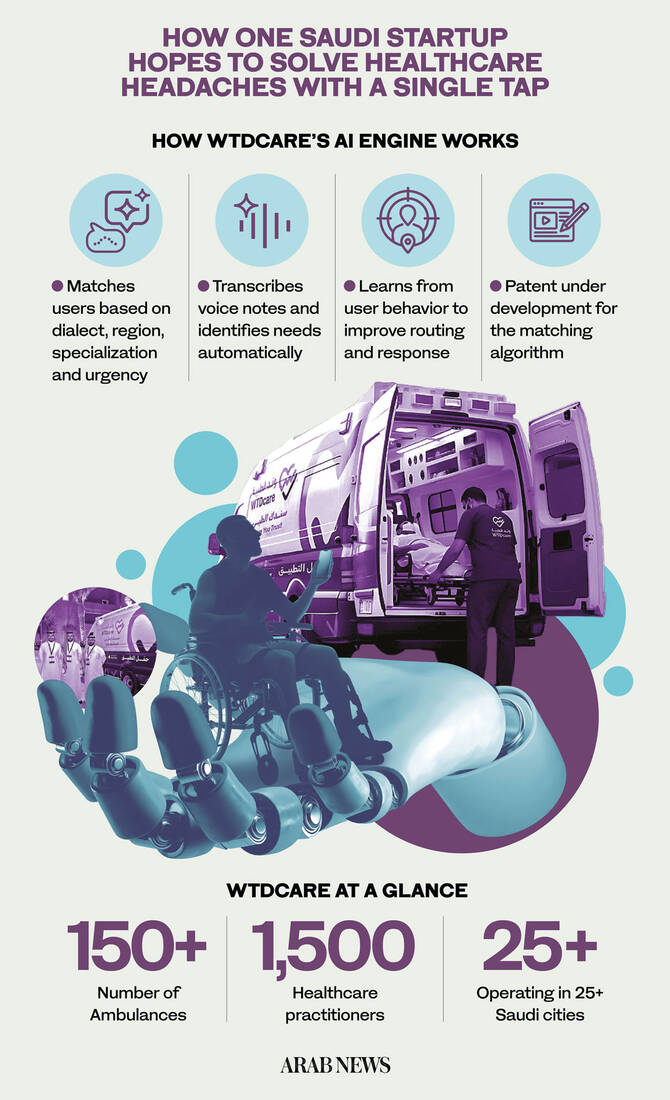
Today, the Riyadh-based startup spans more than 25 cities across the country and connects users to over 150 ambulances and 1,500 healthcare practitioners. It is powered by an all-Saudi leadership team blending academic expertise and field experience.
Co-founder and Chief Operation Officer Dr. Albaraa Jebreel — “the right man in the right place,” as Almadani puts it — holds a master’s in disaster management and a Ph.D. in critical care, bringing a structured, evidence-based approach to operations.
CEO Dr. Rakan Jaber, with a decade of paramedic experience and advanced degrees, shaped the platform’s practical, on-the-ground responsiveness.

Left to right, WTDcare founders Dr. Albaraa Jebreel, Dr. Rakan Jaber, and Abdulrahman Almadani. (AN photo by Huda Bashatah)
Their goal is simple: bring care to people where they are, with precision, speed and cultural sensitivity. The platform’s tagline captures the promise: “Where Technology Meets Healthcare Solutions.”
It uses AI as a tool to make the process easier while keeping the human touch.
WTDcare has evolved into a growing digital ecosystem built around a clear mission: to empower users across the Kingdom with a smart, reliable solution that offers integrated services ranging from non-medical emergency transportation to home care, special needs mobility and medical coverage.
Whether it’s a fully equipped ambulance, a dedicated team transporting individuals with disabilities in specially outfitted vehicles, or event safety supported by rapid-response medical crews, the platform prioritizes comfort, privacy and attentive care. Its vision is equally direct — to become one of the most trusted digital choices in Saudi healthcare by making compassionate, secure and accessible care just a tap away.
Opinion
This section contains relevant reference points, placed in (Opinion field)
In the beginning, though, there was nothing high-tech about the workflow. “We started in our garage,” Almadani said.
They built a simple form online: people filled it out, he received an email, and the team would manually coordinate the service. Over time, that improvised process grew into a multilayered engine that now operates across multiple channels — an app, a call center, an AI assistant and even WhatsApp — making it accessible to people of all ages, tech backgrounds and regions.
A major part of that evolution is the platform’s signature algorithm. Instead of relying on a basic queue, WTDcare’s team developed a matching model that considers cultural nuance, dialect, medical specialization, operational logistics and user behavior.
Almadani explains that the company is developing a patent for this AI-driven engine, which is designed to understand individual needs, monitor trends and match each user with precisely the right healthcare professional for their case.
That attention to context matters deeply in Saudi Arabia’s diverse regions. Many elderly patients, he noted, have strong local dialects or limited mobility; some have never left their villages.
Ensuring that the responder understands their language and background can be the difference between confusion and comfort.
“Sometimes, this old man cannot speak English, and you cannot bring someone non-Saudi. You need to bring someone from that region who understands this person — to make the patient feel safe.”
Accessibility goes far beyond language. Not everyone can navigate an app, especially older users or those in deep distress.
“So many people who are using our services are not very tech savvy,” he said. A phone call, voice note or simple message often becomes their lifeline. “The person that sends a voice note, it gets received, and then AI understands the need of this person. It transcribes it for us and then based on that, it does the action.”
DID YOU KNOW?
• WTDcare began in a garage with a simple online form before evolving into a nationwide health-tech platform.
• Its founders blend academic and field expertise, including a Ph.D. in critical care and a decade of paramedic experience.
• WTDcare provides special-needs mobility, home care, event medical coverage and non-emergency medical transport.
That drive for accessibility and readiness was on display recently in Diriyah in October.
Almadani was a speaker at the inaugural Zenos Health Summit, the Middle East’s first longevity and biohacking event founded by Dr. Mazen Karnaby. WTDcare didn’t just participate from the stage; the team also provided the on-site ambulance, parked directly outside Bab Samhan Hotel. Its presence — powered entirely by Saudi-made innovation — added a quiet promise that help was only steps away if anyone needed it.
They use AI to make the ambulance even more efficient, he said.

WTDcare co-founder Abdulrahman Almadani at the Zenos Health Summit last month. (AN photo by Huda Bashatah)
For Almadani, originally from Jeddah and currently based in Riyadh, the mission is personal and spiritual.
“Every case we are serving, we are making someone’s life way easier and better, and we increase their quality of life. And I think this is aligned directly with what Allah commands us, and also with Vision 2030 goals.”
He still thinks back to the day he was struggling with that cast, exhausted and unseen in a crowded waiting room.
In his words, the burden, the frustration and the wasted hours — “all of that could have been a click through with WTD.”


