

What the crown prince’s Washington visit achieved for the Saudi-US partnership

Short Url
Updated 21 November 2025
Follow

What the crown prince’s Washington visit achieved for the Saudi-US partnership

  • The visit underscored the long-term importance both countries place on maintaining a stable, strategic partnership
  • High-level meetings focused on expanding cooperation across defense, emerging technologies, investment, and energy

RIYADH: A press statement was issued on Thursday at the conclusion of the official visit of His Royal Highness Prince Mohammed bin Salman bin Abdulaziz Al-Saud, Crown Prince and Prime Minister, to the United States of America. The following is the text of the statement.

In implementation of the directives of Custodian of the Two Holy Mosques King Salman bin Abdulaziz Al-Saud, and in response to the gracious invitation of President Donald Trump of the United States of America, and within the framework of the historic relations and strategic partnership between the Kingdom of Saudi Arabia and the United States, His Royal Highness Prince Mohammed bin Salman bin Abdulaziz Al-Saud, Crown Prince and Prime Minister, paid an official working visit to the United States from Nov. 18 to 19, 2025.


US President Donald Trump welcomes Saudi Crown Prince Mohammed bin Salman to the White House in Washington, DC, on Nov. 18, 2025. (AFP)

President Trump received HRH the Crown Prince at the White House. HRH the Crown Prince conveyed the greetings of the Custodian of the Two Holy Mosques to the US president, who in turn asked HRH the Crown Prince to convey his greetings to the Custodian of the Two Holy Mosques.

His Royal Highness the Crown Prince and the US president held the Saudi-US Summit, during which both sides reaffirmed their deep commitment to the historic bonds of friendship and the strategic partnership between the Kingdom and the United States. They also discussed ways to enhance the partnership across all fields.

Opinion

This section contains relevant reference points, placed in (Opinion field)

Attending the Saudi-US Summit on the Saudi side were Minister of Energy and Chairman of the Saudi side of the Saudi-US Strategic Economic Partnership Committee Prince Abdulaziz bin Salman bin Abdulaziz; Saudi Ambassador to the United States Princess Reema bint Bandar bin Sultan bin Abdulaziz; Minister of Foreign Affairs Prince Faisal bin Farhan bin Abdullah; Minister of State, Member of the Cabinet, and National Security Adviser Dr. Musaed bin Mohammed Al-Aiban; Minister of Commerce Dr. Majid Al-Kassabi; Minister of Finance Mohammed Aljadaan; and Governor of the Public Investment Fund (PIF) Yasir bin Othman Al-Rumayyan.

From the US side, attendees included Vice President J.D. Vance; Secretary of State Marco Rubio; Secretary of the Treasury Scott Bessent; Secretary of War Pete Hegseth; Secretary of Commerce Howard Lutnick; Secretary of Energy Chris Wright; and White House Chief of Staff Susie Wiles.

HRH the Crown Prince highlighted the positive results of President Trump’s visit to the Kingdom in May 2025, which elevated the strategic relationship between the two friendly nations to an unprecedented historical level under the leadership of the Custodian of the Two Holy Mosques and President Trump.

KEY ACHIEVEMENTS OF THE VISIT

• Signing of the Strategic Defense Agreement.

• Launch of the US-Saudi AI Strategic Partnership.

• Completion of negotiations on civil nuclear energy cooperation.

• New frameworks on critical minerals and supply-chain security.

• Agreement to accelerate Saudi investment approvals in the US.

• $270bn in commercial deals and MoUs announced at Investment Forum.

Both sides reviewed the latest developments of mutual concern and exchanged views on regional and international issues, in addition to discussing efforts to strengthen aspects of the strategic partnership.

The visit witnessed the signing of several agreements and frameworks, including the Strategic Defense Agreement, the AI Strategic Partnership, the joint declaration on the completion of negotiations regarding cooperation in civil nuclear energy, the strategic framework for cooperation in securing supply chains for uranium, permanent magnets, and critical minerals, the strategic framework for facilitating procedures to accelerate Saudi investments, financial and economic partnership arrangements, arrangements regarding capital markets collaboration, mutual recognition of US federal vehicle safety standards, and a memorandum of understanding (MoU) in the field of education and training.
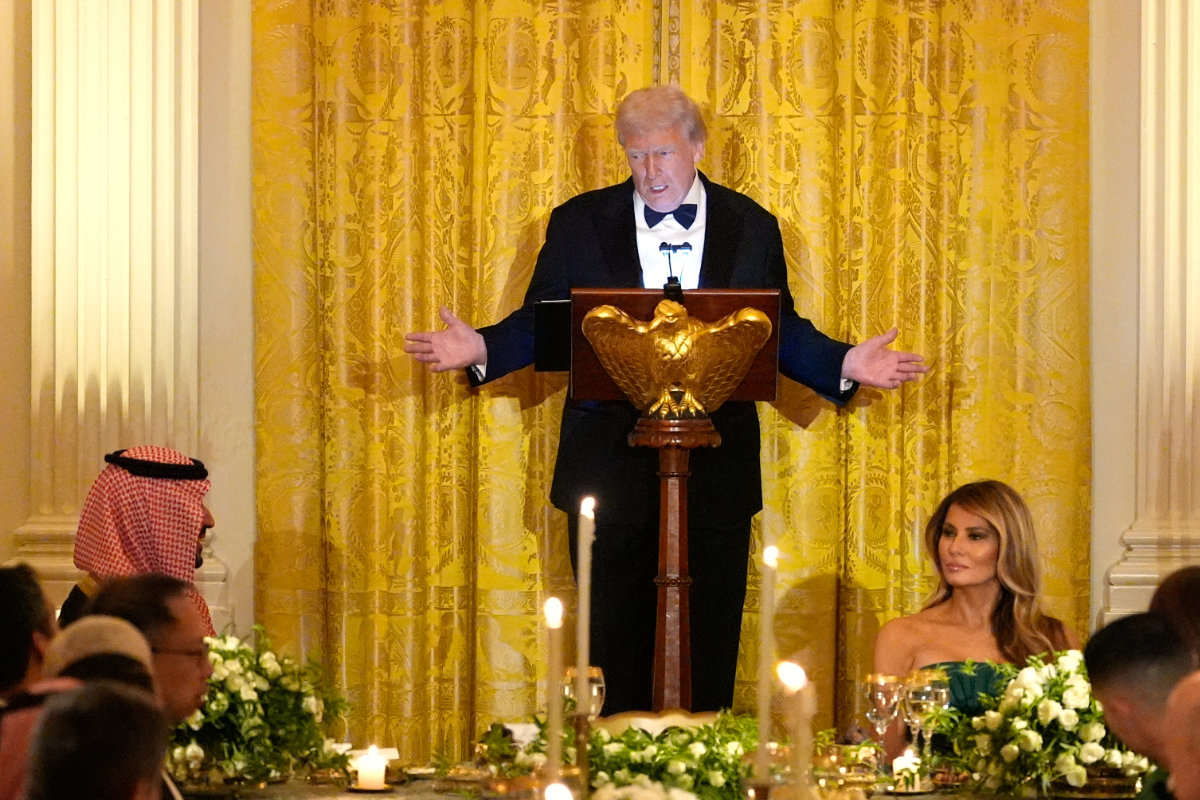


President Donald Trump speaks during a dinner with Saudi Arabia's Crown Prince Mohammed bin Salman at the White House on Nov. 18, 2025, in Washington, as first lady Melania Trump watches at right. (AP)

President Donald Trump and First Lady Melania Trump also hosted a state dinner in honor of His Royal Highness the Crown Prince, attended by senior US officials, members of Congress, and business leaders.

HRH the Crown Prince and President Trump additionally participated in the US-Saudi Investment Forum, during which numerous agreements and memoranda of understanding valued at approximately $270 billion were announced.

HRH the Crown Prince also met with Speaker of the US House of Representatives Mike Johnson and several members of both the Senate and the House of Representatives.

At the conclusion of the visit, HRH the Crown Prince expressed his appreciation to President Trump for the warm welcome and generous hospitality extended to him and his accompanying delegation.

President Trump conveyed his best wishes of health and well-being to the Custodian of the Two Holy Mosques and to His Royal Highness the Crown Prince, wishing the Saudi people continued progress and prosperity.


Historic Bab Al-Bunt in Jeddah reborn as Red Sea Museum

Updated 07 December 2025
Follow

Historic Bab Al-Bunt in Jeddah reborn as Red Sea Museum

  • From manuscripts to contemporary art, the museum takes visitors on a journey through seven galleries celebrating the Red Sea’s heritage

JEDDAH: The recently renovated Bab Al-Bunt building in Historic Jeddah, known as Al-Balad, opened on Saturday night as the Red Sea Museum, giving visitors a first glimpse of a space celebrating the region’s cultural and natural heritage.

The exclusive preview marked the culmination of years of meticulous restoration, preserving one of Jeddah’s most historic landmarks while creating a space that bridges past and present.

The event was attended by Prince Saud bin Mishaal bin Abdulaziz, the deputy governor of Makkah, and Prince Badr bin Abdullah bin Farhan, minister of culture and chairman of the Museums Commission.

Prince Badr said that the Red Sea Museum provides a broad space for creativity and provides a comprehensive cultural platform that fosters dialogue between civilizations and encourages cultural and intellectual exchange.

He noted that the museum reflects the Kingdom’s commitment to preserving its cultural and natural heritage and is a key part of the effort to revive Historic Jeddah. Supported by the Kingdom’s leadership, this initiative contributes to building a vibrant cultural future where diverse forms of culture and the arts can flourish.

Eman Zidan, director of the Red Sea Museum, said: “Red Sea Museum is a revival of Bab Al-Bunt, originally built in 1866. It once served as a bustling port for travelers, pilgrims, and adventurers arriving by sea, and now it opens its doors to visitors, retelling the stories of the Red Sea. It is a cultural anchor that celebrates the legacy, heritage, and rich diversity of the people of the Red Sea."

Zidan detailed the care taken in the restoration, noting the use of original materials such as coral stone and concrete to return the building to its original form.

“This was achieved through a thorough study by experts — architects and heritage specialists — who were able to restore Bab Al-Bunt to its origins. Now the museum speaks to the people and the community, telling the stories of pilgrimage, biodiversity, maritime exchange, and the open dialogue between the countries on the Red Sea,” she added.

Zidan also emphasized the museum’s commitment to providing an enriching visitor experience through diverse programs, from archaeological objects and historical artifacts to modern and contemporary artworks.

Collaborations with local artisans and artists, including Ahmad Angawi, founder of Zawiya97, have produced Red Sea-inspired projects, while the Red Sea Symphony, featuring children’s choirs, is organized with the Tariq Abdulhakim Museum to celebrate the region’s musical traditions.

“Composing a symphony of seven movements representing the countries of the Red Sea, with the participation of the children’s choir, adds a lot, because this is the kind of rebirth of music that unites people and connects them from everywhere,” Zidan said.

Ibrahim Alsanousi, CEO of the Museums Commission, said: “What makes this museum unique is that we rehabilitated and revitalized a historic building with a powerful story to tell, transforming it into the Red Sea Museum, which is now a public space, just as it was before as a port building.”

Alsanousi added that the museum not only displays artifacts from the Red Sea region but also integrates contemporary art to create a dialogue between past and present.

“We hope first and foremost that it is an open and accessible museum, a living space where people feel welcome and a sense of belonging. This is a place for them to come, learn, create, and discover,” he said.

“We also hope that, in the future, there will be more museums reflecting Jeddah’s historic district. While nothing specific is planned yet, several excavations have uncovered numerous objects, some of which will be exhibited here. There may even be potential for a museum dedicated entirely to the district’s artifacts.”

Tayeb Altayeb, acting director of the Tariq Abdulhakim Museum, said: “The Red Sea Museum is one of the unique additions to the historic district. It is a great addition to the city of Jeddah and a testament to how we view experiences through museology — in a modern way, while preserving heritage.”

Speaking about the Silk Road Symphony, Altayeb emphasized the museum’s focus on connecting the Red Sea’s seven countries through music. He highlighted the extensive research and collaboration that went into composing the seven-movement symphony, which draws inspiration from the traditional music, soundscapes, and coastal cultures of Saudi Arabia, Yemen, Jordan, Egypt, Sudan, Eritrea, and Djibouti.

The symphony was performed by the acclaimed Silk Road Ensemble during the opening ceremony, accompanied by a children’s choir, bringing the region’s diverse musical heritage to life. “The idea is communication through the universal language that is music,” he said.

Angawi also highlighted his collaboration with the museum, creating works inspired by the Red Sea’s natural and cultural heritage.

“I was inspired by the sea, its waves, and sea creatures like fish. In my work with the Mangurs, I have been documenting this for many years and innovating new units and openings. With the Red Sea Museum, I developed the idea of the wave, designing pieces that align with the sea view and the beautiful directional geometry.

“Each design works with the museum team to develop a full story and narrative,” he said, noting that this project is just the beginning of ongoing collaborations to produce Red Sea-inspired objects and products.

The museum offers visitors a journey through seven thematic sections that span 23 galleries, displaying more than 1,000 artifacts and artworks. From manuscripts and maps to coral reef specimens and contemporary art, it celebrates the Red Sea’s tangible and intangible heritage.

Temporary exhibitions, such as The Gate of Gates by Saudi photographer Moath Alofi, along with workshops, talks, and special events such as Music of the Red Sea, complement the permanent displays, inviting visitors of all ages to engage with the region’s cultural and natural legacy.