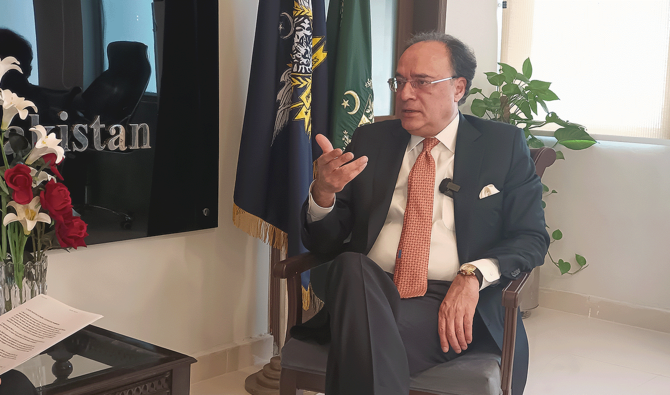

ISLAMABAD: Pakistan’s finance minister Muhammad Aurangzeb said this week the government plans to issue its first Panda bond, a renminbi-denominated instrument sold in China’s domestic market, before the Chinese New Year in February, adding that moderating inflation could allow the benchmark interest rate to return to single digits during the ongoing fiscal year.
The minister’s remarks come in the backdrop of Islamabad’s efforts to re-enter global capital markets after years of external shocks, liquidity pressures and repeated balance-of-payments crises. Pakistan is operating under a $7 billion, 37-month bailout program with the International Monetary Fund that requires fiscal consolidation, stronger tax collection and structural reforms across energy, state-owned enterprises and the investment climate.
Alongside the planned Panda bond, the government has refreshed its Global Medium Term Note (GMTN) program, the legal structure to issue Eurobonds and Islamic sukuk, as it seeks to broaden access to international investors and reduce reliance on dollar markets.
In an interview to Arab News, Aurangzeb said two non-deal roadshows had already been completed for the inaugural Panda issuance and credit enhancement — multilateral guarantees that lower risk for investors — had been approved by the Asian Development Bank, with the Asian Infrastructure Investment Bank expected to follow shortly. He said regulatory clearances with China’s central bank and securities regulator were also progressing.
“I’m very clear we have to get it [Panda bond] done before the Chinese New Year,” he said. “So, it’s not late into 2026. It’s certainly well before CNY, which is going to be in February of this year.”
The minister emphasized that the debut size, equivalent to $250 million in Chinese yuan, was strategic rather than driven by the IMF program’s external financing calendar.
“It has nothing to do with our external discussion at all,” he said, describing the bond as a long-overdue diversification step that Pakistan “should have done some time back.”
On when he expected Pakistan to return to the Eurobond and sukuk market, Aurangzeb said it had to be seen in the context of “overall road to market,” which he described as flowing from export-led growth to foreign investment tied to export potential, and finally a return to international debt markets through instruments such as Eurobonds and sukuk.
“And the last thing is international capital markets. So the fact that we now have three rating agencies aligned, starting with Fitch earlier on in the year, then S&P, and now Moody’s a couple of months back,” he said, referring to the agencies’ recent moves to stabilize Pakistan’s outlook after years of downgrades tied to balance-of-payments stress and political uncertainty.
“We are also refreshing our GMTN program,” he said, adding that it would allow the government to update risk disclosures, financials and legal documentation so it can tap international debt markets quickly when conditions permit.
On monetary policy, Aurangzeb said decisions on interest rates rested solely with the State Bank of Pakistan’s independent Monetary Policy Committee but added that his own view was that the benchmark rate could fall sharply if inflation stayed contained.
“If the inflation stays range-bound… the policy rate, during this fiscal year, can move into single digit,” he said.
He linked this outlook to improvements in Pakistan’s debt profile, noting that the government had brought the debt-to-GDP ratio down from the mid-70s to the mid-60s through liability management and buybacks. This had already reduced the country’s annual debt servicing costs by more than Rs800 billion ($2.9 billion), he said.
TAXING AGRICULTURE, RETAIL, REAL ESTATE
Shifting from monetary policy to fiscal reforms, Aurangzeb said Pakistan’s narrow tax base remained one of the biggest structural constraints on the economy, with the tax-to-GDP ratio stuck around 9 percent for years, far below the level needed to fund basic government operations or meet IMF requirements.
Under the IMF program, Islamabad is expected to broaden its revenue base by bringing traditionally undertaxed sectors — agriculture, retail and real estate — into the net, improving compliance and reducing leakages caused by evasion and weak enforcement.
Aurangzeb said the government had already pushed the ratio to around 10.2 percent and was targeting 11 percent through a mix of enforcement, technology and inclusion of new sectors. He called Pakistan’s long-standing revenue structure “not fiscally sustainable” and said the issue could not be resolved without enlarging the pool of taxpayers rather than repeatedly taxing the same formal and salaried segments.
He said agriculture, retail and real estate made up a large share of Pakistan’s economy — agriculture alone employs more than a third of the workforce — but contributed disproportionately little revenue because most taxation in these areas is either provincial, under-collected, or structured around outdated exemptions.
“These are three areas which have been contributing very handsomely to the GDP, but have not been contributing to the exchequer in the same proportion,” he said.
A major shift, he added, was that all provincial assemblies had now legislated an agriculture income tax, a politically fraught reform widely viewed for decades as impossible because many lawmakers themselves own agricultural land. Historically, federal governments have avoided pushing for agriculture taxation due to the sector’s political weight and the constitutional division of powers that leaves agricultural income under provincial jurisdiction.
He stressed that enforcement would be gradual but the legislative breakthrough alone represented a historic correction to Pakistan’s tax architecture.
“First I was being told this can never be done,” he said. “It’s been done. Now people tell me it can’t be collected. Okay, one thing at a time.”
Retail and real estate — both largely informal and cash-driven — would be tackled next, though such reforms hinge on provincial-federal cooperation and require redesigning how these sectors are documented, according to the minister.
The goal is not simply to raise revenue but to correct a structural imbalance that places a “disproportionate burden” on manufacturing and salaried workers.
Stopping leakages, which he described as “an euphemism for theft and corruption,” was equally critical.
POWER TARIFFS, IMF PRESSURES AND ELECTRICITY SECTOR REFORMS
Aurangzeb said Pakistan’s progress on taxes must be complemented by reforms in the power sector, which has accumulated huge losses due to high theft, corruption, poor recoveries, and system inefficiencies — a problem known locally as “line losses.” These losses accumulate into what is called “circular debt,” forcing the government to borrow more or raise tariffs, and making power-sector reform a central pillar of IMF programs.
Asked whether Pakistan had identified a political or social red line beyond which it would refuse further tariff hikes even if the IMF were to demand them, Aurangzeb said prices were already declining as governance improvements take hold.
“No, in fact, the tariffs have been coming down,” he said.
He credited the shift to reforms in state-owned electricity distribution companies, or DISCOs, which handle billing, recoveries and grid maintenance and have long suffered from corruption and political interference. Nearly 90 percent of DISCO boards are now chaired by private-sector professionals, he said, adding that better governance was gradually improving recoveries and reducing losses.
Alongside administrative changes, Pakistan is advancing structural reforms the IMF has pressed for, including transferring three DISCOs to the Privatization Commission.
“Whether we do outsourcing, whether we privatize… that, to me, is the structural solution as we go forward,” Aurangzeb said.
He said the combined reforms had begun to ease the tariff burden and would help create further room for relief.
“The tariffs have been coming down in providing relief,” he said. “We still have to move forward in providing further relief but it’s moving in the right direction.”
FDI, AI AND EXCHANGE RATES
On foreign investment, Aurangzeb acknowledged that inflows had fallen 26 percent between July and October but attributed some of the decline to Pakistan’s clearance — only by June 2025 — of a multibillion-dollar backlog in profit and dividend repatriation. He said multinational firms were making global portfolio choices unrelated to Pakistan but noted new inflows from US, Middle Eastern and Asian firms, including a US conglomerate acquiring the First Women Bank and Pakistan becoming a regional technical and export hub for Google.
He highlighted a shift toward the digital economy, saying Pakistan recorded the highest monthly IT exports in its history in October at $386 million.
“We have to almost think through the old economy and the new economy,” he said.
On Pakistan’s emerging regulatory framework for crypto and digital assets, Aurangzeb said the government had created a Crypto Council, chaired by him, and established the Pakistan Virtual Asset Regulatory Authority to supervise the sector with consumer-protection standards and anti-money-laundering safeguards. He said Pakistan’s large freelancer workforce could benefit from training in blockchain development and Web3 technologies.
“If these boys and girls… get trained into that, and they can start doing their coding at $10 to $12, it’s great for them, it’s great for the country,” he said.
He also described AI as an opportunity for Pakistan rather than a threat, citing applications in agriculture, health care, industrial monitoring and public-sector governance.
“A lot of AI-led production monitoring that we’re doing… to stop the leakages, I think is going to be huge,” he said.
Asked about allegations that the State Bank is heavily supporting the rupee, with some analysts claiming overvaluation of 20–25 percent, Aurangzeb rejected the idea of targeting a preferred exchange rate.
“It’s a market-based exchange rate, real, which has to define where the value of the rupee is,” he said.