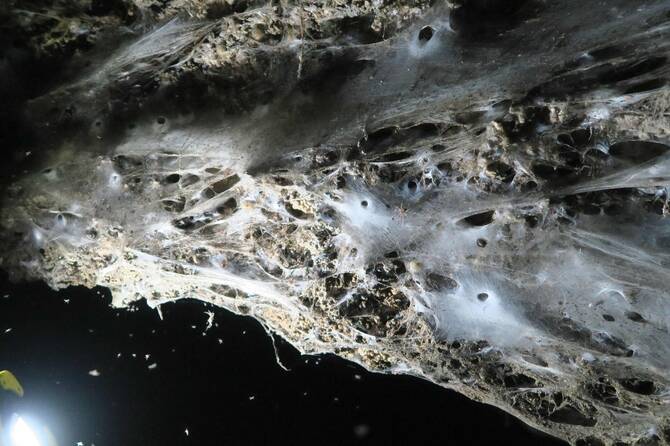
ATHENS: Scientists have discovered a giant spider web spanning about half the size of a tennis court and with some 111,000 spiders in a cave on the border between Greece and Albania.
The web in the “Sulfur Cave” in the Vromoner Gorge covers some 106 square meters (1,140 square feet), according to the study in the publication Subterranean Biology.
In it are some 69,000 domestic house spiders (Tegenaria domestica), in addition to over 42,000 of Prinerigone vagans dwarf weavers (Linyphiidae), the study said.
The researchers from universities and natural history museums in Albania, Romania, Belgium, Germany and Italy called the discovery “the first documented case of colonial web formation” of two species that are normally solitary.
Based on its spatial distribution and dimensions, species composition and population density, in addition to the food resources, the spider colony is unique and remarkable, they said.
This is “the first documented case of colonial web formation in these species,” the experts said, adding that the structure is formed “of numerous individual funnel-shaped webs.”
The cave, so called because of its abundance of the chemical, completely straddles the border — its entrance is in Greece, while the deepest sections are under Albanian soil.
Springs located in the deep recesses of the cave feed a sulfidic stream which flows through the entire length of the main cave passage, the study said.
The spiders share the cave with numerous other insects, including centipedes, scorpions and beetles.
The discovery was first reported by members of the Czech Speleological Society, the study said.


![]()

Giant spider web found in Greek-Albanian border cave: study
Short Url
https://arab.news/2u9ew
Giant spider web found in Greek-Albanian border cave: study
- This is “the first documented case of colonial web formation in these species,” the experts said, adding that the structure is formed “of numerous individual funnel-shaped webs”


Latest updates


© 2026 SAUDI RESEARCH & PUBLISHING COMPANY, All Rights Reserved And subject to Terms of Use Agreement.