NEW YORK: A 1940 self-portrait by famed Mexican artist Frida Kahlo of her asleep in a bed could make history Thursday when it goes on sale by Sotheby’s in New York.
With an estimated price of $40 million to $60 million, “El sueño (La cama)” – in English, “The Dream (The Bed)” — may surpass the top price for a work by any female artist when it goes under the hammer. That record currently stands at $44.4 million, paid at Sotheby’s in 2014 for Georgia O’Keeffe’s “Jimson Weed/White Flower No. 1.”
The highest price at auction for a Kahlo work is $34.9 million, paid in 2021 for “Diego and I,” depicting the artist and her husband, muralist Diego Rivera. Her paintings are reported to have sold privately for even more.
The painting up for auction depicts Kahlo asleep in a wooden colonial-style bed, wrapped in a golden blanket embroidered with crawling vines and leaves. Above her, seemingly levitating atop the bedposts, lies a full-sized skeleton.
In its catalog note, Sotheby’s said the painting “offers a spectral meditation on the porous boundary between sleep and death.”
Last exhibited publicly in the late 1990s, the painting is the star of a sale of more than 100 surrealist works by artists including Salvador Dalí, René Magritte, Max Ernst and Dorothea Tanning. They are from a private collection whose owner has not been disclosed.
Kahlo vibrantly and unsparingly depicted herself and events from her life, which was upended by a bus accident at 18. She started to paint while bedridden, underwent a series of painful surgeries on her damaged spine and pelvis, then wore casts until her death in 1954 at age 47.
“The suspended skeleton is often interpreted as a visualization of her anxiety about dying in her sleep, a fear all too plausible for an artist whose daily existence was shaped by chronic pain and past trauma,” the catalog notes.


Frida Kahlo self-portrait poised to shatter auction records

https://arab.news/g8u6s
Frida Kahlo self-portrait poised to shatter auction records

- The painting shows Kahlo asleep in a bed with a skeleton above her. Sotheby’s describes it as a meditation on the boundary between sleep and death
- The painting is part of a sale featuring over 100 surrealist works


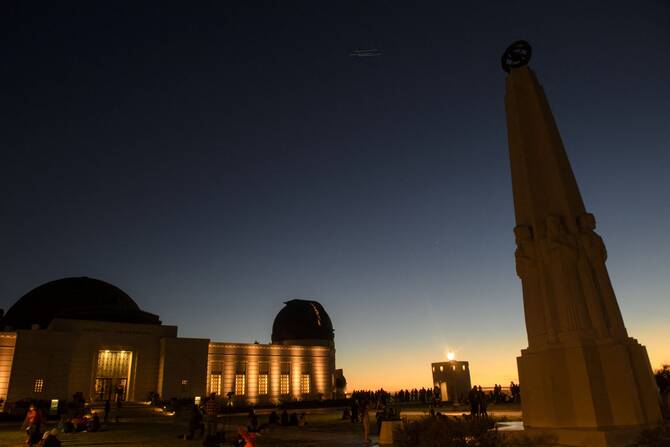
6 planets will parade across the night sky at the end of February
NEW YORK: Six planets are linking up in the sky at the end of February, and most will be visible to the naked eye.
It’s what’s known as a planetary parade, which happens when multiple planets appear to line up in the sky at once. The planets aren’t in a straight line, but are close together on one side of the sun.
Skygazers can usually spot two or three planets after sunset, according to NASA. Hangouts of four or five that can be glimpsed with the naked eye are less common and occur every few years. Last year featured lineups of six and all seven planets.
When will they be visible?
On Saturday, Mercury, Venus, Jupiter and Saturn will be visible to the naked eye if clear skies allow. Uranus and Neptune can only be spotted with binoculars and telescopes.
What time is optimal for viewing?
Go outside about an hour after sunset and venture away from tall buildings and trees that will block the view. Look to the western sky and spot Mercury, Venus and Saturn close to the horizon. Jupiter will be higher up, along with Uranus and Neptune.
How to know if you’ve spied a member of the parade?
“If it’s twinkling, it’s a star. If it is not twinkling, it’s a planet,” said planetary scientist Sara Mazrouei with Humber Polytechnic in Canada.
The parade should be visible over the weekend and in the days after. Eventually, Mercury will bow out and dip below the horizon.
At least one bright planet is visible on most nights, according to NASA.
Glimpsing many in the sky at once is a fun way to connect with astronomers of centuries’ past, said planetary scientist Emily Elizondo with Michigan State University.
Ancient astronomers used to make sense of the universe “just by looking up at the stars and the planets,” Elizondo said, “which is something that we can do today.”