

Pakistan warns 2026 monsoon may be up to 26% more intense, orders urgent preparations

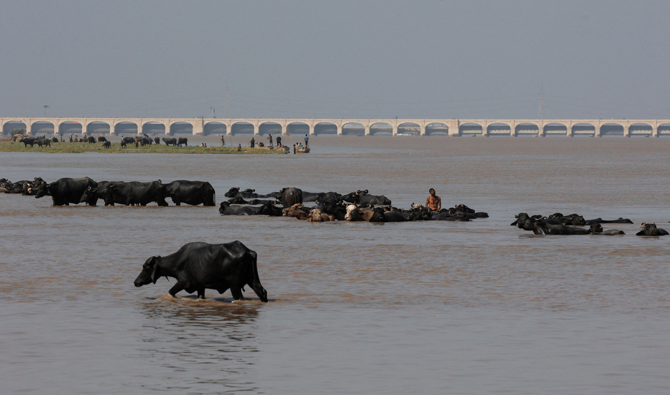
A man takes care of his herd of buffaloes near the eastern bank of the Indus River, with the Sukkur Barrage, formerly known as the Lloyd Barrage, in the background, as floodwater passes by following monsoon rains and rising levels of the Indus River in Rohri, near Sukkur, Sindh province, Pakistan, September 15, 2025. (Reuters/File)
Short Url
Updated 19 November 2025
Follow

Pakistan warns 2026 monsoon may be up to 26% more intense, orders urgent preparations

  • Pakistan PM directs climate change ministry to begin preparations immediately for next year’s monsoon season
  • Pakistan suffered a deadly monsoon season this year which saw over 1,000 people killed due to torrential rains, floods

ISLAMABAD: The chairman of Pakistan’s National Disaster Management Authority (NDMA) warned on Wednesday that the 2026 monsoon season is expected to be more intense in the country, as Prime Minister Shehbaz Sharif directed authorities to start preparations immediately for a potential crisis next year. 

Pakistan suffered a deadly monsoon season this year, which saw over 1,000 people killed due to heavy rains and floods since late June. Deadly floods in Pakistan’s eastern Punjab province in late August killed over 130, affected over 4.5 million people and washed away large swathes of crops across the province. 

Experts attribute Pakistan’s irregular weather patterns, which include floods, droughts and heatwaves to climate change. Pakistan is counted among the world’s most vulnerable countries to climate change effects, where authorities say nearly 4,600 people have been killed in floods since 2010. 

“We think in the coming days, the 2026 monsoon is expected to be 22-26% more intense compared to this year’s monsoon,” NDMA Chairman Lt. Gen. Inam Haider Malik told reporters at a news conference. 

Malik said this meant glaciers would melt earlier next year or in higher quantity, pointing out that glacial lake outburst floods (GLOFs) and deluges were observed in the northern Gilgit-Baltistan (GB) region, Punjab and the southern Sindh province during 2025. 

“Pakistan bore all possible components of the monsoon this year,” Malik said, adding that over 3.1 million people were evacuated from high-risk riverine areas across the country. 

PM APPROVES SHORT-TERM PLAN

Separately, Sharif approved a short-term plan by the climate change ministry to induce climate-related losses for the next year’s monsoon, a statement by his office said, directing authorities to begin preparations to implement it immediately. 

The prime minister noted that a substantial amount of Pakistan’s GDP has to be spent every three years to mitigate the adverse impacts of climate change. 

Speaking to reporters alongside Malik, Climate Change Minister Musadik Maik said that as per the short-term plan, the government will fix all dams, embankments and floodgates that were damaged due to the recent floods in Pakistan in late August. 

“Whatever damage that has happened in the next 200 days it will be fixed,” Malik said. 

He pointed out that the prime minister has also directed authorities to ensure that an integrated early warning system is made functional and implemented in the country. 

Malik said at the moment, various government ministries and authorities, such as the Planning Ministry and the NDMA, had their own early warning systems. 

He said that as per one automatic and integrated warning system, the people and officials of the area where a natural calamity strikes will be warned first so that they can take precautionary measures before Islamabad is alerted. 
 
“The prime minister has issued an order and told us that you have to do both of these things immediately,” the minister said. 


‘Fully stand with Bangladesh’: Pakistan PM backs decision to boycott India match

Updated 04 February 2026
Follow

‘Fully stand with Bangladesh’: Pakistan PM backs decision to boycott India match

  • Pakistan’s government have not allowed the national cricket team to play its World Cup match against India on Feb. 15
  • Pakistan has accused India of influencing ICC decisions, criticized global cricket body for replacing Bangladesh in World Cup

ISLAMABAD: Prime Minister Shehbaz Sharif on Wednesday backed his government’s decision to bar the national men’s cricket team from playing against India in the upcoming T20 World Cup tournament, reaffirming support for Bangladesh. 

Pakistan’s government announced on social media platform X last week that it has allowed its national team to travel to Sri Lanka for the World Cup. However, it said the Green Shirts will not take the field against India on their scheduled match on Feb. 15. 

Pakistan’s participation in the tournament was thrown into doubt after Pakistan Cricket Board (PCB) Chairman Mohsin Naqvi criticized the International Cricket Council (ICC) for replacing Bangladesh with Scotland. The decision was taken after Bangladesh said it would not let its team travel to India out of security concerns. 

During a meeting of the federal cabinet, Sharif highlighted that Pakistan has said that politics should be kept away from sports. 

“We have taken this stand after careful consideration and in this regard, we should stand fully with Bangladesh,” Sharif said in televised remarks. 

“And I believe this is a very reasonable decision.”

Pakistan has blamed India for influencing the ICC’s decisions. The global cricket governing body is currently led by Jay Shah, the head of the Board of Control for Cricket in India. Shah is the son of Indian Home Minister Amit Shah. 

Pakistan’s boycott announcement has triggered media frenzy worldwide, with several Indian cricket experts and analysts criticizing Islamabad for the decision. An India-Pakistan cricket contest is by far the most lucrative and eagerly watched match of any ICC tournament. 

The ICC has ensured that the two rivals and Asian cricket giants are always in the same group of any ICC event since 2012 to capitalize on the high-stakes game. 

The two teams have played each other at neutral venues over the past several years, as bilateral cricket remains suspended between them since 2013 due to political tensions. 

Those tensions have persisted since the two nuclear-armed nations engaged in the worst fighting between them since 1999 in May 2025, after India blamed Pakistan for an attack in Indian-administered Kashmir that killed tourists. 

Pakistan denied India’s allegations that it was involved in the attack, calling for a credible probe into the incident.