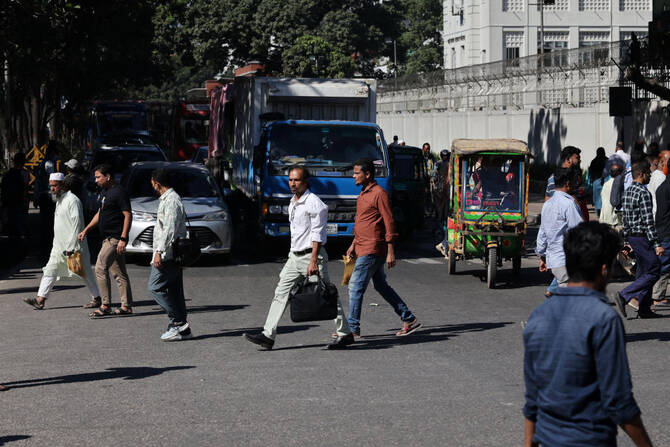
DHAKA: Bangladesh’s capital and major cities were calm Tuesday despite a call for a nationwide shutdown by the former ruling party of ousted Prime Minister Sheikh Hasina after she was sentenced to death over her crackdown on a student uprising last year.
The International Crimes Tribunal handed down death sentences in absentia to Hasina and former Home Minister Asaduzzaman Khan on Monday for their involvement in deadly force used against protesters last year.
Hasina’s former ruling Awami League party rejected the court proceedings Monday, calling it “a kangaroo court” and called for a nationwide shutdown the next day.
Hasina’s opponents clashed with police and soldiers until late Monday and attempted to use excavators to demolish the home of her father, Bangladesh independence leader Sheikh Mujibur Rahman. Local media reported the home of former President Abdul Hamid, a veteran Awami League leader, was vandalized in the northeastern Kishoreganj district.
But on Tuesday, there was no closure of services or shops and schools, although some people expressed tension and confusion over what lies ahead for the South Asian nation, a parliamentary democracy of 170 million people.
Mohammad Saikot Hossain, a Dhaka businessman, said there is “no real rule of law here” and he worries about his children’s future.
“Those who ruled the country before shaped the law in their own way, and those who are ruling now are also shaping the law in their own way,” he said. “Our next generation is growing up in this environment. They have no aim and no future. I am very worried about where they will go and what they will do in the days to come.”
Hasina, 78, was convicted Monday on five charges of crimes against humanity. She also was sentenced to prison until natural death for making inflammatory remarks and ordering the extermination of student protesters with helicopters, drones and lethal weapons.
A former police chief was sentenced to five years’ imprisonment after pleading guilty and becoming a state witness against Hasina.
Bangladesh experienced weeks of student-led protests in July and August last year. Demonstrators voiced discontent over a quota system for allocating government jobs that critics said favored those with connections to Hasina’s party. More than 800 people were killed and about 14,000 were injured, Bangladesh’s interim government reported. The United Nations in February estimated that as many as 1,400 people were killed.
The uprising led to the collapse of Hasina’s 15-year rule on Aug. 5, 2024. Hasina and Khan fled to India, which has declined to extradite them, making it unlikely they would ever be executed or imprisoned.
Hasina cannot appeal unless she surrenders or is arrested within 30 days of the sentencing. She and Khan did not designate defense lawyers and rejected a state-appointed defense attorney for the tribunal.
On Monday, she said the charges were unjustified, arguing that she and Khan “acted in good faith and were trying to minimize the loss of life.”
“We lost control of the situation, but to characterize what happened as a premeditated assault on citizens is simply to misread the facts,” she said in a statement.
The UN said Hasina’s sentencing marked “an important moment for victims of the grave violations committed during the suppression of protests last year.”
New York-based Human Rights Watch expressed misgivings, saying the trial process raised “serious human rights concerns” and questioned statements by the witnesses and the conduct of the defense appointed by the state.
“There is enduring anger and anguish in Bangladesh over Hasina’s repressive rule, but all criminal proceedings need to meet international fair trial standards,” said Meenakshi Ganguly, Human Rights Watch deputy Asia director.
Those responsible for the “horrific abuses” under the Hasina administration should be held to account after “impartial investigations and credible trials,” Ganguly said.
Amnesty International Secretary General Agnès Callamard protested the death sentence and said “this trial and sentence is neither fair nor just.”
“This was not a fair trial,” Callamard said in a statement Monday. “The victims of July 2024 deserve far better. Bangladesh needs a justice process that is scrupulously fair and fully impartial beyond all suspicion of bias and does not resort to order further human rights violations through the death penalty.”
The sentencing came as Bangladesh grapples with stability under an interim government headed by Nobel Peace Prize laureate Muhammad Yunus, who took over an interim government three days after Hasina was ousted. An election is planned for February, although specific dates have not been announced.

Bangladesh remains calm a day after tribunal issues death sentence for Sheikh Hasina
Short Url
https://arab.news/2x22c
Bangladesh remains calm a day after tribunal issues death sentence for Sheikh Hasina
- The International Crimes Tribunal handed down death sentences in absentia to Hasina and former Home Minister Asaduzzaman Khan
- She said the charges were unjustified, arguing that she and Khan “acted in good faith and were trying to minimize the loss of life”
Palestinian protester, detained for nearly a year, says ‘inhumane’ jail conditions prompted seizure
A Palestinian woman who has been held in an immigration jail for nearly a year after she attended a protest in New York City said she suffered a seizure after fainting and hitting her head last week, an episode she linked to “filthy” and “inhumane” conditions inside the privately run detention facility.
Leqaa Kordia, 33, was hospitalized for three days following the seizure, which she said was the first of her life. She has since returned to the Prairieland Detention Facility in Texas, where she has been held since March.
In a statement released through her lawyers on Thursday, Kordia said she was shackled the entire time she was hospitalized and prevented from calling family or meeting with her lawyers.
“For three days in the emergency room, my hands and legs were weighed down by heavy chains as they drew my blood and gave me medications,” Kordia said. “I felt like an animal. My hands are still full of marks from the heavy metal.”
Her doctors, she said, told her the seizure may have been the result of poor sleep, inadequate nutrition and stress. Her lawyers previously warned that Kordia, a devout Muslim, had lost 49 pounds (22 kilograms) and fainted in the shower, in part because the jail had denied her meals that comply with religious requirements.
“I’ve been here for 11 months, and the food is so bad it makes me sick,” the statement continued. “At Prairieland, your daily life — whether you can have access to the food or medicine you need or even a good night’s sleep — is controlled by the private, for-profit business that runs this facility.”
Department of Homeland Security spokesperson Tricia McLaughlin didn’t immediately respond to a request for comment from The Associated Press, but said in a statement to The New York Times that Kordia wasn’t being mistreated and was receiving proper medical care.
A resident of New Jersey who grew up in the West Bank, Kordia was among around 100 people arrested outside Columbia University during protests at the school in 2024.
The charges against her were dismissed and sealed. But information about her arrest was later given to the Trump administration by the New York City police department, which said it was told the records were needed as part of a money laundering investigation.
Last year, Kordia was among the first pro-Palestinian protesters arrested in the Trump administration’s crackdown on noncitizens who had criticized Israel’s military actions in Gaza. She is the only one who remains jailed.
She has not been accused of a crime and has twice been ordered released on bond by an immigration judge. The government has challenged both rulings, an unusual step in cases that don’t involve serious crimes, which triggers a lengthy appeals process.
Kordia was taken into custody during a March 13 check-in with US Immigrations and Customs Enforcement. At the time, federal officials touted her arrest as part of the sweeping crackdown on pro-Palestinian campus activists, pointing to her 2024 arrest outside of Columbia as proof of “pro-Hamas” activities.
Kordia said she joined the demonstration after Israel killed scores of her relatives in Gaza, where she maintains deep personal ties. “My way of helping my family and my people was to go to the streets,” she told The Associated Press in October.
Federal officials have accused Kordia of overstaying her visa, while casting scrutiny on payments she sent to relatives in the Middle East. Kordia said the money was meant to help family members whose homes were destroyed in the war or were otherwise suffering.
An immigration judge later found “overwhelming evidence” that Kordia was telling the truth about the payments. Attorneys for Kordia say she was previously in the US on a student visa, but mistakenly surrendered that status after applying to remain in the country as the relative of a US citizen.
In her statement on Thursday, Kordia said the detention facility was “built to break people and destroy their health and hope.”
“The best medicine for me and everyone else here is our freedom,” she added.
Leqaa Kordia, 33, was hospitalized for three days following the seizure, which she said was the first of her life. She has since returned to the Prairieland Detention Facility in Texas, where she has been held since March.
In a statement released through her lawyers on Thursday, Kordia said she was shackled the entire time she was hospitalized and prevented from calling family or meeting with her lawyers.
“For three days in the emergency room, my hands and legs were weighed down by heavy chains as they drew my blood and gave me medications,” Kordia said. “I felt like an animal. My hands are still full of marks from the heavy metal.”
Her doctors, she said, told her the seizure may have been the result of poor sleep, inadequate nutrition and stress. Her lawyers previously warned that Kordia, a devout Muslim, had lost 49 pounds (22 kilograms) and fainted in the shower, in part because the jail had denied her meals that comply with religious requirements.
“I’ve been here for 11 months, and the food is so bad it makes me sick,” the statement continued. “At Prairieland, your daily life — whether you can have access to the food or medicine you need or even a good night’s sleep — is controlled by the private, for-profit business that runs this facility.”
Department of Homeland Security spokesperson Tricia McLaughlin didn’t immediately respond to a request for comment from The Associated Press, but said in a statement to The New York Times that Kordia wasn’t being mistreated and was receiving proper medical care.
A resident of New Jersey who grew up in the West Bank, Kordia was among around 100 people arrested outside Columbia University during protests at the school in 2024.
The charges against her were dismissed and sealed. But information about her arrest was later given to the Trump administration by the New York City police department, which said it was told the records were needed as part of a money laundering investigation.
Last year, Kordia was among the first pro-Palestinian protesters arrested in the Trump administration’s crackdown on noncitizens who had criticized Israel’s military actions in Gaza. She is the only one who remains jailed.
She has not been accused of a crime and has twice been ordered released on bond by an immigration judge. The government has challenged both rulings, an unusual step in cases that don’t involve serious crimes, which triggers a lengthy appeals process.
Kordia was taken into custody during a March 13 check-in with US Immigrations and Customs Enforcement. At the time, federal officials touted her arrest as part of the sweeping crackdown on pro-Palestinian campus activists, pointing to her 2024 arrest outside of Columbia as proof of “pro-Hamas” activities.
Kordia said she joined the demonstration after Israel killed scores of her relatives in Gaza, where she maintains deep personal ties. “My way of helping my family and my people was to go to the streets,” she told The Associated Press in October.
Federal officials have accused Kordia of overstaying her visa, while casting scrutiny on payments she sent to relatives in the Middle East. Kordia said the money was meant to help family members whose homes were destroyed in the war or were otherwise suffering.
An immigration judge later found “overwhelming evidence” that Kordia was telling the truth about the payments. Attorneys for Kordia say she was previously in the US on a student visa, but mistakenly surrendered that status after applying to remain in the country as the relative of a US citizen.
In her statement on Thursday, Kordia said the detention facility was “built to break people and destroy their health and hope.”
“The best medicine for me and everyone else here is our freedom,” she added.
© 2026 SAUDI RESEARCH & PUBLISHING COMPANY, All Rights Reserved And subject to Terms of Use Agreement.


