

Palestine welcomes UN resolution as key step toward recognition of statehood

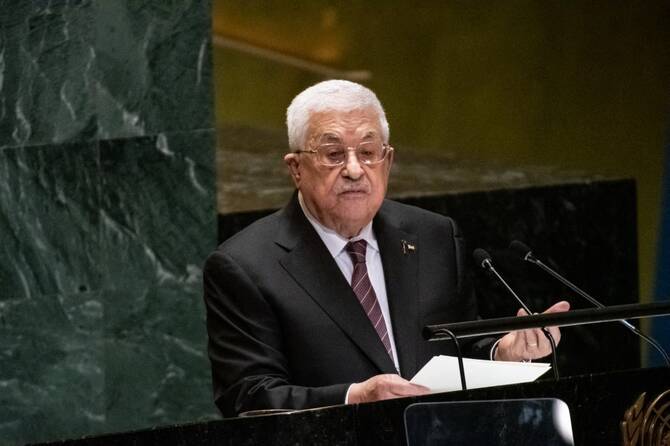
Mahmoud Abbas, President of the State of Palestine, speaks during the United Nations General Assembly. (File/AFP)
Short Url
Updated 18 November 2025
Follow

Palestine welcomes UN resolution as key step toward recognition of statehood

  • Palestinian officials urged the immediate implementation of the resolution, stressing the need to restore normal life in Gaza

DUBAI: The State of Palestine on Tuesday welcomed the UN Security Council’s adoption of a US-drafted resolution on Gaza, saying it reaffirms the Palestinian people’s right to self-determination and an independent state.

It described the resolution as an important step toward securing a permanent and comprehensive ceasefire and ensuring unimpeded humanitarian aid.

In a statement, Palestinian officials urged the immediate implementation of the resolution, stressing the need to restore normal life in Gaza, protect civilians, prevent displacement and secure the full withdrawal of Israeli forces.

They said the resolution must also support reconstruction efforts, safeguard the two-state solution and stop any attempt at annexation.

The State of Palestine expressed readiness to work with the US administration, Security Council members, Arab and Islamic countries, the European Union, the United Nations and all partners involved in the New York Declaration.

Officials said such cooperation is essential to ending the suffering of Palestinians in Gaza, the West Bank, and East Jerusalem, while advancing a political path toward a just and lasting peace based on international law and the two-state framework.

Reaffirming its commitment to national unity, the State of Palestine said it stands prepared to assume full responsibilities in the Gaza Strip as part of a unified Palestinian state.

The statement also conveyed appreciation to countries that have pledged support for efforts to end the occupation and achieve Palestinian freedom and independence, calling the resolution an important step toward regional and global peace and stability.


Iran open to compromises to reach nuclear deal with US, minister tells BBC

Updated 15 sec ago
Follow

Iran open to compromises to reach nuclear deal with US, minister tells BBC

  • A US delegation, including envoys Steve Witkoff and Jared Kushner, will meet with the ⁠Iranians on Tuesday morning
LONDON: Iran is ready to consider compromises to reach a nuclear deal with the United States ​if Washington is willing to discuss lifting sanctions, Iran’s Deputy Foreign Minister Majid Takht-Ravanchi told the BBC in an interview published on Sunday.
Iran has said it is prepared to discuss curbs on its nuclear program in return for the lifting of sanctions, but has repeatedly ruled out linking the issue to other questions including ‌missiles.
Takht-Ravanchi confirmed ‌that a second round of ​nuclear talks ‌would ⁠take place ​on ⁠Tuesday in Geneva, after Tehran and Washington resumed discussions in Oman earlier this month.
“(Initial talks went) more or less in a positive direction, but it is too early to judge,” Takht-Ravanchi told the BBC.
A US delegation, including envoys Steve Witkoff and Jared Kushner, will meet with the ⁠Iranians on Tuesday morning, a source ‌had told Reuters on Friday, ‌with Omani representatives mediating the US-Iran contacts.
Iran’s ​atomic chief said on ‌Monday the country could agree to dilute its most ‌highly enriched uranium in exchange for all financial sanctions being lifted. Takht-Ravanchi used this example in the BBC interview to highlight Iran’s flexibility.
The senior diplomat reiterated Tehran’s stance that ‌it would not accept zero uranium enrichment, which had been a key impediment to reaching ⁠a deal ⁠last year, with the US viewing enrichment inside Iran as a pathway to nuclear weapons.
Iran denies seeking such nuclear weapons.
During his first term in office, Trump pulled the US out of a 2015 Iran nuclear agreement, known as the Joint Comprehensive Plan of Action, the signature foreign policy achievement of former Democratic President Barack Obama.
The deal eased sanctions on Iran in exchange for Tehran limiting its nuclear program to ​prevent it from being ​able to make an atomic bomb.