KSrelief completes first phase of livestock project for vulnerable families in northwest Pakistan

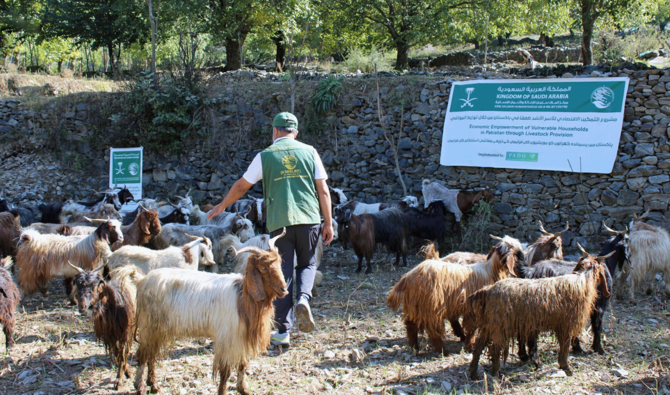
In this picture released by KS relief on November 18, 2025, a worker walks past a herd of goats in Pakistan northwestern province. (KS relief).
Short Url
Updated 18 November 2025
Follow

KSrelief completes first phase of livestock project for vulnerable families in northwest Pakistan

  • Saudi agency provides two vaccinated goats, four bags of silage and training to vulnerable families in four Khyber Pakhtunkhwa districts
  • KSrelief says is planning to implement phase two and three of same livestock project in KP’s Swat, Swabi, Haripur and Mansehra cities

ISLAMABAD: Saudi Arabia’s King Salman Humanitarian Aid and Relief Center (KSrelief) announced on Tuesday that it has completed the first phase of a livestock program it launched earlier to empower vulnerable families in Pakistan, saying the package has benefitted 1,000 households. 

KSrelief launched the program, titled: ‘Economic Empowerment of Vulnerable Households in Pakistan through Livestock Provision Project’ last month. The Saudi agency aims to reduce poverty and promote self-reliance among Pakistani families affected by economic hardship and natural disasters by providing livestock, poultry and practical training in animal care and small-scale income generation.

The first phase of the program was implemented by the Peach and Development Organization in collaboration with the Relief, Rehabilitation and Settlement Department (RRSD) of the provincial disaster management authority across four districts of the northwestern Khyber Pakhtunkhwa (KP) province. KSrelief said around 7,250 individuals benefited from the first phase. 

“Under this phase, 1,000 beneficiary households from Lower Chitral, Upper Chitral, Lower Dir and Upper Dir received a livelihood support package consisting of two vaccinated goats, four bags of silage and training provided by the Livestock Department to enable sustainable livestock-based income generation,” KSrelief said in a press release. 

KSrelief said it is planning the second and third phase of the project, which would focus on supporting vulnerable households in KP’s Swat, Swabi, Haripur and Mansehra cities. 

These households will be given 25 poultry birds per family, along with a complete poultry kit and training on poultry management and income generation. 

“Additionally, families in Charsadda, Mardan, and Nowshera will be assisted with cattle, silage and hands-on training in animal care and dairy production to strengthen their livelihood opportunities,” the Saudi agency added. 

KSrelief said its livestock project continues to promote self-reliance, improved nutrition and long-term economic stability among vulnerable communities in Pakistan. 

Saudi Arabia, through KSrelief, has been one of Pakistan’s largest humanitarian partners, contributing to flood recovery, health, education and livelihood programs across the country. The livestock project expands that cooperation by helping rural households in KP, a province frequently affected by floods and displacement, to rebuild economic stability and reduce dependence on aid.


Pakistan says $50 million meat export deal with Tajikistan nearing finalization

Updated 5 sec ago
Follow

Pakistan says $50 million meat export deal with Tajikistan nearing finalization

  • Islamabad expects to finalize agreement soon after Dushanbe signals demand for 100,000 tons
  • Pakistan is seeking to expand agricultural trade beyond rice, citrus and mango exports

ISLAMABAD: Tajikistan has expressed interest in importing 100,000 tons of Pakistani meat worth more than $50 million, with both governments expected to finalize a supply agreement soon, Pakistan’s food security ministry said on Tuesday.

Pakistan is trying to grow agriculture-based exports as it seeks regional markets for livestock and food commodities, while Tajikistan, a landlocked Central Asian state, has been expanding food imports to support domestic demand. Pakistan currently exports rice, citrus and mangoes to Dushanbe, though volumes remain small compared to national production, according to official figures.

The development came during a meeting in Islamabad between Pakistan’s Federal Minister for National Food Security and Research Rana Tanveer Hussain and Ambassador of Tajikistan Yusuf Sharifzoda, where agricultural trade, livestock supply and food-security cooperation were discussed.

“Tajikistan intends to purchase 100,000 tons of meat from Pakistan, an import valued at over USD 50 million,” the ambassador said, according to the ministry’s statement, assuring full facilitation and that Islamabad was prepared to meet the demand.

The statement said the two sides agreed to expand cooperation in meat and livestock, fresh fruit, vegetables, staple crops, agricultural research, pest management and standards compliance. Pakistan also proposed strengthening coordination on phytosanitary rules and establishing pest-free production zones to support long-term exports.

Pakistan and Tajikistan have long maintained political ties but bilateral food trade remains below potential: Pakistan produces 1.8 million tons of mangoes annually but exported just 0.7 metric tons to Tajikistan in 2024, while rice exports amounted to only 240 metric tons in 2022 out of national output of 9.3 million tons. Pakistan imports mainly ginned cotton from Tajikistan.