

Pakistan vow ‘maximum chances’ for young players as tri-nation series kicks off today

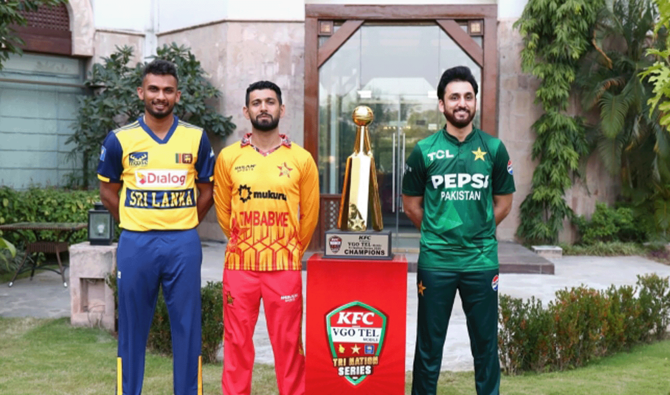
Pakistan's cricket team's captain, Salman Ali Agha (right) posing with the captain of Sri Lankan cricket team (left) and captain of Zimbabwe's cricket team (center) with the trophy ahead of the Tri-nations series in Rawalpindi, Pakistan, on November 17, 2025. (PCB/Facebook)
Short Url
Updated 18 November 2025
Follow

Pakistan vow ‘maximum chances’ for young players as tri-nation series kicks off today

  • Pakistan’s T20I squad includes young cricketers Abdul Samad, Usman Tariq, pacer Salman Mirza
  • Pakistan take on Zimbabwe in tri-nation series involving Sri Lanka in Rawalpindi today

ISLAMABAD: Pakistan’s T20I captain Salman Ali Agha has vowed to give “maximum chances” to young players as the Green Shirts brace for their opening clash against Zimbabwe today, Tuesday, as the tri-nation series with Sri Lanka kicks off. 

Pakistan have recently discovered fresh talent in the form of aggressive batter Abdul Samad, pacer Mohammad Salman Mirza and spinner Usman Tariq in recent months. The South Asian team has been on the lookout this year for aggressive players more suited to the modern standards of T20 cricket, typically aggressive batting.

The hosts will open the tri-nation series today in Rawalpindi by taking on Zimbabwe. Sri Lanka will look to improve their prospects in white-ball cricket after losing 3-0 to Pakistan in their recently concluded ODI series. 

“As far as the new players are concerned, we will make sure everyone gets an opportunity,” Agha told reporters at a press conference on Monday night. “But at the end of the day, whatever team you play, our first priority is always winning matches.

Agha said one cannot afford the luxury of taking any team “lightly” in the T20 format. 

“So our first priority will be winning matches and we will try to give people maximum chances,” he added. 

Agha noted that Samad was returning to the squad after four months, having last played against New Zealand. He said the team will try to give him the maximum number of chances in the tri-nation series. 

“Salman [Mirza] has also played only three to four matches. We will try to give him maximum chances as well,” he added. 

Pakistan head into the series with an impressive momentum, having won a tri-nation series in the UAE earlier this year involving Afghanistan and the UAE, and later reaching the final of the Asia Cup tournament. 

Pakistan also won the T20I series against South Africa 2-1. 

Squads:

Pakistan: Salman Ali Agha (captain), Abdul Samad, Abrar Ahmed, Babar Azam, Faheem Ashraf, Fakhar Zaman, Mohammad Nawaz, Mohammad Wasim Jr., Mohammad Salman Mirza, Naseem Shah, Sahibzada Farhan (wicketkeeper), Saim Ayub, Shaheen Shah Afridi, Usman Khan (wicketkeeper), Usman Tariq

Zimbabwe: Sikandar Raza (captain), Brian Bennett, Ryan Burl, Graeme Cremer, Bradley Evans, Clive Madande, Tinotenda Maposa, Wellington Masakadza, Tadiwanashe Marumani, Tony Munyonga, Tashinga Musekiwa, Dion Myers, Richard Ngarava, Newman Nyamhuri, Brendan Taylor


Pakistan says defense pact with Saudi Arabia elevated brotherly ties to ‘new heights’

Updated 25 February 2026
Follow

Pakistan says defense pact with Saudi Arabia elevated brotherly ties to ‘new heights’

  • Pakistan, Saudi Arabia signed strategic defense pact last year pledging aggression against one will be treated as attack on both
  • Deputy PM Ishaq Dar says enduring bonds with Islamic and Arab nations form vital pillar of Pakistan’s foreign policy 

ISLAMABAD: Deputy Prime Minister Ishaq Dar said on Wednesday that Pakistan’s defense pact with Saudi Arabia elevated its brotherly ties with the Kingdom to “new heights,” stressing that close ties with Arab and Islamic nations form a key pillar of Islamabad’s foreign policy. 

Pakistan and Saudi Arabia signed a Strategic Mutual Defense Agreement on Sept. 17 last year, pledging that aggression against one country would be treated as an attack on both, enhancing joint deterrence and formalizing decades of military and security cooperation.

Both nations agreed in October 2025 to launch an economic cooperation framework to strengthen trade and investment ties. 

“In the Middle East, our landmark Strategic Mutual Defense Agreement with Saudi Arabia has elevated our brotherly ties to new heights,” Dar said while speaking at the Pakistan Governance Forum 2026 event in Islamabad. 

The Pakistani deputy prime minister was speaking on the topic “Navigating International Relations Amidst Changing Geo-Politics.”

Dar noted that Pakistan has reinforced partnerships with other Middle Eastern nations such as the UAE, Qatar, Jordan, Oman, Egypt and Bahrain. He said these partnerships have yielded “concrete agreements” in investment, agriculture, infrastructure, and energy sectors. 

“Our enduring bonds with Islamic and Arab nations form a vital pillar of our foreign policy, and we will continue to expand our partnerships across Asia, Latin America, and Africa,” he said. 

Dar pointed out that the presidents of Kazakhstan, Uzbekistan and Kyrgyzstan have undertaken visits to Pakistan in recent months, reflecting Central Asian nations’ desire to boost cooperation with Islamabad.

On South Asia, the Pakistani deputy PM said Pakistan has successfully transformed its fraternal ties with Bangladesh into “a substantive partnership.”

“Similarly, the trilateral mechanism involving China, Pakistan, and Bangladesh has been launched with a view to expanding and deepening regional cooperation and synergy,” the Pakistani minister said. 

He said Islamabad has strengthened its “all-weather” partnership with China via the second phase of the multi-billion-dollar China-Pakistan Economic Corridor agreement and “unwavering support” from both sides for each other’s core interests. 

Dar said Pakistan had also reinvigorated its partnership with the US, advancing cooperation in trade, technology, investment, and regional stability. 

“This calibrated approach has enhanced our ability to navigate complexity with skill and confidence, ensuring that our national interests are served without compromising our core foreign policy principles,” he said.