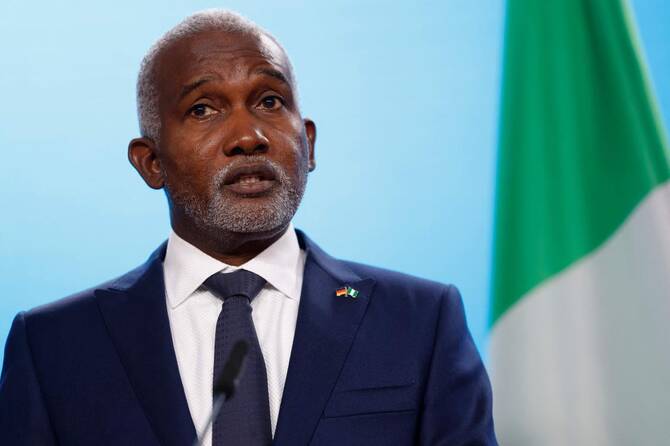

ABUJA: Nigeria is in talks with the United States following President Donald Trump’s threats of military intervention over the killing of Christians by jihadists in the country, Nigeria’s foreign minister told AFP on Monday.
Trump said late last month he was naming Nigeria a Country of Particular Concern (CPC) — a State Department designation for religious freedom violations — over the killing of Christians by “radical Islamists” before he issued a threat to strike.
“What we are discussing is how we can collaborate to tackle security challenges that are in the interest of the entire planet,” Foreign Minister Yusuf Tuggar said in an interview in the capital Abuja.
Trump at the start of November said he had asked the Pentagon to map out a possible plan of attack in Africa’s most populous nation because radical Islamists are “killing the Christians and killing them in very large numbers.”
Asked whether he thought Washington would send the military to strike, Tuggar said: “No, I do not think so.”
“Because we continue to talk, and as I said, the discussion has progressed. It’s moved on from that.”
Trump had said that Christianity was “facing an existential threat” in the west African nation.
The US leader warned that if Nigeria does not stem the killings, the United States will attack and “it will be fast, vicious, and sweet.”
Nigeria, home to 230 million inhabitants, is divided roughly equally between a predominantly Christian south and a Muslim-majority north.
It is the scene of numerous conflicts, including jihadist insurgencies, which kill both Christians and Muslims, often indiscriminately.
- ‘False narratives’ -
“We accept, we admit, we have security challenges due to factors, many of them beyond our control,” Tuggar said.
But the foreign minister also argued that the narrative about Christian killings in Nigeria was fed by “false narratives.”
“People have been misinformed. There’s a drive toward creating these false narratives in order to, I suppose, debilitate Nigeria,” he said.
The US House of Representatives Subcommittee on Africa will hold an open hearing on Thursday to examine Trump’s recent redesignation of Nigeria as a Country of Particular Concern.
“Our hope is that Nigeria will get a fair hearing when they’re having their public hearings, instead of just listening to one side,” said Tuggar.
He said Abuja had worked to tackle multiple security crises, including criminal gangs known locally as bandits.
“What exists is a government that has been fighting insurgency, that has been fighting terrorism in our region,” he added.
“Sometimes with a lot of success, sometimes we have setbacks due to exogenous factors, not due to something that we’re doing wrong.”
Tuggar said if the US or any other country wants to partner Nigeria to help with the security issues, “we more than welcome it.”
“But Nigeria and Nigerian security and Nigerian troops, Nigerian military, has to be the one to take the lead,” he added.
He said the diplomatic row with the US was “a slight bump in what has been a very long and illustrious, ...relationship.”
“We continue to work closely on several fronts. And it will continue to do so. We need each other now more than ever,” he said, speaking on the sidelines of the launch of a joint Nigeria-UNDP project aimed at strengthening democratic governance across West Africa.
When Trump suddenly brought up the fate of Christians in Nigeria, the country did not have an ambassador posted to the United States as President Bola Tinubu had recalled nearly all the country’s ambassadors in 2023 as part of an “efficiency” review and has yet to replace most of them.
But Tuggar said “we have competent hands, regardless of whether we have accredited ambassadors or not.”
Nigeria has faced a jihadist conflict in the northeast that has killed more than 40,000 people and displaced around two million since it broke out in 2009.
The violence has spilt over into neighboring Niger, Chad and Cameroon, prompting the creation of a regional military force to fight the jihadists.