Islamabad to host three-day global space conference drawing participants from 25 countries

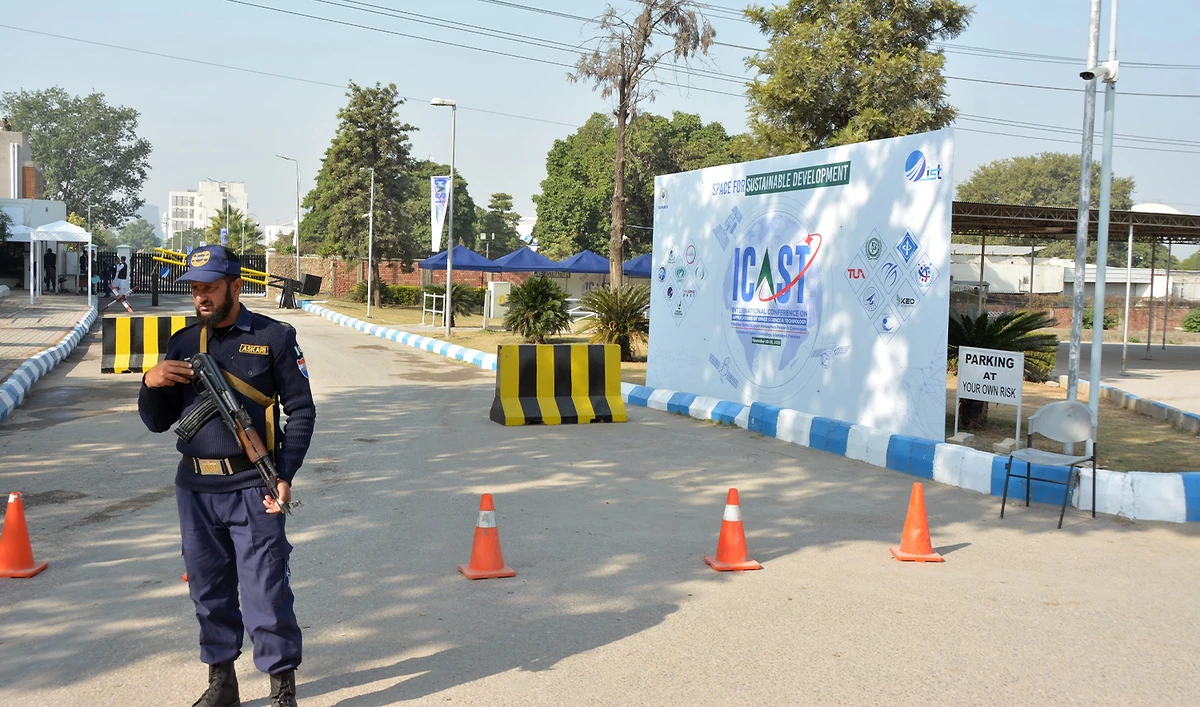
A security guard is standing near ICAST 2025 conference banner at Institutre of Space Technology in Islamabad, Pakistan, on November 17, 2025. (ICAST)
Short Url
Updated 17 November 2025
Follow

Islamabad to host three-day global space conference drawing participants from 25 countries

  • Three-day global ICAST-2025 conference to underscore growing role of space-based solutions in addressing global challenges
  • Conference to attract renowned scientists, researchers, astronauts, policymakers and officials of global space organizations 

ISLAMABAD: Pakistan will host a three-day international space conference featuring delegates from over 25 countries across Asia, Europe, Africa, North America and Oceania tomorrow, Tuesday, state-run media reported. 

The three-day International Conference on Applications of Space Science and Technology (ICAST-2025) will be held in Islamabad from Nov. 18-20. Organized jointly by the Pakistan Space and Upper Atmosphere Research Commission (SUPARCO) and the Institute of Space Technology (IST), the conference is being held under the theme ‘Space for Sustainable Development.’

According to state-run Associated Press of Pakistan (APP), the global conference will underscore the growing role of space-based solutions in addressing global challenges. 

“ICAST-2025 is expected to be one of the largest space-related gatherings in the region, drawing more than 2,000 participants, including over 70 international delegates from 25 countries across Asia, Europe, Africa, North America, and Oceania,” APP reported. 

The conference will be attended by senior officials from global space organizations, renowned scientists, researchers, astronauts, policymakers and industry experts, the state media said. 

Participants will engage in panel discussions, seminars, plenary sessions, masterclasses and a series of technical sessions covering emerging trends in satellite technologies, climate monitoring, geospatial intelligence, and AI-driven applications.

“A dedicated Technology Exhibition and a technical poster display will highlight cutting-edge innovations and ongoing research projects from across the world,” the report said. 

APP said the conference will also include a ‘Meet the Astronauts Forum’ featuring astronauts from Türkiye, Mongolia and the US. The astronauts will interact with students, share personal spaceflight experiences and inspire the youth to pursue careers in space science and exploration, the report added. 

The conference will also seek to strengthen Pakistan’s international collaborations, with Islamabad expected to sign several memorandums of understanding with institutions from Kazakhstan, Tunisia, Senegal, Bangladesh and Iraq, APP said. 

“These agreements aim to enhance joint research, capacity building, and knowledge sharing in the fields of space science and technology,” the state-run outlet said. 

The initiative highlights Pakistan’s efforts in bolstering its space program. Last month, the South Asian country launched its first Hyperspectral Satellite (HS-1) from China’s Jiuquan Satellite Launch Center. 

The satellite joined Pakistan’s growing remote-sensing fleet, including the PRSS-1 launched in 2018 and two Earth-observation satellites— EO-1 and KS-1— placed in orbit earlier this year. 

A Pakistani astronaut will also train at the Chinese space station and be part of upcoming short-duration spaceflight missions as a payload specialist, China announced last month. 

Pakistan launches final nationwide polio drive for 2025 amid rise in global cases

Updated 11 sec ago
Follow

Pakistan launches final nationwide polio drive for 2025 amid rise in global cases

  • Global polio tracking data shows Pakistan accounted for 30 of the world’s 39 cases in 2025, with remainder in Afghanistan
  • Health authorities urge parents to cooperate with vaccination teams and ensure all children under five receive polio drops

ISLAMABAD: Pakistan will launch its final nationwide polio vaccination campaign for 2025 from tomorrow, aiming to immunize more than 45 million children under the age of five, health authorities said on Sunday, as the country remains at the center of global efforts to eradicate the disease.

Global polio tracking data shows that 30 of the 39 confirmed wild poliovirus type 1 (WPV1) cases worldwide 2025 were reported in Pakistan, with the remainder in neighboring Afghanistan.

Pakistan recorded 74 polio cases in 2024, a sharp increase from six cases in 2023 and just one case in 2021, highlighting the volatility of eradication efforts in a country where misinformation, vaccine hesitancy and security issues have repeatedly disrupted progress.

“The final national polio campaign of 2025 will formally begin across the country from tomorrow,” Pakistan’s National Emergency Operations Center (NEOC) said in a statement.

“During the campaign, polio drops will be administered to more than 45 million children nationwide,” it said, adding that the seven-day drive would run from Dec. 15 to Dec. 21.

The NEOC said more than 400,000 male and female polio workers would take part in the campaign, with vaccination targets including over 23 million children in Punjab, 10.6 million in Sindh, 7.2 million in Khyber Pakhtunkhwa, 2.6 million in Balochistan and smaller numbers in Islamabad, Gilgit-Baltistan and Azad Jammu and Kashmir.

“Protecting children from polio is a shared national responsibility,” the NEOC said. “Parents must fully cooperate with polio workers to secure the future of the nation.”

It urged families to ensure that all children under five years of age receive the required two drops of the vaccine during the campaign.

Pakistan has drastically reduced polio prevalence since the 1990s, when annual cases exceeded 20,000.

By 2018, the number had fallen to eight. But health authorities warn that without consistent access to children — particularly in high-risk and underserved regions — eradication will remain out of reach.

Violence has also hampered the program. Polio teams and their security escorts have frequently come under attack from militants in parts of northwestern Khyber Pakhtunkhwa and southwestern Balochistan.

Officials say continued security threats, along with natural disasters such as recent flooding, remain major obstacles to reaching every child.