At Baku talks, Pakistan, China push Digital Silk Road as next phase of economic corridor 

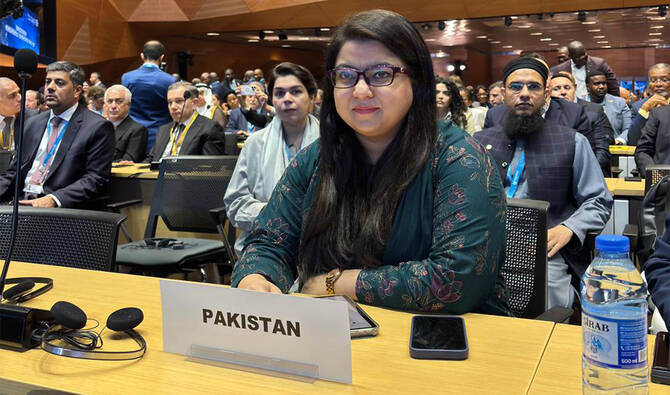
Pakistan IT Minister Shaza Fatima Khawaja is attending World Telecommunication Development Conference in Baku on November 17, 2025. (IT Ministry)
Short Url
Updated 17 November 2025
Follow

At Baku talks, Pakistan, China push Digital Silk Road as next phase of economic corridor 

  • Pakistan proposes new tech partnerships with China in 5G/6G, hardware manufacturing, ICT components, AI and cloud
  • Islamabad links digital cooperation to plans for industrial upgrading, skills development and regional data-transit role

ISLAMABAD: Pakistan has highlighted the Digital Silk Road as the next major phase of the China–Pakistan Economic Corridor (CPEC) while proposing new technology partnerships with Beijing, including joint ventures in 5G/6G, hardware manufacturing and ICT components, a statement from the Ministry of IT said on Monday. 

Launched in 2015, CPEC is a multibillion-dollar connectivity program linking western China to the Arabian Sea. The initiative has historically focused on energy projects, highways, power plants and the Gwadar port, with committed investments estimated at around $60 billion. As the two countries enter CPEC’s second phase, cooperation is expanding beyond physical infrastructure into technology, digital governance, manufacturing and skills development.

The Digital Silk Road — Beijing’s framework for cross-border connectivity in fiber, cloud services, data routing, smart manufacturing and emerging technologies — is increasingly positioned as the backbone of CPEC’s next stage. Pakistan says aligning with this digital track will help modernize local industry, deepen tech supply-chain integration with China and support its ambition to become a regional digital transit and services hub.

“[Pakistan IT Minister] Shaza Fatima Khawaja proposed joint ventures in 5G/6G, hardware manufacturing, and ICT components,” a statement from the IT ministry said after she met with Zhang Yunmeng, Vice Minister of China’s Ministry of Industry and Information Technology (MIIT), on the sidelines of the World Telecommunication Development Conference.

The ministry added that Pakistan had framed these proposals within its wider CPEC technology agenda:

“Khawaja highlighted the Pakistan–China Digital Silk Road as the next important phase of CPEC.”

As part of its digital cooperation agenda, Pakistan said it had asked China to partner on overcoming structural barriers that limit the ability of developing countries to enter global technology supply chains. According to the statement, Islamabad stressed the need for a joint initiative to help remove the “Systemic Diversity Barrier” in global tech sourcing, alongside cooperation in cybersecurity, AI and cloud computing through a bilateral talent exchange program. 

The ministry said the minister also proposed industrial digital upgrading under China’s “Intelligent Manufacturing” model to modernize local production and align Pakistan’s factories with emerging technologies.

Both sides discussed technical cooperation to make Pakistan a regional data transit hub through Pakistan–China fiber, and agreed to deepen their partnership in digital cooperation, the statement concluded. 



Pakistan sells Multan Sultans for record $8.7 million ahead of PSL 11th edition

Updated 09 February 2026
Follow

Pakistan sells Multan Sultans for record $8.7 million ahead of PSL 11th edition

  • New owner Walee Technologies plans to change franchise’s name to Rawalpindi
  • PCB chairman says ‘Multan Sultans still dear to my heart, will think of something’

ISLAMABAD: The Pakistan Cricket Board (PCB) on Monday sold Pakistan Super League (PSL) franchise Multan Sultans for a record Rs2.45 billion ($8.7 million), ahead of the 11th edition of the Twenty20 tournament.

The 11th edition of the tournament will kick off on March 26, the Pakistan Cricket Board (PCB) announced on Friday, which will feature eight franchises competing across multiple venues.

The previous owner of Multan Sultans, Ali Tareen, announced in Dec. he was walking away from the ownership of the franchise. The PCB said earlier said it will run the Multan Sultans team for the 11th edition before looking for a potential buyer.

Walee Technologies, which specializes in media, finance and technology, bought the rights for the franchise for $8.7 million at an auction held in Lahore, with local media reporting the new owner planned to change its name to Rawalpindi.

“I cannot ask the person paying Rs2.45bn to keep the name Multan Sultans,” Naqvi told reporters after the auction. “Multan Sultans is still dear to my heart, but we will think of something.”

Walee Technologies was among five bidders that participated in the auction, which came a month after Hyderabad and Sialkot joined the PSL 11th edition.

FKS, an aviation and health care conglomerate based in the US who also run the Chicago Kingsmen team, bought the Hyderabad franchise for a whopping Rs1.75 billion ($6.2 million). The other winner was OZ

Developers, a real estate consortium, which bought the Sialkot franchise for Rs1.85 billion ($6.55 million) at the auction.

The PSL has become a key pillar of the country’s cricket economy, providing financial stability to the PCB and serving as a talent pipeline for the national team.

The league, which features a mix of local and international players, already had six city-based teams, including Karachi Kings, Multan Sultans, Lahore Qalandars, Islamabad United, Peshawar Zalmi and Quetta Gladiators.