

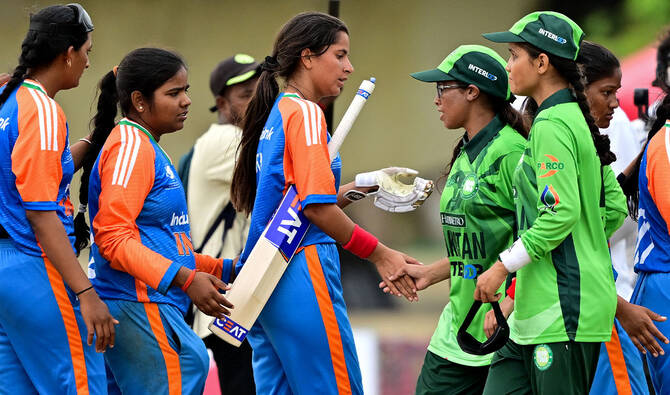
India and Pakistan blind women show spirit of cricket with handshakes

Pakistan's captain Nimra Rafique (3R) shakes hands with India's players at the end of the Women’s Blind Twenty20 World Cup 2025 match between India and Pakistan at the BOI Cricket Stadium in Katunayake on November 16, 2025. (AFP)
Short Url
Updated 16 November 2025
Follow

India and Pakistan blind women show spirit of cricket with handshakes

  • India's men refused to shake hands with Pakistani opponents at Asia Cup, with animosity spreading to women's sides at T20 World Cup
  • Tensions off and on the field have been high since a four-day military clash between nuclear-armed Pakistan and India in May this year

Katunayake: Blind women from India and Pakistan brushed aside political tensions on Sunday, shaking hands in neutral Sri Lanka at a cricket tournament for the visually impaired.

At what organisers describe as the world's first blind women's T20 tournament, players from the two South Asian neighbours showed they had sporting vision even if they lacked sight -- unlike their regular national teams.

Tensions off and on the field have been high since a deadly military clash between the nuclear-armed neighbours in May.

India's men refused to shake hands with their Pakistani opponents at the Asia Cup in September, since when neither side has shown signs of making up.

That animosity spread to the women's sides who declined any greeting at the recent T20 World Cup and also to Sunday's men's Rising Stars Asia Cup tie in Doha.

India's blind players were expected to mirror the conduct of their sighted teams when there was no handshake after the toss, but at the end of the match both sides warmly greeted each other.

The two sides, who travelled to the venue together in the same bus, not only shook hands but also exchanged generous compliments.

India won by eight wickets in just 10.2 overs after Pakistan were restricted to 135 for eight in their 20 overs at the Free Trade Zone grounds in Katunayake, 30 kilometres (18 miles) north of Colombo.

Pakistan skipper Nimra Rafique congratulated India on their comprehensive victory, while her Indian counterpart T. C. Deepika said Pakistan had played well.

The teams applauded one another loudly but neither set of players was permitted to talk to the press.

'BIGGEST OPPORTUNITY'

There were hardly any spectators but the match was shown live on Sri Lanka's national television, Rupavahini. Blind Sri Lankan officials hosting the tournament "watched" the match on YouTube by listening to the commentary.

Indian team manager Shika Shetty told AFP before the match that the tournament was opening up opportunities for more women.

"This is the first-ever World Cup for blind women... I think this is one of the biggest opportunities for our entire visually impaired girls," said Shetty, who is not blind.

"Maybe many girls with disabilities will come out from their villages. Maybe they will come for studies, maybe they will come for the sport. So it is helpful for other girls too."

Blind cricket relies on a sharp ear, as players must detect a white plastic ball -- the size of a tennis ball -- filled with ball bearings that rattle as it moves.

Pakistan coach Tahir Mehmood Butt, also speaking before the game, said the launch of women's blind cricket had created new opportunities for young players in Pakistan.

"For the totally blind, if they have good hearing, they can become good cricketers," Tahir told AFP.

Each team must field at least four completely blind players, three who can see up to two metres, and four partially sighted players able to see up to about six metres.

Totally blind batters may have a partially sighted runner. Bowling is underarm, unlike in the traditional game.

Four other nations - Australia, Nepal, Sri Lanka and the US -- are competing in the tournament which began in India and moved to Sri Lanka for the final stages. The final is scheduled for next Sunday in Colombo.


Sindh assembly passes resolution rejecting move to separate Karachi

Updated 21 February 2026
Follow

Sindh assembly passes resolution rejecting move to separate Karachi

  • Chief Minister Shah cites constitutional safeguards against altering provincial boundaries
  • Calls to separate Karachi intensified amid governance concerns after a mall fire last month

ISLAMABAD: The provincial assembly of Pakistan’s southern Sindh province on Saturday passed a resolution rejecting any move to separate Karachi, declaring its territorial integrity “non-negotiable” amid political calls to carve the city out as a separate administrative unit.

The resolution comes after fresh demands by the Muttahida Qaumi Movement (MQM) and other voices to grant Karachi provincial or federal status following governance challenges highlighted by the deadly Gul Plaza fire earlier this year that killed 80 people.

Karachi, Pakistan’s largest and most densely populated city, is the country’s main commercial hub and contributes a significant share to the national economy.

Chief Minister Syed Murad Ali Shah tabled the resolution in the assembly, condemning what he described as “divisive statements” about breaking up Sindh or detaching Karachi.

“The province that played a foundational role in the creation of Pakistan cannot allow the fragmentation of its own historic homeland,” Shah told lawmakers, adding that any attempt to divide Sindh or separate Karachi was contrary to the constitution and democratic norms.

Citing Article 239 of Pakistan’s 1973 Constitution, which requires the consent of not less than two-thirds of a provincial assembly to alter provincial boundaries, Shah said any such move could not proceed without the assembly’s approval.

“If any such move is attempted, it is this Assembly — by a two-thirds majority — that will decide,” he said.

The resolution reaffirmed that Karachi would “forever remain” an integral part of Sindh and directed the provincial government to forward the motion to the president, prime minister and parliamentary leadership for record.

Shah said the resolution was not aimed at anyone but referred to the shifting stance of MQM in the debate while warning that opposing the resolution would amount to supporting the division of Sindh.

The party has been a major political force in Karachi with a significant vote bank in the city and has frequently criticized Shah’s provincial administration over its governance of Pakistan’s largest metropolis.

Taha Ahmed Khan, a senior MQM leader, acknowledged that his party had “presented its demand openly on television channels with clear and logical arguments” to separate Karachi from Sindh.

“It is a purely constitutional debate,” he told Arab News by phone. “We are aware that the Pakistan Peoples Party, which rules the province, holds a two-thirds majority and that a new province cannot be created at this stage. But that does not mean new provinces can never be formed.”

Calls to alter Karachi’s status have periodically surfaced amid longstanding complaints over governance, infrastructure and administrative control in the megacity, though no formal proposal to redraw provincial boundaries has been introduced at the federal level.