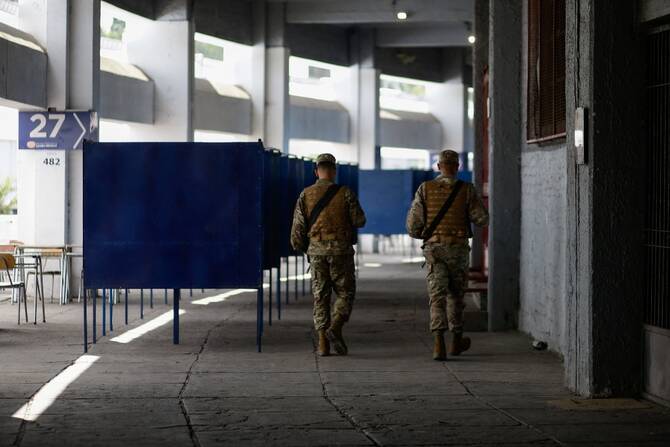
SANTIAGO: Polls opened in Chile, with over 15 million obliged to vote on Sunday for president and parliament. It’s a pivotal contest between a left-wing incumbent and hard-right challengers who have benefited from rising concern over organized crime and illegal immigration in one of Latin America’s safest nations.
The starkly opposed front-runners are Jeannette Jara, a lifelong member of Chile’s Communist Party who defeated center-left contenders to represent the governing coalition, and José Antonio Kast, a veteran ultraconservative politician who promises “drastic measures” to fight rising gang violence and deport undocumented immigrants.
Polls suggest that none of the eight candidates in Sunday’s ballot will secure the over 50 percent of votes needed to avoid a runoff on Dec. 14.
Left-wing President Gabriel Boric is constitutionally barred from seeking a second consecutive term.
It’s the first of what’s likely to be two rounds of presidential elections in the South American country, as polls show none of the candidates clearing the 50 percent threshold needed to avoid a runoff scheduled for Dec. 14.
On the surface, Sunday’s election offers Chileans a dramatic choice between two extremes: Jeannette Jara, 51, a card-carrying communist and former labor minister in the left-wing government, and, among other right-wing contenders, José Antonio Kast, 59, an ultraconservative lawyer and former lawmaker who opposes abortion and vows to shrink the state.
But with voters anxious about a rise in gang-driven crime that they blame on a recent surge of illegal immigration from crisis-stricken Venezuela, the campaign has steered the starkly opposed front-runners toward the shared theme of public insecurity.
Two extremes pursue the center
In a feat of political gymnastics, the communist candidate has promoted fiscal restraint and the Catholic father of nine has avoided talk of traditional family values.
Both say it’s a top priority to fight foreign gangs, like Venezuela’s Tren de Aragua, whose recent push into Chile has fueled kidnappings, extortion and sex trafficking and shattered the country’s self-perception as far safer and more stable than the rest of the region.
“They’re talking about things that all voters care about, they’re vying for the center,” said Rodolfo Disi, a political scientist at Chile’s Adolfo Ibáñez University.
Polling behind Jara and Kast in the eight-candidate field are Johannes Kaiser, 49, a radical libertarian congressman and YouTuber, and Evelyn Matthei, 72, a veteran center-right politician.
With the right-wing vote divided and President Gabriel Boric’s center-left coalition united behind its former minister, most experts see the charismatic Jara prevailing in Sunday’s first round. Boric is constitutionally barred from seeking a consecutive term.
But an initial win for Jara may yet spell her defeat in a runoff against a right-wing rival who promises a harsher security crackdown.
“If (Jara) moves toward being tougher on crime, the right can always be tougher,” said Disi. “It’s a losing game.”
Mandatory voting is a wildcard
This is the first time in Chile’s history that all eligible citizens will be obliged to vote for president.
The country recently reintroduced mandatory voting after ending the practice in 2012. Voter registration is now automatic, so the millions of people who never bothered to register, even when voting was compulsory, will be casting their first ballots in a presidential race. Those who fail to do so face fines up to $100.
Analysts are divided over the potential effects.
“It’s a huge question,” said Robert Funk, an associate professor of political science at the University of Chile. “We have 4 million new voters. Who are they? Are they young people who like Jara? Are they people from marginal neighborhoods attracted to Kast’s hard-line stance on crime?”
Chile will also renew the entire lower house of Congress and part of the Senate on Sunday.
The country has 15.7 million eligible voters, of whom over 800,000 are immigrants with residency of five years or more and are exempt from mandatory voting. Polls show that foreigners overwhelmingly favor the right — especially Venezuelans who fled their repressive socialist government.
But some immigrants have qualms this time about supporting a candidate who vows to round up and deport their compatriots.
“I would vote for Kast, but it hurts to hear speeches like that,” said Juan Pablo Sánchez, a delivery app worker who migrated from Venezuela six years ago. “I don’t know what to do.”
High unemployment, sluggish growth
On the economy, Jara talks of boosting investment in infrastructure and keeping a lid on public debt — hardly the talking points of a communist firebrand.
To address Chile’s cost-of-living crisis — which in 2019 helped fuel the country’s most significant social upheaval since the 1990 fall of Gen. Augusto Pinochet’s dictatorship — she proposes a “living” monthly income of $800 through subsidies and minimum wage hikes.
Taking a page from the playbook of President Javier Milei in neighboring Argentina, Kast vows to shrink the public payroll and slash corporate taxes in a bid to revive a stagnant economy that has slowed the pace of job creation as immigrants flood the labor market.
He says he’ll cut more than $6 billion in spending over 18 months — something his conservative rival Matthei, an economist by training, has called “totally and absolutely impossible.” She proposes a more gradual fiscal adjustment over four years.
Courting more radical voters disillusioned with Kast’s moderation, Kaiser promises to slash up to $15 billion in spending and lay off 200,000 state workers.
Competing for the harshest crackdown
All front-runners have taken an iron-fisted approach to illegal immigration. Chile’s foreign population has doubled since 2017, with 1.6 million immigrants recorded last year in the nation of 18 million. An estimated 330,000 are undocumented.
Kast wants to build a massive wall along Chile’s northern border and deport tens of thousands of people who entered illegally. Kaiser wants to hold undocumented migrants in detention camps and bar their children from attending school. Matthei wants to deploy drones and more armed forces to the border.
Jara, too, has sought to burnish her tough-on-crime credentials with promises to build new prisons and expel foreigners convicted of drug trafficking.
This law and order election stands in stark contrast to Chile’s last presidential poll in 2021, when voters outraged over widening inequality elected its youngest-ever president, a tattooed ex-student protest leader who promised sweeping social change.
But economic constraints and legislative opposition ultimately restricted Boric’s ambitions.
“I want a better country — not just for me, but for my children,” said Alatina Velázquez, 20, a student at a recent Kaiser rally who said she lost two of her friends to gang violence in the last two years.
“Right now, all that means is being able to leave class at night without looking over my shoulder.”


![]()

Polls open in Chile’s presidential vote pitting a communist against the far right
Short Url
https://arab.news/jm74n
Polls open in Chile’s presidential vote pitting a communist against the far right
- Polls suggest that none of the eight candidates in Sunday’s ballot will secure the over 50 percent of votes needed to avoid a runoff on Dec. 14


Latest updates


© 2026 SAUDI RESEARCH & PUBLISHING COMPANY, All Rights Reserved And subject to Terms of Use Agreement.