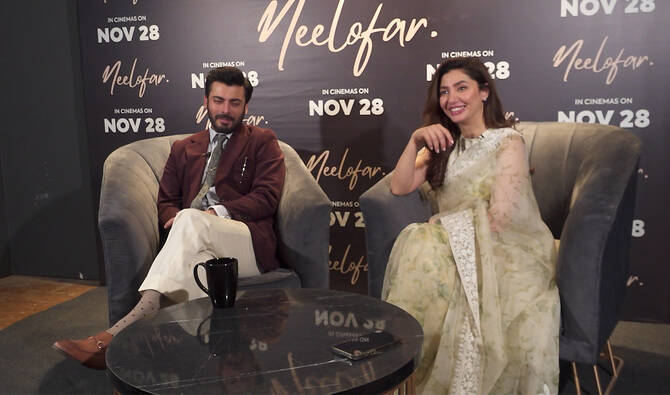

KARACHI: Pakistani heartthrob Fawad Khan is set to star alongside actress Mahira Khan in their long-awaited film ‘Neelofar,’ with the latter playing his muse in the movie that reunites the couple after three long years.
Khan and Mahira shot to fame after they starred in Pakistani drama ‘Humsafar’ in 2011. The two of them again shared the screen after over a decade in ‘The Legend of Maula Jatt’ in 2022.
The duo is anticipated to once again create magic with their on-screen chemistry in the romantic drama movie, Neelofar, which is set for worldwide release on November 28.
Khan and Mahira, who have been busy with the film’s promotions, this week spoke with Arab News on the sidelines of an event in Karachi, where they shared insights from Neelofar.
“It’s a story of a writer who’s hit a block and he keeps coming to Lahore and on one such visit, he bumps into the most unlikely muse,” said Khan, who plays the role of a writer.
“I’m telling you a little bit of the story, but what are the odds that he’s going to bump into a woman out of what relation or what coincidence would he bump into a woman who’s visually impaired. And then it turns into this unbelievable romance.”
During the conversation, Mahira opened up about her role as Neelofar, saying the visually impaired woman, who is curious about things at the same time, “wants to do everything.”
“There is a part of her that’s so brave, that’s so curious, like, I almost want to be Neelofar. I feel very attached to Neelofar,” she said.
So, yeah, that curiosity, you know, that I want to experience this and I want to experience that. And the people that she chooses is very interesting.”
In Humsafar, Khan recalled, he and Mahira were like two completely lost souls.
“[In ‘Neelofar’], it’s as if these two wandering souls are actually being brought together by fate because they know that they are meant for each other,” he said, describing the movie as “an ode to Lahore.”
Written and directed by debutant Ammar Rasool, Neelofar had been in the works for quite a few years. Besides Khan and Mahira, the cast includes Madiha Imam, Sarwat Gilani, Behroze Sabzwari, Atiqa Odho, Rashid Farooqi and Gohar Rasheed. Khan is also one of the producers of the film besides Hassaan Khalid and Usaf Shariq.
Earlier this year, Khan starred alongside Vaani Kapoor in Bollywood movie ‘Aabeer Gulaal,’ which was banned in India due to political tensions between Pakistan and India. Mahira, on the other hand, was last seen in the Pakistani film ‘Love Guru’ opposite Humayun Saeed.
But the duo, who have made it big on the small screen, are hardly seen in Pakistani dramas.
“I don’t want to do what I have done already,” Mahira remarked.
Khan’s relationship with the performing arts goes back to early 2000s, when he was the lead vocalist for the Pakistani rock band, Entity Paradigm, more popularly known as EP.
He is currently one of the judges on the second edition of a reality television singing competition, Pakistan Idol, but there has been some criticism by younger audiences about his credibility as a musician.
“Performance was a very big part of the earlier part of my career onstage but then it converted into performance on film. And now when we look at Pakistan Idol, we look at it from a complete perspective,” Khan said, when asked about this criticism.
“In a world where visual media is so important now and how music actually kind of gels with that, we are seeing things from that perspective. I don’t mind that criticism, it’s alright. It’s right at its place.”
But for Mahira, it has always been about taking on new challenges and Neelofar provided another such opportunity.
“Neelofar is a feeling,” she said. “This is something else. This is innocent.”