BOGOTA: Colombia’s human rights ombudswoman said Saturday that seven children were killed in a controversial airstrike against a rebel group in the country’s south earlier this week, as the administration of President Gustavo Petro steps up efforts to regain control of rural areas in Guaviare province.
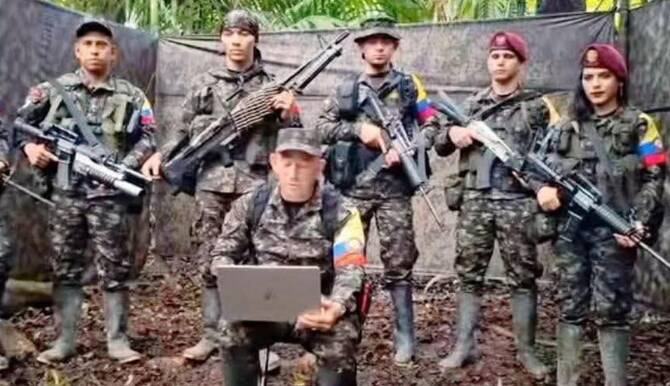
In a statement, ombudswoman Iris Marin said the minors killed in the strike against the FARC-EMC rebel group had been forcibly recruited and were being used as “human shields.”
Marin called on the Colombian government and rebel groups in the country to respect international humanitarian law. The public defender had initially said that six minors were killed in the strike, but updated the death toll following a statement from Colombia’s Forensic Medicine institute.
“No child or teenager who has been recruited should be affected by military operations,” Marin said. “The armed forces must adopt precautions to protect children who have been forced to take part in hostilities.”
Earlier this week, Colombian Defense Minister Pedro Sanchez blamed criminal groups for putting children in danger and told journalists that in his view, “whoever gets involved in hostilities loses protection, without distinction.”
The deaths of children in military strikes is a sensitive topic in Colombia, where a former defense minister resigned in 2019, after it was found that the government covered up t he deaths of eight children during an airstrike in the province of Caqueta.
According to Colombia’s military, at least 19 fighters were killed in the strike that took place on Tuesday in Guaviare, including the six minors.
Petro said Saturday that he had decided to order the airstrike because the column of rebel fighters was advancing toward a position from where they could ambush a smaller group of Colombian troops.
“The death of any person is regrettable, and especially that of minors,” Petro wrote on X. “I took a risk to save the lives” of soldiers.
Petro suspended airstrikes against criminal groups shortly after he came into office three years ago, in order to decrease the possibilities of killing minors. The left wing leader had accused previous governments of committing “war crimes” when it was found that minors died in airstrikes against rebel groups.
But airstrikes against Colombian rebels resumed last year, as the Petro administration struggles to contain the expansion of groups that are fighting to take over territory abandoned by the FARC, the guerrilla group that made peace with the Colombian government in 2016.
Petro is an outspoken critic of President Donald Trump’s strikes on suspected drug traffickers in the Caribbean, which he has described as “extrajudicial executions.”
On Friday he argued that his government’s airstrikes against rebels groups are different.
“Those who are falling in the bombardments of Colombian forces have machine guns, explosives, and have declared themselves members of an armed group,” Petro wrote on X. “They are trying to eliminate government forces and civilians with their lethal weapons.”

Colombian officials say 7 children were killed in an airstrike against a rebel group this week
https://arab.news/wxuet
Colombian officials say 7 children were killed in an airstrike against a rebel group this week
- Marin said the minors killed in the strike against the FARC-EMC rebel group had been forcibly recruited and were being used as “human shields”
- “No child or teenager who has been recruited should be affected by military operations”
At least 4 countries pull out of 2026 Eurovision contest as Israel’s participation sows discord
- The pullouts came after a general assembly of the European Broadcasting Union met to discuss concerns about Israel’s participation
- The feel-good pop music gala that draws more than 100 million viewers every year has been roiled by the war in Gaza for the past two years
GENEVA: Public broadcasters from at least four countries — including Spain and the Netherlands — on Thursday pulled out of next year’s Eurovision Song Contest after organizers decided to allow Israel to compete.
The developments expose how political discord has taken center stage over a usually joyful celebrating harmony through music.
The pullouts, which were joined by Ireland and Slovenia, came after a general assembly of the European Broadcasting Union — a group of public broadcasters from 56 countries that runs the event — met to discuss concerns about Israel’s participation, which some countries oppose over its conduct of the war in Gaza.
Earlier, EBUs members voted to adopt tougher voting rules in response to allegations that Israel manipulated the vote in favor of their contestants, but took no action to exclude any broadcaster from the competition.
The feel-good pop music gala that draws more than 100 million viewers every year has been roiled by the war in Gaza for the past two years.
A report on the website of Icelandic broadcaster RUV, meanwhile, said it would hold a meeting next Wednesday to discuss whether Iceland would take part, after its board last week recommended Israel be barred from the contest in Vienna next May.
The broadcasting union, in a statement emailed to The Associated Press, said it was aware that broadcasters from four countries — RTVE in Spain, AVROTROS in the Netherlands, RTE in Ireland, and Slovenia’s RTVSLO — had publicly said they would not take part.
“We await formal confirmation of their decision,” the union said. A final list of participating countries will be announced by Christmas.
Israeli President Isaac Herzog said on X that he was “pleased” Israel will again take part, “and I hope that the competition will remain one that champions culture, music, friendship between nations, and cross-border cultural understanding.”
“Thank you to all our friends who stood up for Israel’s right to continue to contribute and compete at Eurovision,” he added.
Austria, which is set to host the competition after Viennese singer JJ won this year with “Wasted Love,” supports Israel’s participation. Germany, too, was said to back Israel.
Dutch broadcaster AVROTROS said that the participation of Israel “is no longer compatible with the responsibility we bear as a public broadcaster.”
Spain’s state broadcaster RTVE echoed similar concerns: “We would like to express our serious doubts about the participation of Israeli broadcaster KAN in Eurovision 2026,” said Secretary General Alfonso Morales.
The EBU said the new rules would strengthen “transparency and trust” and allow all countries, including Israel, to participate.
“Eurovision is becoming a bit of a fractured event,” said Paul Jordan, an expert on the contest known as Dr. Eurovision. “The slogan is ‘United by Music’ ... unfortunately it’s disunited through politics.”
“It’s become quite a messy and toxic situation,” he said.
Divided over politics
The contest, whose 70th edition is scheduled for Vienna in May, pits acts from dozens of nations against one another for the continent’s musical crown.
It strives to put pop before politics, but has repeatedly been embroiled in world events. Russia was expelled in 2022 after its full-scale invasion of Ukraine.
The war in Gaza has been its biggest challenge, with pro-Palestinian protesters demonstrating against Israel outside the last two Eurovision contests in Basel, Switzerland, in May and Malmo, Sweden, in 2024.
Iceland, Ireland, the Netherlands, Slovenia and Spain had previously threatened to sit out the contest, if Israel was let in.
Opponents of Israel’s participation cite the war in Gaza, which has left more than 70,000 people dead, according to the territory’s Health Ministry, which operates under the Hamas-run government and whose detailed records are viewed as generally reliable by the international community.
Israel’s government has repeatedly defended its campaign as a response to the attack by Hamas-led militants that started the war on Oct. 7, 2023. The militants killed around 1,200 people — mostly civilians — in the attack and took 251 hostage.
A number of experts, including those commissioned by a UN body, have said that Israel’s offensive in Gaza amounts to genocide, a claim that Israel — home to many Holocaust survivors and their relatives — has vigorously denied.
Earlier, it wasn’t clear whether a decrease in violence in Gaza, where a US-brokered ceasefire is holding, or planned EBU plans to change voting processes would placate some broadcasters who opposed Israel’s participation.
A boycott by some European broadcasters could have implications for viewership and money at a time when many broadcasters are under financial pressure from government funding cuts and the advent of social media.
The pullouts include some big names in the Eurovision world. Spain is one of the “Big Five” large-market countries that contribute the most to the contest. Ireland has won seven times, a record it shares with Sweden.
The controversy over Israel’s 2026 participation also threatens to overshadow the return next year of three countries — Bulgaria, Moldova and Romania — after periods of absence because of financial and artistic reasons.


