VATICAN CITY: The Vatican on Saturday returned 62 artifacts to Indigenous peoples from Canada as part of the Catholic Church’s reckoning with its role in helping suppress Indigenous culture in the Americas.
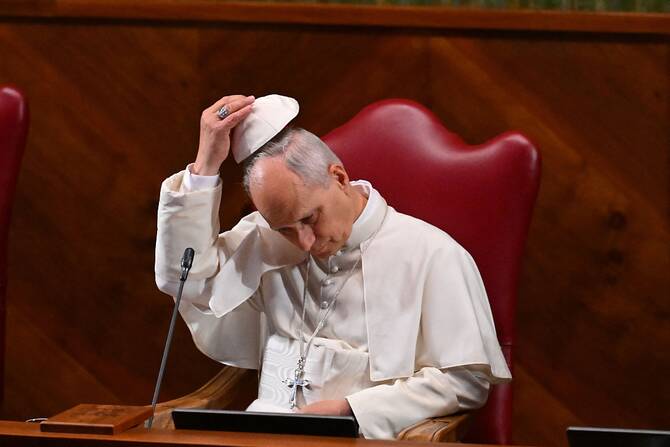
Pope Leo XIV gave the artifacts and supporting documentation to a delegation of the Canadian Conference of Catholic Bishops during an audience. According to a joint statement from the Vatican and Canadian church, the pieces were a gift and a “concrete sign of dialogue, respect and fraternity.”
The items are part of the Vatican Museum’s ethnographic collection, known as the Anima Mundi museum. The collection has been a source of controversy for the Vatican amid the broader museum debate over the restitution of cultural goods taken from Indigenous peoples during colonial periods.
Most of the items in the Vatican collection were sent to Rome by Catholic missionaries for a 1925 exhibition in the Vatican gardens that was a highlight of that year’s Holy Year.
The Vatican insists the items were “gifts” to Pope Pius XI, who wanted to celebrate the church’s global reach, its missionaries and the lives of the Indigenous peoples they evangelized.
But historians, Indigenous groups and experts have long questioned whether the items could really have been offered freely, given the power imbalances at play in Catholic missions at the time. In those years, Catholic religious orders were helping to enforce the Canadian government’s forced assimilation policy of eliminating Indigenous traditions, which Canada’s Truth and Reconciliation Commission has called “cultural genocide.”
Part of that policy included confiscating items used in Indigenous spiritual and traditional rituals, such as the 1885 potlatch ban that prohibited the integral First Nations ceremony. Those confiscated items ended up in museums in Canada, the US and Europe, as well as private collections.
Negotiations on returning the Vatican items accelerated after Pope Francis in 2022 met with Indigenous leaders who had traveled to the Vatican to receive his apology for the church’s role in running Canada’s disastrous residential schools. During their visit, they were shown some objects in the collection, including an Inuit kayak, wampum belts, war clubs and masks, and asked for them to be returned.
Francis later said he was in favor of returning the items and others in the Vatican collection on a case-by-case basis, saying: “In the case where you can return things, where it’s necessary to make a gesture, better to do it.”
The Vatican said Saturday the items were given back during the Holy Year, exactly 100 years after the 1925 exhibition where they were first exhibited in Rome.
“This is an act of ecclesial sharing, with which the Successor of Peter entrusts to the Church in Canada these artifacts, which bear witness to the history of the encounter between faith and the cultures of the Indigenous peoples,” said the joint statement from the Vatican and Canadian church.
It added that the Canadian Catholic hierarchy committed to ensuring that the artifacts are “properly safeguarded, respected and preserved.” Officials had previously said the Canadian bishops would receive the artifacts with the explicit understanding that the ultimate keepers will be the Indigenous communities themselves.

Pope returns 62 artifacts to Canada’s Indigenous peoples as part of reckoning with colonial past
Short Url
https://arab.news/76upz
Pope returns 62 artifacts to Canada’s Indigenous peoples as part of reckoning with colonial past
- According to a joint statement from the Vatican and Canadian church, the pieces were a gift and a “concrete sign of dialogue, respect and fraternity”
Chaos erupts at Indian airports as country’s largest airline cancels flights
NEW DELHI: Chaos gripped major Indian airports Friday as passengers of the country’s biggest airline, IndiGo, scrambled to cope up with widespread flight disruptions and cancelations triggered by newly enforced rules limiting working hours for crew and pilots.
Scenes of frustration played out as passengers slept on airport floors, queued for hours at customer service counters and waited without clear communication from the airline.
Friday was the fourth straight day of disruptions as the low cost carrier struggles with new regulations that mandate longer rest periods and limit night flying hours to address concerns about fatigue and safety.
The first phase of the rules came into effect in July while the second phase kicked in November. IndiGo struggled to adapt its rosters in time, resulting in widespread cancelations and disruptions.
On Thursday, more than 300 IndiGo flights were grounded while several hundreds delayed. A passenger advisory from the Delhi airport Friday stated that all domestic IndiGo flights will remain canceled until midnight. Other major airlines, including Air India, have not faced similar issues so far.
IndiGo operates around 2,300 flights daily and controls nearly 65 percent of India’s domestic aviation market.
Senior citizen Sajal Bose was scheduled to travel with his wife Senjuti Bose early Friday from Kolkata to New Delhi to attend a friend’s silver jubilee celebration. His flight was canceled an hour before the scheduled take off.
Bose told The Associated Press he was now taking a nine-hour train ride to the city Bagdogra, where he plans to get a flight to New Delhi on another airline. “Its very irresponsible and complete negligence. Very difficult for older people like us,” he said.
In an internal email to employees this week, seen by The Associated Press, IndiGo CEO Pieter Elbers apologized, and cited technology glitches, schedule changes, adverse weather conditions, heightened congestion and the implementation of the new rules as the reasons for flight disruptions.
The Civil Aviation Ministry said in a statement that the disruptions arose primarily through misjudgment and planning gaps as the airline implemented phase two of the new rules, and that the airline acknowledged that the effect on crew strength exceeded their expectations.
IndiGo has sought temporary exemptions in implementing the new rules and told the government that corrective measures were underway. It has indicated the operations will be fully restored by Feb. 10.
More cancelations are expected in the next couple of weeks, and the airline said it would reduce its flight operations from Dec. 8 to minimize disruptions.
Scenes of frustration played out as passengers slept on airport floors, queued for hours at customer service counters and waited without clear communication from the airline.
Friday was the fourth straight day of disruptions as the low cost carrier struggles with new regulations that mandate longer rest periods and limit night flying hours to address concerns about fatigue and safety.
The first phase of the rules came into effect in July while the second phase kicked in November. IndiGo struggled to adapt its rosters in time, resulting in widespread cancelations and disruptions.
On Thursday, more than 300 IndiGo flights were grounded while several hundreds delayed. A passenger advisory from the Delhi airport Friday stated that all domestic IndiGo flights will remain canceled until midnight. Other major airlines, including Air India, have not faced similar issues so far.
IndiGo operates around 2,300 flights daily and controls nearly 65 percent of India’s domestic aviation market.
Senior citizen Sajal Bose was scheduled to travel with his wife Senjuti Bose early Friday from Kolkata to New Delhi to attend a friend’s silver jubilee celebration. His flight was canceled an hour before the scheduled take off.
Bose told The Associated Press he was now taking a nine-hour train ride to the city Bagdogra, where he plans to get a flight to New Delhi on another airline. “Its very irresponsible and complete negligence. Very difficult for older people like us,” he said.
In an internal email to employees this week, seen by The Associated Press, IndiGo CEO Pieter Elbers apologized, and cited technology glitches, schedule changes, adverse weather conditions, heightened congestion and the implementation of the new rules as the reasons for flight disruptions.
The Civil Aviation Ministry said in a statement that the disruptions arose primarily through misjudgment and planning gaps as the airline implemented phase two of the new rules, and that the airline acknowledged that the effect on crew strength exceeded their expectations.
IndiGo has sought temporary exemptions in implementing the new rules and told the government that corrective measures were underway. It has indicated the operations will be fully restored by Feb. 10.
More cancelations are expected in the next couple of weeks, and the airline said it would reduce its flight operations from Dec. 8 to minimize disruptions.
© 2025 SAUDI RESEARCH & PUBLISHING COMPANY, All Rights Reserved And subject to Terms of Use Agreement.


