

WHO, Pakistan team up to protect 112 million children against violence

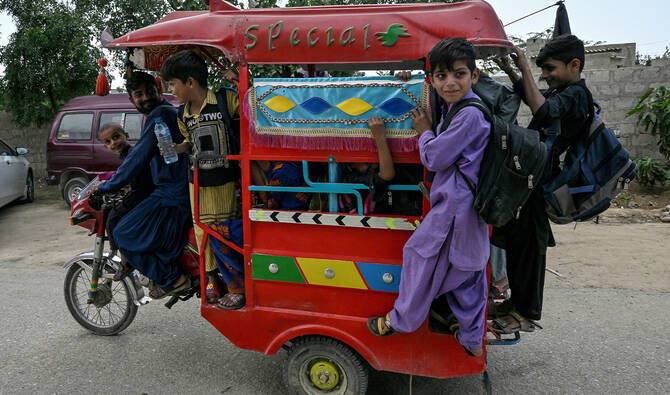
This photo taken on November 13, 2024 shows students travelling on a three-wheeler rickshaw after they left from a community school in Abdullah Goth village on the outskirts of Karachi. (AFP/File)
Short Url
Updated 15 November 2025
Follow

WHO, Pakistan team up to protect 112 million children against violence

  • In Pakistan, over 12.5 million kids are involved in child labor, while displaced children in poor urban settlements face high risks of exploitation
  • The proposed plan aims to reduce violence against children by addressing laws and norms, providing safe environment, caregiver support and stability

KARACHI: Pakistan’s Ministry of Human Rights and the World Health Organization (WHO) have initiated consultations to prepare a Strategic Action Plan on Violence Against Children with the vision of strengthening prevention and protecting 112 million children across the country, they said in a joint statement on Saturday.

In Pakistan, children experience multiple forms of violence – including violent killing, physical violence, sexual violence, psychological violence, and child neglect, according to the statement. 

The WHO-Pakistan consultations with relevant partners and experts began in Karachi and concluded in Islamabad on Friday, with participation from all provinces and self-governed areas.

The plan will be grounded in the principles of the Convention on the Rights of the Child and the INSPIRE framework, an evidence-based package developed by a group of 10 international agencies under the leadership of WHO.

“We recognize that fragmented efforts must now evolve into a cohesive, national, multi-sectoral strategy, one that mobilizes education, health, law enforcement, and community systems together. The National Strategy on Violence Against Children will provide that unified vision, with measurable targets, clear institutional responsibilities, and a robust monitoring and evaluation framework,” said Federal Secretary, Ministry of Human Rights, Abdul Khalique Shaikh.

In Pakistan, only 1 in 3 children under five is registered at birth, which creates further gaps in protection – and more than 12.5 million children are involved in child labor. Displaced children, migrant children, and those living in informal or poor urban settlements face disproportionately high risks of exploitation, early marriage, trafficking and child labor. 

INSPIRE includes seven strategies that have consistently reduced violence against children across many countries by addressing laws, norms, safe environments, caregiver support, financial stability, response services, and life skills.

“Violence against children is a concerning public health issue. This Strategic Action Plan is not just a document. It is the roadmap to protect our children and our grandchildren from a worldwide crisis. Violence is jeopardizing the lives and the future of millions of children ¬– and therefore our own future,” said WHO Representative in Pakistan, Dr. Luo Dapeng. “WHO stands with Pakistan to build together a country where every child is safe and able to thrive.”

Globally, each year, 1 billion children experience physical, sexual, or emotional violence, which can generate lifelong physical and mental health impacts. Every five minutes, a child dies from violence. These deaths are preventable.

“These consultations mark not an end, but the beginning of a coordinated effort to develop a strategic roadmap aligned with the fundamental rights guaranteed by the Constitution of Pakistan, the Sustainable Development Goals (SDGs), and

Pakistan’s international commitments under key UN human rights conventions,” said Dr. Muhammad Arif, director of international cooperation at the Pakistani Ministry of Human Rights.

“Strengthening and integrating existing legal and institutional frameworks is crucial to effectively prevent and respond to violence against children.”


UK announces ‘major reset’ of Pakistan development partnership with new trade, climate, education initiatives

Updated 10 December 2025
Follow

UK announces ‘major reset’ of Pakistan development partnership with new trade, climate, education initiatives

  • UK commits to increased investment-led cooperation in climate, business regulation and higher education
  • London shifts from aid donor to investment-focused partner as bilateral trade crosses $7.3 billion

ISLAMABAD: The United Kingdom on Wednesday unveiled what it called a “major reset” in its development partnership with Pakistan, announcing new investment-focused cooperation, education programs and a bilateral climate compact during a visit by UK Minister for Development Jennifer Chapman.

The trip marks the first federal-level development dialogue between the two governments in eight years and reflects London’s shift from a traditional aid-donor role toward investment-based partnerships. The British government said the new approach aims to use UK expertise to help partner economies build capacity and unlock domestic growth.

Pakistan-UK trade has also reached a record high, crossing £5.5 billion ($7.3 billion) for the first time, with more than 200 British firms now active in Pakistan, an increase London says signals growing two-way commercial confidence.

“Pakistan is a crucial partner for the UK. We work together to tackle the drivers behind organized crime and illegal migration, keeping both our countries safer,” Chapman was quoted as saying in a statement by the British High Commission in Islamabad. 

“Our strong bilateral trading relationship brings jobs and growth to us both. And we’re working together to tackle climate change, a global threat.”

The minister and Prime Minister Shehbaz Sharif on Tuesday jointly launched a package of business regulatory reforms aimed at improving Pakistan’s investment climate and making it easier for UK firms to operate. Officials said the initiative supports Pakistan’s economic recovery agenda and creates new commercial avenues for British companies.

A second key announcement was the next phase of the Pak-UK Education Gateway, developed with the British Council and Pakistan’s Higher Education Commission. The expanded program will enable joint research between universities in both countries, support climate- and technology-focused academic collaboration, and introduce a startup fund to help commercialize research. The Gateway will also promote UK university courses delivered inside Pakistan, giving students access to British degrees without traveling abroad.

Accompanied by Pakistan’s Minister for Climate Change Dr. Musadik Malik, Chapman also launched a Green Compact, a framework for climate cooperation, green investment, environmental protection and joint work at global climate forums.

The UK emphasized it remains one of Pakistan’s largest development partners, citing ongoing work in education, health, climate resilience and anti-trafficking capacity building. 

During the visit to Pakistan, Chapman will meet communities benefiting from UK-supported climate programs, which London says helped 2.5 million Pakistanis adapt to climate impacts in the past year, and observe training of airport officers working to prevent human trafficking.

“We remain firm friends of Pakistan, including in times of crisis, as shown through our floods response,” Chapman said. “And we know to accelerate growth in both our countries, we must work together in partnership to tackle the problems we face.”