

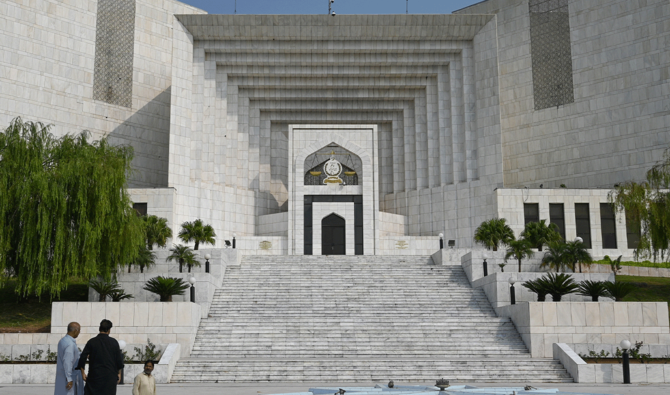

ISLAMABAD: Pakistan’s legal community is sharply divided over the creation of the Federal Constitutional Court (FCC) under the newly approved 27th Amendment, with some lawyers defending the development as parliament’s right to legislate, while others condemn it as an attack on judicial independence.
The 27th Amendment, passed by Parliament with a two-thirds majority earlier this week, represents one of the most sweeping changes to Pakistan’s constitutional and judicial framework in decades. It establishes the court as a separate institution responsible for interpreting the constitution and adjudicating matters involving fundamental rights, powers that had previously rested with the Supreme Court.
Two members of the country’s superior judiciary resigned in protest against the amendment hours after it was signed into law on Thursday, calling it a “grave assault” on the constitution.
“I believe that the Supreme Court was under a lot of pressure,” Syed Wajid Gilani, President of the Islamabad High Court Bar Association, told Arab News on Friday. “It had been in the pipeline for a long time that a Federal Constitutional Court should be formed here. People say that the constitutional court will impact their fundamental rights, but I don’t think that will happen.”
Another lawyer, Barrister Husnain Haider, maintained parliament’s decision to pass the amendment perfectly fell within its constitutional authority, adding that the amendment reflected the legislature’s intent to bring institutional balance between the judiciary and other government branches.
“It is purely the privilege of the legislature to amend the constitution ... and they have [come up with the] majority ... required under the constitution to make the amendment,” he said.
Haider added that judicial integrity depends on those who occupy the bench rather than on the institutional structure itself.
However, critics have called it an “executive capture” of the judiciary.
“This new court will not become a parallel structure, it will actually become a superstructure, and that is what is intended,” Abdul Moiz Jaferii, a senior lawyer, said.
He dismissed the government’s contention that the new court was meant to facilitate constitutional interpretation.
“It is basically the capture of the Supreme Court and the appointment of compliant and executive-minded judges in the place of independent ones,” he added.
Jaferii said the new arrangement posed a risk to judicial independence, as it may deter judges from challenging government actions.
“This will set back any judicial system but especially ours, where government actions are routinely and significantly challenged in courts on a daily basis,” he said.
Defending the amendment, however, several ministers argued during parliamentary debate it will strengthen governance and enhance judicial efficiency, rather than erode the independence of Pakistani courts.
Pakistan’s planning minster Ahsan Iqbal reiterated on Friday that a dedicated constitutional court has enjoyed “national consensus for nearly two decades,” adding it would “strengthen national cohesion” and allow the Supreme Court of
Pakistan to focus on everyday cases without being bogged down by complex constitutional matters.
Meanwhile, President Asif Ali Zardari accepted the resignations of Justices Athar Minallah and Mansoor Ali Shah resigned from their Supreme Court positions, saying the amendment had made “more distant, more fragile, and more vulnerable to power.”


