Pakistan, Saudi Arabia move to deepen defense ties under new security pact

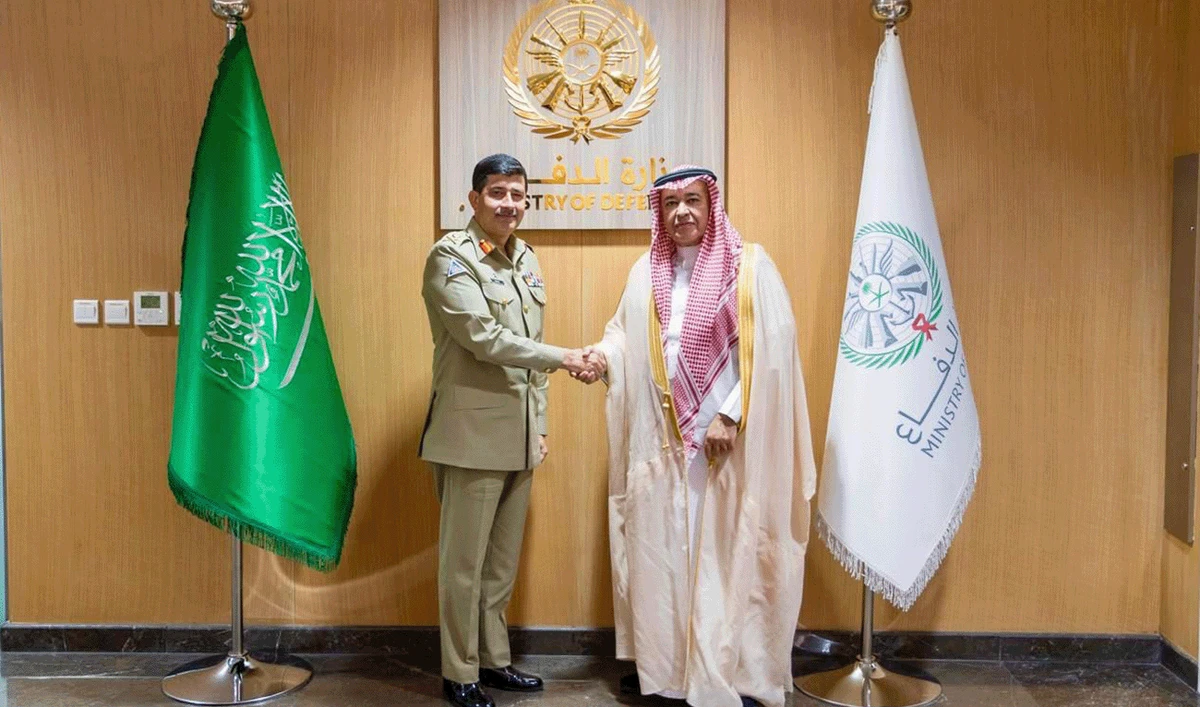
Pakistan’s Chief of General Staff Lt. Gen. Syed Aamer Raza (left), shaking hands with Saudi Arabia's Chief of General Staff, General Fayyadh Bin Hameed Al-Rowaily, in Riyadh, Saudi Arabia, in a picture shared by the media wing of Pakistan Army on November 14, 2025. (ISPR)
Short Url
Updated 14 November 2025
Follow

Pakistan, Saudi Arabia move to deepen defense ties under new security pact

  • Pakistan’s chief of general staff meets top Saudi military leaders in Riyadh
  • Both sides review defense projects and explore tech-focused joint ventures

KARACHI: Pakistan’s Chief of General Staff Lt. Gen. Syed Aamer Raza met Saudi Arabia’s top military leadership in Riyadh to discuss expanding defense cooperation under a strategic framework between the two countries, the Pakistan military said on Friday.

The meeting came nearly two months after Pakistan and Saudi Arabia signed a joint defense security pact, pledging that an attack on one country would be treated as an attack on both.

The Strategic Mutual Defense Agreement was signed in September and further solidified decades of Saudi-Pakistan security cooperation covering areas such as intelligence-sharing, counterterrorism and regional stability.

“Lt. Gen. Syed Aamer Raza, Chief of General Staff (CGS) Pakistan Army, called on General Fayyadh Bin Hameed Al-Rowaily, Chief of General Staff, Royal Saudi Armed Forces, at Riyadh,” the military’s media wing, Inter-Services Public Relations (ISPR), said in a statement.

“During the meeting, matters of mutual strategic interest were discussed, with a special focus on strengthening bilateral defense cooperation, enhancing interoperability and advancing collaboration under the Strategic Mutual Defense Agreement,” it added.

ISPR said both sides reaffirmed their commitment to further strengthen the longstanding relations contributing to regional stability and self-reliance.

A special session of the Pakistan-Saudi Bilateral Defense Industrial Forum was also held in Riyadh. The Pakistan tri-services delegation was led by Raza, while the Saudi side was headed by Assistant Minister of Defense for Executive Affairs Khalid Al Biyari.

“During the bilateral meet, both sides reviewed the progress of ongoing defense cooperation projects and discussed new avenues for joint ventures in emerging technologies in line with the Kingdom’s Vision 2030,” the statement said.

The Pakistani general reaffirmed his country’s support for the capacity-building of Saudi defense forces.

ISPR said Saudi officials also praised Pakistan’s “achievements and sacrifices in the fight against terrorism and vital contributions to regional peace and stability.”


Pakistan to sell excess gas in international markets from Jan.1— petroleum minister

Updated 4 sec ago
Follow

Pakistan to sell excess gas in international markets from Jan.1— petroleum minister

  • Pakistan was reportedly exploring ways to reduce $378 million in annual losses from supply glut caused by excess fuel imports 
  • Move to sell excess LNG in international markets will limit $3.56 billion losses caused since 2018-19, says petroleum minister

ISLAMABAD: Pakistan will sell its excess liquefied natural gas (LNG) in international markets from Jan. 1, Petroleum Minister Ali Pervaiz Malik said, revealing the move would limit losses caused from a years-long supply gut. 

Local and international media outlets had reported in July that Pakistan was exploring ways to sell excess LNG cargoes amid a gas supply glut that government officials said was costing domestic producers $378 million in annual losses. News reports had said Pakistan had at least three LNG cargoes in excess that it imported from Qatar and has no immediate use for.

Speaking to reporters during a press conference on Sunday, Malik said there was an excess of imported gas in Pakistan as the use of this fuel for power generation had reduced in the country during the past few months. He said Islamabad had been forced to sell the gas to local consumers, due to which the circular debt in the gas sector from 2018 till now had ballooned to around Rs1,000 billion [$3.56 billion]. 

“From Jan. 1 we will sell this excess fuel in international markets to reduce our burden and limit our losses of this Rs1,000 billion [$3.56 billion],” Malik said. 

He said this move would also allow Pakistan’s state-owned enterprises in the sector to operate on their full capacity and generate profits and employment. 

Malik also spoke of foreign oil companies that were ready to invest millions in the country in the near future. 

The minister cited the recent visit of Turkish energy minister to Pakistan which had resulted in the state-owned Turkish Petroleum signing deals to carry out onshore and offshore drilling activities in Pakistan. 

“Turkish Petroleum will also open its office in Islamabad, where 10 to 15 Turkish nationals will be working,” Malik said. 

He also said that a delegation of the State Oil Company of Azerbaijan Republic (SOCAR) visit Pakistan this week, adding that it was also expected to collaborate with local companies for oil and gas exploration.

The minister said SOCAR was also opening its office in Pakistan. 

“It will also invest millions of dollars in the construction of an oil pipeline from Machike to Thalian in collaboration with the PSO (Pakistan State Oil) and FWO (Frontier Works Organization),” Malik said.