

Pakistan, Saudi Arabia move to deepen defense ties under new security pact

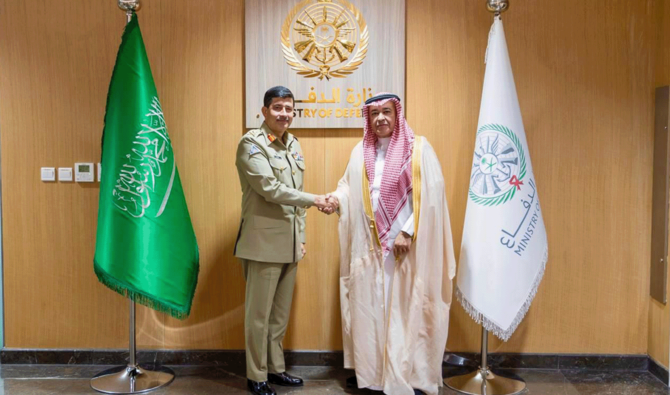
Pakistan’s Chief of General Staff Lt. Gen. Syed Aamer Raza (left), shaking hands with Saudi Arabia's Chief of General Staff, General Fayyadh Bin Hameed Al-Rowaily, in Riyadh, Saudi Arabia, in a picture shared by the media wing of Pakistan Army on November 14, 2025. (ISPR)
Short Url
Updated 14 November 2025
Follow

Pakistan, Saudi Arabia move to deepen defense ties under new security pact

  • Pakistan’s chief of general staff meets top Saudi military leaders in Riyadh
  • Both sides review defense projects and explore tech-focused joint ventures

KARACHI: Pakistan’s Chief of General Staff Lt. Gen. Syed Aamer Raza met Saudi Arabia’s top military leadership in Riyadh to discuss expanding defense cooperation under a strategic framework between the two countries, the Pakistan military said on Friday.

The meeting came nearly two months after Pakistan and Saudi Arabia signed a joint defense security pact, pledging that an attack on one country would be treated as an attack on both.

The Strategic Mutual Defense Agreement was signed in September and further solidified decades of Saudi-Pakistan security cooperation covering areas such as intelligence-sharing, counterterrorism and regional stability.

“Lt. Gen. Syed Aamer Raza, Chief of General Staff (CGS) Pakistan Army, called on General Fayyadh Bin Hameed Al-Rowaily, Chief of General Staff, Royal Saudi Armed Forces, at Riyadh,” the military’s media wing, Inter-Services Public Relations (ISPR), said in a statement.

“During the meeting, matters of mutual strategic interest were discussed, with a special focus on strengthening bilateral defense cooperation, enhancing interoperability and advancing collaboration under the Strategic Mutual Defense Agreement,” it added.

ISPR said both sides reaffirmed their commitment to further strengthen the longstanding relations contributing to regional stability and self-reliance.

A special session of the Pakistan-Saudi Bilateral Defense Industrial Forum was also held in Riyadh. The Pakistan tri-services delegation was led by Raza, while the Saudi side was headed by Assistant Minister of Defense for Executive Affairs Khalid Al Biyari.

“During the bilateral meet, both sides reviewed the progress of ongoing defense cooperation projects and discussed new avenues for joint ventures in emerging technologies in line with the Kingdom’s Vision 2030,” the statement said.

The Pakistani general reaffirmed his country’s support for the capacity-building of Saudi defense forces.

ISPR said Saudi officials also praised Pakistan’s “achievements and sacrifices in the fight against terrorism and vital contributions to regional peace and stability.”


Pakistan Customs seize ecstasy tablets worth $1 million in Karachi

Updated 5 sec ago
Follow

Pakistan Customs seize ecstasy tablets worth $1 million in Karachi

  • Pakistan Customs has initiated investigation to identify recipients, facilitators of smuggling attempt, says FBR
  • Ecstasy, also known as “party drug,” causes energizing effect, enhanced enjoyment of tactile experiences

ISLAMABAD: Pakistan Customs this week foiled a bid to smuggle more than 9,000 MDMA or ecstasy tablets into the country valued at Rs299.8 million [$1 million], the Federal Board of Revenue (FBR) said in a statement. 

According to the FBR, the narcotics were found concealed inside speakers and LED lamps in a parcel that arrived from Germany at the International Mail Office in the southern port city of Karachi. 

It said the shipment had been falsely declared as containing “clothes, socks and music boxes.”

“Officials of the Airport Cargo Control Unit (ACCU), Collectorate of Customs Airports Karachi, seized 9,455 MDMA (ecstasy) tablets valued at Rs299.791 million during a targeted inspection,” the FBR said on Friday. 

“Customs authorities have initiated further investigation to identify the recipients and facilitators of the smuggling attempt.”

Ecstasy/MDMA acts as both a stimulant and hallucinogen, producing an energizing effect, distortions in time and perception, and enhanced enjoyment of tactile experiences.

Adolescents and young adults use it around the world to reduce inhibitions and to promote euphoria, feelings of closeness, and empathy. 

Known as a “party drug,” ecstasy is consumed in both pill and powder form. 

Pakistan has stepped up efforts against clamping down on illegal drugs, with authorities frequently seizing large quantities of narcotics such as heroin, ecstacy, ice and hashish across the country. 

In November, Pakistan Navy seized narcotics worth Rs36 billion ($130 million) under a Saudi-led maritime task force. 

In October, another Pakistan Navy ship seized a record haul worth nearly Rs271 billion ($972 million), one of the largest drug seizures ever reported in the North Arabian Sea.