Tobacco conference to weigh up stubbing out cigarette butts

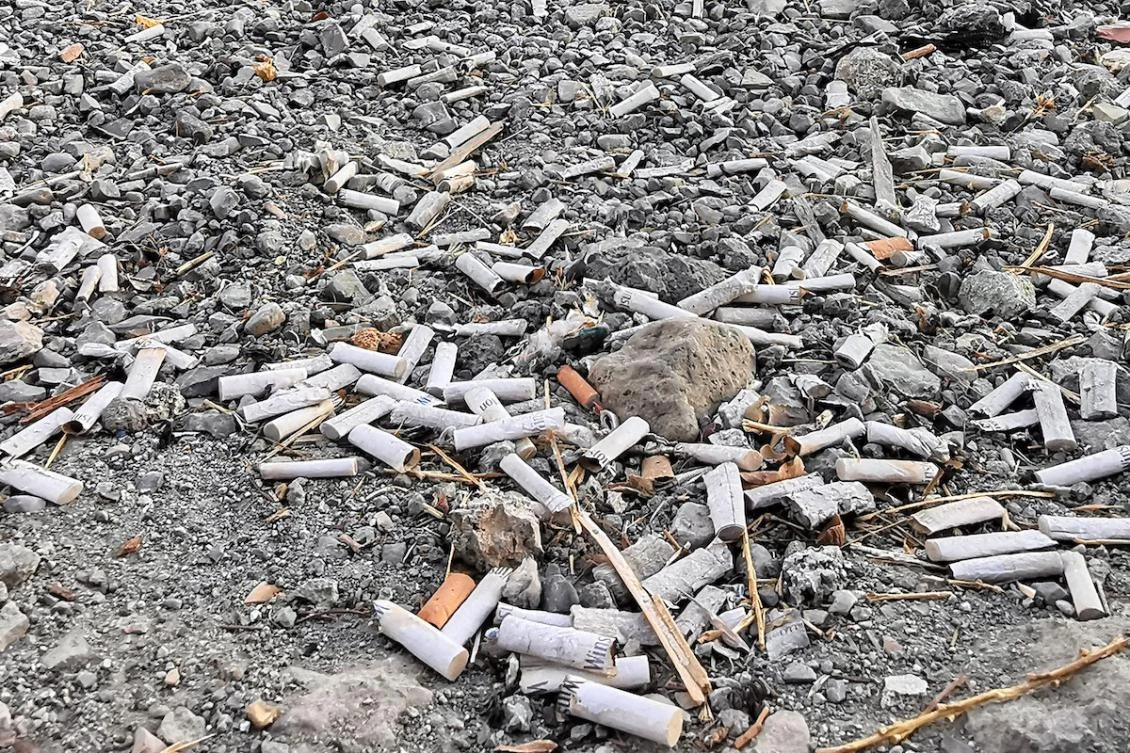
Discarded cigarette filters are pictured on the ground at Pardisan park in Tehran on September 13, 2025. (FILE/AFP)
Short Url
Updated 14 November 2025
Follow

Tobacco conference to weigh up stubbing out cigarette butts

  • Next week’s global conference on tobacco control will consider what to do about the sheer volume of cigarette butts trashing the planet

GENEVA: Next week’s global conference on tobacco control will consider what to do about the sheer volume of cigarette butts trashing the planet, with some recommending banning them completely.
“The best thing that we could see for the environment is getting rid of filters altogether,” Andrew Black, acting head of the secretariat of the World Health Organization Framework Convention on Tobacco Control (FCTC), said Thursday.
Plastic cigarette filters are the world’s most littered item, leaching toxic chemicals into the environment and breaking down into microplastics — while doing very little for the smoker, the secretariat said.
The 11th conference of the parties to the FCTC is being held in Geneva from November 17-22.
The WHO warned Wednesday that the tobacco industry was trying to infiltrate and undermine the conference.
- Litter and pollution -
Black said that, among other topics, the gathering would look at the environmental damage wrought by the tobacco industry and its products.
“An estimated 4.5 trillion cigarette butts are littered each year worldwide, making them the most common form of litter on the planet,” he told reporters.
“These discarded butts are toxic and a significant source of plastic pollution, due to their filters, which do not biodegrade.”
Furthermore, plastic filters “don’t provide any meaningful increase in the safety of cigarettes,” he said.
Rudiger Krech, the WHO’s environment and climate change chief, said it was “high time to ban those plastics... because they are the highest pollutants in waters” and are “contaminated also with toxicants,” he told a press conference.
Ultimately, it will be down to countries what measures they want to take.
To date, around 180 states have ratified the FCTC, which came into effect in 2005.
The landmark treaty brought in a package of tobacco control measures, including picture warnings on cigarette packets, smoke-free laws and increased taxes.
- Death toll -
The conference will take decisions that will set the trajectory of the global tobacco epidemic for future generations, said Black.
He said more than seven million deaths a year were down to tobacco — an “entirely preventable” body count.
Other major agenda items include the “aggressive marketing” of tobacco products, as well as widespread concerns about the numbers of children being lured in to a life of addiction via new means of getting kids hooked.
More than 100 million people are vaping, including at least 15 million teens aged 13 to 15, according to the WHO’s first global estimate of e-cigarette use.
WHO chief Tedros Adhanom Ghrebreyesus said: “Although e-cigarettes are often promoted as safer alternatives to conventional tobacco products, there is no evidence of their net benefit for public health — but mounting evidence of their harm.”
- Infiltration attempts -
Tedros claimed Wednesday that the tobacco industry was motivated by “one thing only: generating profit.”
“We are aware of attempts by the tobacco industry to infiltrate and undermine” next week’s conference, he told journalists.
Benn McGrady, head of the WHO’s public health law and policies unit, said the tobacco industry was “lobbying like crazy” and “trying to sow division.”
He said their new products were being marketed as consumer products of harm reduction, but in fact bore characteristics that are “specifically attractive to children,” such as bright colors and sweet flavours.
Highlighting the “alarming rise in use among children” of e-cigarettes, he said the industry was launching new products on social media — “spaces in which children and young people shape their identities.”
WHO wants comprehensive bans on tobacco advertising, promotion and sponsorship, including for e-cigarettes and nicotine pouches.

Trump’s new tariffs shift focus to balance of payments; economists see no crisis

Updated 2 sec ago
Follow

Trump’s new tariffs shift focus to balance of payments; economists see no crisis

President Donald Trump’s temporary 15 percent tariffs to replace those struck down by the US Supreme Court are meant to resolve a problem that many economists say ​does not exist: a US balance of payments crisis, making them potentially vulnerable to new legal challenges.
Hours after the high court on Friday struck down a huge swath of tariffs Trump had imposed under the International Emergency Economic Powers Act, the president announced the new duties under Section 122 of the Trade Act of 1974 — a never-used statute that even his own legal team dismissed as irrelevant months ago.
Collections of the new 15 percent tariffs began at midnight on Tuesday as IEEPA tariff collections of 10 percent to 50 percent halted.
The Section 122 law allows the president to impose duties of up to 15 percent for up to 150 days on any and all countries to address “large and serious” balance-of-payments deficits and “fundamental international payments problems.”
Trump’s tariff order argued that a serious balance of payments deficit existed in the form of a $1.2 trillion annual US goods trade ‌deficit and a current ‌account deficit of 4 percent of GDP and a reversal of the US primary income surplus.
Some ​economists, ‌including ⁠former International ​Monetary Fund ⁠First Deputy Managing Director Gita Gopinath, disagreed with the Trump administration’s alarm.
“We can all agree that the US is not facing a balance of payment crisis, which is when countries experience an exorbitant increase in international borrowing costs and lose access to financial markets,” Gopinath told Reuters.
Gopinath rejected the White House’s claim that a negative balance on the US primary income for the first time since 1960 was evidence of a large and serious balance of payment problem.
She attributed the negative balance to a large increase in foreign purchases of US equities and risky assets over the past decade, which outperformed foreign equities over this period.
Mark Sobel, a former US Treasury and IMF official, said that balance of payments crises are more associated with countries that have ⁠fixed exchange rates, and noted that the floating-rate dollar has been steady, the 10-year Treasury yield fairly ‌stable, with US stocks performing well.
Josh Lipsky, chair of international economics at the Atlantic Council ‌think tank, agreed, noting that a balance of payments crisis occurred when a country ​could not pay for what it was importing or was unable to ‌service foreign debt. That was fundamentally different from a trade deficit, he added.
Brad Setser, a currency and trade expert at the ‌Council on Foreign Relations who served as a senior adviser to the US Trade Representative in the Biden administration, took a somewhat contrarian view, arguing in lengthy X posts on Sunday that the Trump administration may have a reasonable case that there is a “large and serious” balance of payments deficit.
He noted that the current account deficit was far higher than when then-president Richard Nixon erected tariffs in 1971 to address a balance of payments crisis, and the US net international investment ‌position is much worse. This “gives the administration a real argument,” in favor of its tariffs, Setser wrote.
The White House, US Treasury and US Trade Representative did not immediately respond to requests for comment about ⁠the use of Section 122.

WRONG STATUTE ⁠FOR THE JOB
Despite the Trump administration’s new focus on balance of payments, the Justice Department had previously argued that Section 122 was the wrong statute to handle a national emergency over the trade deficit.
In court filings in its defense of IEEPA tariffs, the Justice Department said Section 122 would not have “any obvious application here, where the concerns the president identified in declaring an emergency arise from trade deficits, which are conceptually distinct from balance-of-payments deficits.”
Neal Katyal, who argued at the Supreme Court on behalf of plaintiffs challenging the IEEPA tariffs, told CNBC that the Trump administration’s stance against the use of Section 122 for a trade deficit will make those tariffs vulnerable to litigation.
“I’m not sure it will necessarily even need to get to the Supreme Court, but if the president adheres to this plan of using a statute that his own Justice Department has said he can’t use, yeah, I think that’s a pretty easy thing to litigate,” Katyal said.
It is unclear who might take the lead in challenging the Section 122 tariffs.
Sara Albrecht, chair of the Liberty Justice Center, a nonprofit, public-interest law firm representing several small businesses that challenged the IEEPA ​tariffs, said the group would closely monitor any new statutes ​being invoked.
Albrecht did not reveal any future litigation strategy, adding: “Our immediate focus is simple: making sure the refund process begins and that checks start flowing to the American businesses that paid those unconstitutional duties.”
In its ruling, the Supreme Court did not give instructions regarding refunds, instead remanding the case to a lower ​trade court to determine next steps.