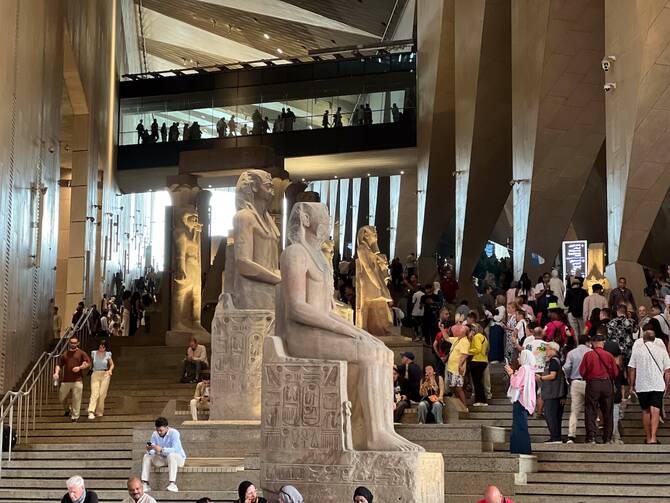

CAIRO: The Grand Egyptian Museum opened its doors to the public on Nov. 4, attracting around 18,000 visitors on its first day, underscoring widespread enthusiasm for Egypt’s newest cultural and archaeological landmark.
Fittingly, the museum opened on an historic date. Nov. 4, 1922 was the day that a team led by British Egyptologist Howard Carter made one of the most significant finds in archaeological history: the tomb of the pharaoh Tutankhamun — the only known near-intact royal burial site from ancient Eygpt, uncovered more than three millennia after its creation.
The exhibition space dedicated to Tutankhamun has garnered international headlines celebrating the first full showcase of the famed pharaoh’s belongings. Arab News toured that gallery, along with others dedicated to parts of a now-underwater city found off the coast of Alexandria, and to King Khufu’s solar barge — one of two grand vessels discovered in 1954 that may have been intended to carry the Khufu’s soul into the afterlife.

The exhibition space dedicated to Tutankhamun has garnered international headlines celebrating the first full showcase of the famed pharaoh’s belongings. (Supplied)
German interior design expert Shirin Frangoul-Brückner, managing director of Atelier Bruckner, which led the interior design of the flagship Tutankhamun exhibition, told Arab News: “The display method combines clarity, precision, and atmosphere. Every object is shown in its best light, literally and conceptually. Two design lines structure the exhibition: the Curatorial Path, a floor panel holding the objects, and the Path of the Sun, a dynamic light band along the ceiling.
“In ancient Egyptian mythology, the sun is a central symbol, it represents life, death, and rebirth. Together, these two lines connect the physical and the symbolic, guiding visitors through the monumental space,” she continued. “Light itself is the key element of the scenography. Through it, we reveal the fine details and extraordinary craftsmanship of these artifacts.”

Tutankhamun’s iconic golden mask. (Supplied)
The solar barge of King Khufu, who reigned during the 26th century B.C., is a fascinating draw. In 1951, the then-chief inspector of antiquities at Giza, Mohamed Zaki Nour, commissioned Antiquities Service architect Kamal Al-Mallakh to tidy up the south side of the Great Pyramid. In May 1954, upon removing the original enclosure wall of the pyramid complex, two sealed pits were uncovered, which contained solar barges, one of which has now been extensively restored for display in collaboration with a team from Japan, having previously been housed in the Giza Solar boat museum. The second boat is still undergoing restoration at the museum.
The GEM’s Tutankhamun gallery is home to more than 5,000 artifacts showcased together for the first time, just as Carter and his team would have discovered them 103 years ago. Its innovative design immerses visitors in the life of the pharaoh, who ruled the country for 10 years from around 1333 B.C., taking museum goers on a journey that brings each stage of his story to life.
“Our philosophy is ‘Form follows content.’ The narrative defines the space,” Frangoul-Brückner, said. “In the Tutankhamun Gallery, the objects themselves tell the story of the young king, his life, his death, and his journey into the afterlife.”

The reconstructed solar barge of King Khufu. (Supplied)
The display of Tutankhamun’s iconic golden mask awed visitors, helped in part by Atelier Bruckner’s design. “The golden mask alone is illuminated by 14 precisely positioned light spots, creating an almost invisible separation between the viewer and the glass,” Frangoul-Brückner explained.
One of the museum’s most moving exhibits is the display of the mummies of King Tutankhamun’s two daughters, discovered in an undecorated box — number 317 in Carter’s catalogue of the artifacts.
“Inside were two miniature coffins, each containing nested, gilded coffins that held tiny mummified bodies,” said Dr. Sahar Saleem, a radiologist and member of the Mummy Project and the Museum Display Scenario Committee at the Egyptian Ministry of Tourism and Antiquities. “For this unprecedented study, I invented the world's first specialized CT protocol for ancient mummified fetuses, allowing detailed analysis without damaging their fragile forms. The resulting images were heartbreakingly clear: two perfectly formed female fetuses, one at six months’ gestation and the other a full-term stillborn at nearly nine months.”

Dr. Sahar Selim and the daughters of Tutankhamen. (Supplied)
The scans revealed that these unborn daughters received the same royal mummification as their father — their organs ceremoniously removed and replaced with embalming packs. This meticulous care for two children who never drew breath paints an emotional picture of a young king ensuring his daughters could accompany him into the afterlife.
The scan also “proved — based on bone and dental development,” Saleem said, that Tutankhamun died at the age of 19, likely from complications caused by a broken leg exacerbated by an infection and possibly malaria.
“The scan revealed a mildly twisted left foot and attacks of malaria, while decisively debunking the theory (that the pharaoh was murdered); the hole in his skull was part of an elite mummification ritual, not a fatal blow as previously assumed,” she explained. “The scan also exposed the destruction of Howard Carter’s 1925 dissection to obtain the jewelry, which had left the king’s body severely disarticulated in seven parts.”
The largest archaeological museum in the world dedicated to a single civilization, GEM covers a total of 490,000 sq. meters, divided into 12 exhibition galleries. On the day of its opening, the museum’s management team also announced the launch of an audio-guide service, enabling guests to navigate the museum’s 57,000-plus artifacts with relative ease.