NIAGARA-ON-THE-LAKE, Ontario: Top diplomats from the Group of Seven industrialized democracies publicly showed their consensus on Ukraine and Sudan on Wednesday, but stayed away from contentious issues like the US military strikes on boats in the Caribbean and trade.
The foreign ministers of the G7 met with Ukraine’s foreign minister on Wednesday as Kyiv tries to fend off Russian aerial attacks that have brought rolling blackouts across the country. Andriy Sybiha said Ukraine needs the support of its partners to survive what will be a “very difficult, very tough winter.”
“We have to move forward to pressure Russia, to raise the price for the aggression, for Russia, for (Russian President Vladimir) Putin, to end this war,” Sybiha said.
The G7 ministers said in a joint statement at the conclusion of the two-day gathering that they are increasing the economic costs to Russia and exploring measures against those who finance Russia’s war efforts.
Canada announced more sanctions against Russia, including targeting those involved in the development and deployment of drones, and Britain, a day earlier, pledged money for Ukraine’s energy infrastructure.
US Secretary of State Marco Rubio made no immediate announcements about new US initiatives but said on social media that the meeting delved into ways “to strengthen Ukraine’s defense and find an end to this bloody conflict.”
“We are doing whatever is necessary to support Ukraine,” Canadian Foreign Minister Anita Anand said.
The meeting in Niagara-on-the-Lake, near the US border, followed US President Donald Trump’s decision to end trade talks with Canada after the Ontario provincial government ran an anti-tariff advertisement in the US, which upset him. That followed a spring of acrimony, since abated, over the president’s insistence that Canada should become the 51st US state.
Anand declined to talk about the trade dispute.
“I am here to talk about the work that the G7 ministers are doing,” she said. “And that is exactly what I think I should be discussing.”
Anand met with Rubio, but said she did not bring up trade talks, noting that a different minister leads the trade issue.
US military strikes also ‘didn’t come up’
The Trump administration says the US military has killed at least 75 people in 19 known strikes against what it says are drug-smuggling vessels in the Caribbean Sea and eastern Pacific Ocean since early September. The administration has been under pressure from Congress to provide more information about who is being targeted and the legal justification for the strikes.
Rubio told reporters that questions about the military campaign and intelligence sharing in support of the operations were not raised with him at all by any of his G7 or other counterparts on Wednesday.
“It didn’t come up once,” Rubio said. He also denied a report that Britain has stopped sharing intelligence.
“Again, nothing has changed or happened that is impeded in any way our ability to do what we’re doing. Nor are we asking anyone to help us with what we’re doing — in any realm. And that includes military,” Rubio said.
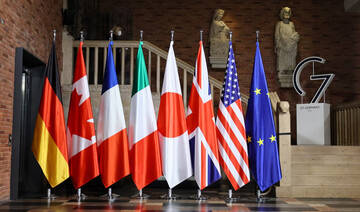
The G7 comprises Canada, the United States, Britain, France, Germany, Italy and Japan. Anand also invited the foreign ministers of Australia, Brazil, India, Saudi Arabia, Mexico, South Korea, South Africa and Ukraine to the meeting, which began Tuesday.


G7 diplomats publicly show support for Ukraine but avoid contentious issues like trade

https://arab.news/7jsfb
G7 diplomats publicly show support for Ukraine but avoid contentious issues like trade

- Ministers say they are economic costs to Russia and exploring measures against those who finance Russia’s war efforts on Ukraine
- Canada announced more sanctions against Russia, and Britain has pledged money for Ukraine’s energy infrastructure


Germany to order strike drones worth 536 million euros
BERLIN: The German government plans to order strike drones worth 536 million euros ($638 million) from German startups Helsing and Stark Defense, part of a rearmament push after Russia’s attack on Ukraine.
The contracts for loitering munitions — drones that hover over a potential strike area before flying into targets — are part of a larger framework deal worth 4.3 billion euros.
The contracts, outlined in documents seen by Reuters, are widely expected to be rubber-stamped by the lower house of parliament’s budget committee. They were first reported by Spiegel magazine.
The drones are initially intended to support Germany’s 45th Tank Brigade, which is deployed in Lithuania.
According to the documents, the contracts with the two companies are to have a term of seven years. The initial batch is scheduled to be delivered by early 2027.
($1 = 0.8399 euros)


