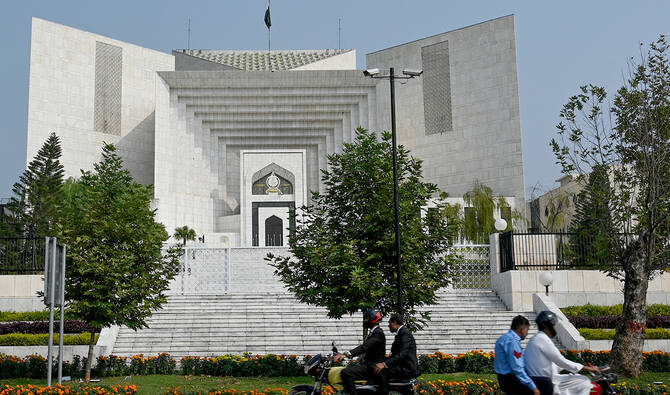

ISLAMABAD: Several former senior judges and prominent lawyers have written to Chief Justice Yahya Afridi warning that Pakistan’s proposed 27th constitutional amendment would “permanently denude” the Supreme Court of its constitutional authority, according to a letter seen by Arab News on Monday.
The amendment, which is currently being debated in parliament, introduces sweeping institutional changes to establish a new Federal Constitutional Court, alter procedures for judicial appointments and transfers, and restructure the command hierarchy of Pakistan’s armed forces by creating the post of Chief of Defense Forces and abolishing the office of Chairman of the Joint Chiefs of Staff Committee (CJCSC). The bill also proposes revisions to how federal tax revenue is shared with provinces under the National Finance Commission (NFC) award, a core element of Pakistan’s federal system.
Because these measures affect the Supreme Court’s role as the country’s highest constitutional authority, the proposal has become one of the most politically sensitive constitutional debates in years. Opposition lawmakers have also warned that the 27th amendment would undermine civilian oversight and provincial rights. Ruling party members have rejected this, arguing the changes clarify institutional roles and strengthen the federation.
“With deep sadness and with the deepest regret, this letter is being written by us not in normal times but in times that present the greatest threat to the Supreme Court of Pakistan since its establishment in 1956,” the signatories wrote in a letter to the chief justice, adding that the proposed amendment would be “the biggest and the most radical restructuring of the Federal Appellate Court structure since the enactment of the Government of India Act, 1935.”
“We say this without any fear of contradiction that no civilian or military government in Pakistan’s history has even tried, let alone succeeded, in relegating the Supreme Court of Pakistan as a sub-ordinate court and permanently denude it of its constitutional jurisdiction, as is being done through the proposed Constitution (Twenty-Seventh Amendment) Act, 2025,” the letter said.
The signatories requested Chief Justice Afridi to “call a Full Court Meeting immediately and without any delay” to deliberate on the amendment before parliament votes on it.
In its most severe warning, the letter says that if the request is refused, “we would at least expect you to accept and admit in a written response to us that you are now reconciled to be the last Chief Justice of Pakistan and now reconciled to accept the demise of the Supreme Court of Pakistan as the highest court in Pakistan.”
The letter was signed by former Senior Puisne Judge of the Supreme Court Justice (R) Mushir Alam, former senior judges, and multiple former presidents of the Supreme Court Bar Association, including Muneer A. Malik, Muhammad Akram Sheikh, Anwar Mansoor Khan, Ali Ahmad Kurd and Abid S. Zuberi.
Earlier on Monday, Information Minister Attaullah Tarar said the government had the votes required to pass the 27th constitutional amendment.
“God willing, we have the complete votes [to have the amendment passed],” Tarar told reporters at the Parliament House.
“There is no ambiguity in it. This is a positive constitutional amendment and has been made keeping in mind the best international practices in the world and our prevailing circumstances.”
Constitutional amendments in Pakistan require a two-thirds majority in both houses of parliament. Since its adoption in 1973, the constitution has been amended more than two dozen times, often reflecting shifts in authority between civilian governments, the judiciary and the military.
The current proposal follows the 26th constitutional amendment passed in October 2024, which gave parliament a formal role in appointing the chief justice and established a senior judges’ panel to hear constitutional cases, measures critics said weakened judicial independence.