

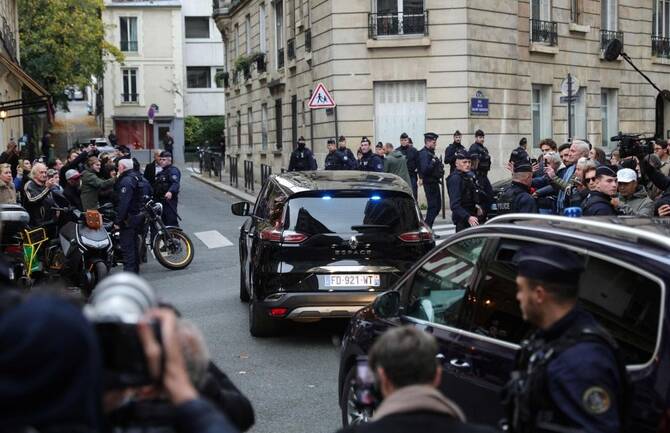


PARIS: France’s former president Nicolas Sarkozy vowed on Monday that the truth would win out after he was released from prison under judicial supervision ahead of an appeal trial over Libyan funding.
Sarkozy, 70, earlier Monday left La Sante prison in Paris — a 20-day experience the former president called a “nightmare,” after a judge ordered his release.
Sarkozy, who maintains his innocence, arrived home in a car with tinted windows, escorted by police motorcyclists.
“The truth will prevail,” he wrote on X shortly afterwards.
“I will now prepare for an appeal. My energy is focused solely on proving my innocence,” he added, thanking his supporters.
“Your thousands of messages moved me deeply and gave me the strength to endure this ordeal.”
A lower court in September found the right-wing politician — who was head of state from 2007 to 2012 — guilty of seeking to acquire funding from Muammar Qaddafi’s Libya for the campaign that saw him elected.
He was sentenced to five years behind bars.
He entered jail on October 21, becoming the first former head of a European Union state to be incarcerated, and his lawyers swiftly sought his release.
But the appeal case means that Sarkozy is now presumed innocent again.
During the examination of Sarkozy’s request in court earlier Monday, prosecutors had called for him to be freed ahead of the appeal trial set to start in March.
“Long live freedom,” one of Sarkozy’s sons, Louis, said on X.
Very hard
During the court hearing earlier Monday, Sarkozy, speaking via video call from jail, said his time in prison was tough.
“It’s hard, very hard, certainly for any prisoner. I would even say it’s gruelling,” he said.
He thanked the prison staff, whom he said “showed exceptional humanity and made this nightmare — because it is a nightmare — bearable.”
In the prison, the former president was separated from the general population, with two bodyguards occupying a neighboring cell to ensure his safety.
In the courtroom showing their support were his wife, the singer and model Carla Bruni-Sarkozy, and two of the former president’s sons.
Finally free
The lower court in late September ordered Sarkozy to go to jail, even if he appealed, due to the “exceptional gravity” of the conviction.
Under the terms of his release on Monday, the court banned Sarkozy from leaving France.
The former president was also prohibited from contacting former Libyan officials as well as senior French judicial officials including Justice Minister Gerald Darmanin.
Sarkozy last month received a visit from Darmanin, despite warnings from France’s top prosecutor Remy Heitz that it risked “undermining the independence of magistrates.”
Sarkozy, seen as a mentor to many conservative politicians, still enjoys considerable influence on the French right.
“The former president, presumed innocent, is finally free again,” Bruno Retailleau, head of the conservative Republicans, said on X, praising his “courage.”
Sarkozy is the first French leader to be incarcerated since Philippe Petain, the Nazi collaborationist head of state, who was jailed after World War II.
Sarkozy’s social media account last week posted a video of piles of letters, postcards and packages it said had been sent to him, some including a collage, a chocolate bar or a book.
Legal woes
Sarkozy has faced a flurry of legal woes since losing his re-election bid in 2012, and has already been convicted in two other cases.
In one, he served a sentence for graft — over seeking to secure favors from a judge — under house arrest while wearing an electronic ankle tag, which was removed after several months.
In another, France’s top court is later this month to rule over accusations of illegal campaign financing in 2012.
In the so-called “Libyan case,” prosecutors said his aides, acting in Sarkozy’s name, struck a deal with Qaddafi in 2005 to illegally fund his victorious presidential election bid.
Investigators believe that in return, Qaddafi was promised help to restore his international image after Tripoli was blamed for the 1988 bombing of a plane over Lockerbie, Scotland, and another over Niger in 1989, killing hundreds of passengers.
The court convicted Sarkozy of criminal conspiracy over the plan. But it did not conclude that he received or used the funds for his campaign.


