

Pakistan to move welfare payments to digital wallets by month-end — PM

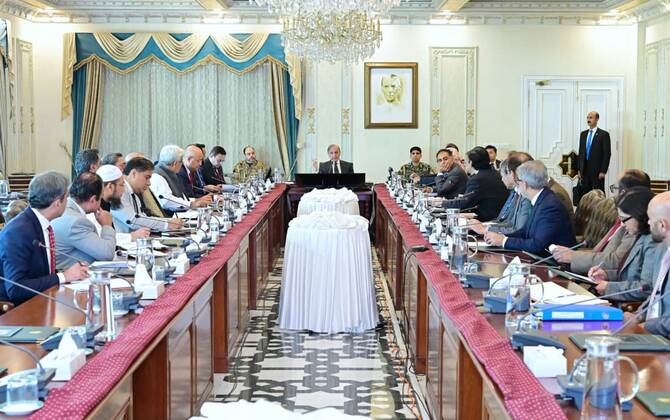
Pakistan Prime Minister Shehbaz Sharif speaks during a cabinet meeting in Islamabad on November 10, 2025. (Handout/PMO)
Short Url
Updated 10 November 2025
Follow

Pakistan to move welfare payments to digital wallets by month-end — PM

  • Pakistan launched 10 million digital wallets under flagship cash-transfer initiative for low-income households in August
  • A cashless economy will lead to improved governance and a significant reduction in corruption, says Shehbaz Sharif

ISLAMABAD: Pakistan’s government will activate digital wallets by the end of this month through which millions of beneficiaries will receive social protection payments, the Prime Minister’s Office (PMO) said in a statement on Monday as Islamabad accelerates its efforts to move toward a cashless economy.

Sharif launched 10 million digital wallets under the Benazir Income Support Programme (BISP), Pakistan’s flagship cash-transfer initiative for low-income households, in August. The Pakistani prime minister had termed the move as a “historic milestone” in the country’s journey toward transparency, financial inclusion and adopting a cashless economy.

Pakistan, which is a cash-dominated market especially considering the informal sector, has undertaken efforts in recent months to promote digital transactions. Officials have said promoting a cashless economy will promote accountability, curb corruption and prevent tax evasion.

Sharif chaired a review meeting of the government’s measures to promote cashless economy on Monday during which he was briefed on the status of the 10 million BISP digital wallets.

“[Participants] of the meeting were informed that these wallets will become fully functional by the end of this month, and the next tranche of payments to beneficiaries will be made through them,” the PMO said in a statement.

The prime minister was also informed that payment of electricity and gas bills are being made cashless through QR codes issued by instant digital payment platform Raast. The move would enable payment of bills worth billions of rupees digitally, the PMO said.

Sharif was briefed that the mobile application for obtaining government services in Islamabad has been linked with Raast to enable payments through it. The PMO added that issuing new business licenses in Islamabad has been made conditional on adopting digital payment systems, while all existing shops have been enabled to accept payments via Raast QR codes.

Sharif called for promoting awareness of the importance of a cashless economy in rural areas to fully eliminate informal economy.

“The entire world is rapidly moving toward a digital economy, and Pakistan must keep pace with global developments,” the prime minister said according to the PMO. “A cashless economy will lead to improved governance and a significant reduction in corruption.”


IAEA approves safeguards for Pakistan’s Chashma nuclear power plant unit — FO

Updated 6 sec ago
Follow

IAEA approves safeguards for Pakistan’s Chashma nuclear power plant unit — FO

  • Move reflects world’s confidence in Pakistan’s commitment to peaceful use of nuclear energy, non-proliferation, says FO
  • Says after completion, power plant’s unit will provide substantial source of low-carbon electricity to the national grid

ISLAMABAD: Pakistan’s foreign office said on Wednesday that the International Atomic Energy Agency’s (IAEA) board of governors has approved a safeguards agreement with Islamabad for a unit of its Chashma nuclear power plant, reflecting the world’s growing confidence in the South Asian country’s commitment to peaceful use of nuclear energy. 

Under a safeguards agreement, the IAEA has the right and obligation to ensure that safeguards are applied on all nuclear material in the territory, jurisdiction or control of a state to verify that such material is not diverted to nuclear weapons or other nuclear explosive devices.

The agreement pertains to Unit 5 of the Chashma nuclear power plant located in Pakistan’s eastern Punjab province. The plant will have a gross capacity to generate 1,200 megawatts, with its pressurized water reactor expected to become operational by 2030, the foreign office said. 

“This important development reflects the international community’s continued confidence in Pakistan’s commitment to the peaceful use of nuclear energy and its adherence to global non-proliferation and safeguards obligations,” the statement said. 

It said after completion, the plant’s Unit 5 will provide a substantial source of low-carbon electricity to Pakistan’s national grid, contributing to energy security, climate goals and sustainable economic growth.

Over the past year, nuclear power accounted for 18.3 percent of Pakistan’s national electricity mix and 34 percent of the country’s total low-carbon electricity generation. 

Pakistan currently operates six nuclear power plants with a combined installed capacity of 3,530 megawatts, the foreign office said. 

“With more than 100 reactor-years of operational experience, Pakistan maintains a strong record of safe, secure and fully safeguarded nuclear power operations in line with international standards,” the statement included. 

Despite contributing less than one percent to greenhouse gas emissions worldwide, Pakistan is ranked among the world’s most vulnerable nations to climate change effects. 

Torrential rains and floods in 2022 and 2025 wreaked havoc across the country, killing thousands and inflicting damages of billions of dollars on the country.