Pakistan parliamentary committees review 27th constitutional amendment after cabinet’s approval

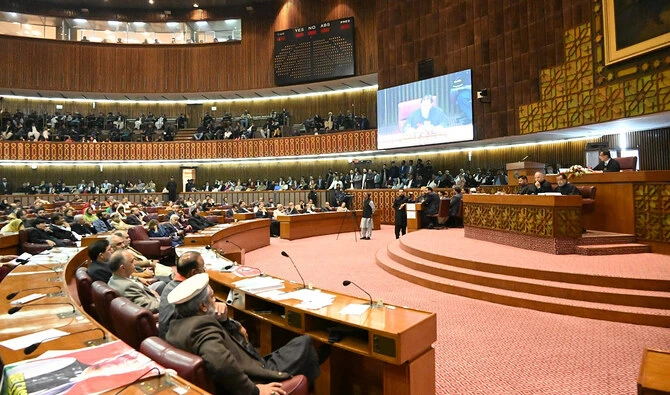
In this handout photo, taken and released by the Government of Pakistan, members of Pakistan’s lower house of parliament attend the National Assembly meeting in Islamabad on March 1, 2024. (Photo courtesy: X/@NAofPakistan/File)
Short Url
Updated 09 November 2025
Follow

Pakistan parliamentary committees review 27th constitutional amendment after cabinet’s approval

  • The amendment proposes new constitutional court, revising distribution of federal revenue, judicial and military appointments
  • A multi-party opposition alliance on Saturday announced a nationwide protest campaign against the proposed constitutional changes

ISLAMABAD: Pakistan’s Senate and National Assembly committees on law and justice on Sunday met in Islamabad to discuss the proposed 27th constitutional amendment, a day after its approval from the federal cabinet.

The amendment proposes creating a new constitutional court, restoring executive magistrates, revising the distribution of federal revenue among provinces under the National Finance Commission (NFC) and making changes to how senior judges and military leadership appointments are structured within the constitution.

The bill proposes that the transfer of judges be handled by the Judicial Commission of Pakistan, titles given to national heroes should remain with them for lifetime, and provincial cabinet threshold of 11 percent be increased to 13 percent for smaller provinces like Khyber Pakhtunkhwa and Balochistan.

The draft amendment, which has been opposed by an alliance of opposition parties, was referred to the Senate standing committee on law and justice for a review after Law Minister Azam Nazeer Tarar tabled in the upper house of parliament on Saturday.

"The remaining proposals, on which debate was not held, there will be a meeting on them," Farooq H. Naek, who heads the Senate panel, told reporters ahead of the meeting.

He said the joint parliamentary panel would review changes to clauses relating to the transfer of judges, immunity of president and command of the armed forces.

"An opinion will be sought on all clauses and after that, this will be finalized... Definitely, we have complete hope that we will complete it today," Naek added.

In Pakistan, constitutional amendments have historically been used to reshape the balance of power between the legislature, judiciary and provinces.

The proposed 27th amendment follows the 26th amendment passed in October 2024, which gave parliament a role in appointing the chief justice and created a new panel of senior judges to hear constitutional cases, measures critics said weakened judicial independence.

Pakistan’s constitution, adopted in 1973, has been amended more than two dozen times, often reflecting shifts in authority among civilian governments and the military. Provisions governing the NFC award are among the most politically sensitive because they underpin the country’s federal structure and provincial autonomy.

On Saturday, the Tehreek-e-Tahaffuz-e-Ayeen-e-Pakistan (TTAP), a multi-party opposition alliance, announced a nationwide protest campaign against the proposed amendment.

"The constitution is being tampered with. Our own parliament is attacking the constitution, so we have no other option, we will go to the people," Mahmood Khan Achakzai, a senior member of the opposition alliance, said in a post on X.

The Pakistan Tehreek-e-Insaf (PTI), the main opposition party led by jailed former prime minister Imran Khan, said the amendment would harm democracy, judicial independence and civilian supremacy in the country.

"The new constitutional draft contained not a single amendment in the public interest; rather, it is entirely person-specific and self-serving, aimed at centralizing power and empowering the elite," PTI's Central Information Secretary Sheikh Waqas Akram said in a sharply worded statement.

"Pakistan must put an end to the culture of arbitrary extensions and raising retirement ages."

But State Minister for Law Aqeel Malik said the approval of the 27th constitutional amendment by the federal cabinet marks a “significant step toward strengthening the supremacy of parliament.”

“This amendment not only symbolizes the strengthening of democratic institutions but also fulfills the long-cherished vision of establishing a constitutional court,” he said.

“This development represents a positive and historic milestone toward promoting constitutional balance, transparent accountability, and institutional harmony across the country.”



Pakistan, 21 other countries condemn Israeli West Bank measures, warn of ‘de facto annexation’

Updated 5 sec ago
Follow

Pakistan, 21 other countries condemn Israeli West Bank measures, warn of ‘de facto annexation’

  • Joint statement says settlement expansion violates international law, cites UN resolutions, ICJ advisory opinion
  • Signatories include European and Latin American nations such as France and Brazil , alongside Muslim countries

ISLAMABAD: Pakistan and 21 other countries, including France, Brazil, Spain and Denmark, on Tuesday condemned sweeping Israeli measures to expand control over the occupied West Bank, warning the steps risk advancing “unacceptable de facto annexation” and undermining prospects for a two-state solution.

In a joint statement issued by the foreign ministers of countries from the Middle East, Europe and Latin America, as well as the secretaries general of the League of Arab States and the Organization of Islamic Cooperation, the signatories urged Israel to immediately reverse recent decisions reclassifying Palestinian land and accelerating settlement activity.

The statement marks a broadening of international criticism beyond Muslim-majority states that have long denounced Israeli settlement expansion, bringing together countries like Norway, Sweden, Portugal, Finland, Iceland, Ireland and Luxembourg alongside Arab and other Muslim-majority nations.

“Israel’s illegal settlements, and decisions designed to further them, are a flagrant violation of international law, including previous United Nations Security Council Resolutions and the 2024 Advisory Opinion of the International Court of Justice,” the ministers said.

They added the measures were “part of a clear trajectory that aims to change the reality on the ground and to advance unacceptable de facto annexation,” warning that they undermine ongoing efforts for regional peace and stability, including a proposed 20-Point Plan for Gaza, and threaten prospects for broader regional integration.

The ministers called on Israel “to reverse them immediately, to respect its international obligations, and to refrain from actions that would result in permanent changes to the legal and administrative status of the occupied Palestinian Territory.”

The latest statement follows mounting concern over Israel’s land and settlement policies in the West Bank.

Last week, Pakistan and seven other Muslim nations condemned Israel’s decision to approve land registration procedures in parts of the West Bank for the first time since 1967, a move widely seen as easing the path for settlement expansion and potential annexation.

Members of the Israeli cabinet have backed measures to tighten administrative control over areas of the West Bank, including Area C, which makes up around 60 percent of the territory and remains under full Israeli security and administrative control under the Oslo accords.

More than 500,000 Israeli settlers live in settlements and outposts in the West Bank, excluding Israeli-annexed East Jerusalem, alongside around three million Palestinians.

Settlements are considered illegal under international law, a position Israel disputes.

In the latest statement, the foreign ministers reiterated their rejection of “all measures aimed at altering the demographic composition, character and status of the Palestinian Territory occupied since 1967, including East Jerusalem,” and said they oppose “any form of annexation.”

“In view of the alarming escalation in the West Bank, we also call on Israel to put an end to settler violence against Palestinians, including by holding those responsible accountable,” they added.

The ministers pledged to take “concrete steps, in accordance with international law,” to counter the expansion of illegal settlements and policies or threats of forcible displacement and annexation.

Highlighting sensitivities around Jerusalem during Ramadan, they stressed the importance of preserving the historic and legal status quo at the city’s holy sites, recognizing the special role of the Hashemite custodianship of Jordan.

Reaffirming support for a negotiated settlement, the signatories said they remain committed to achieving “a just, comprehensive and lasting peace” on the basis of a two-state solution, in line with the Arab Peace Initiative and relevant UN resolutions, based on the June 4, 1967 lines.

“As reflected in the New York Declaration, the end of the Israeli-Palestinian conflict is imperative for regional peace, stability and integration,” the statement said, adding that only the realization of an independent, sovereign and democratic Palestinian state would allow coexistence among the region’s peoples and states.