

Philippines braces for impact of Super Typhoon Fung-wong, strongest storm of 2025

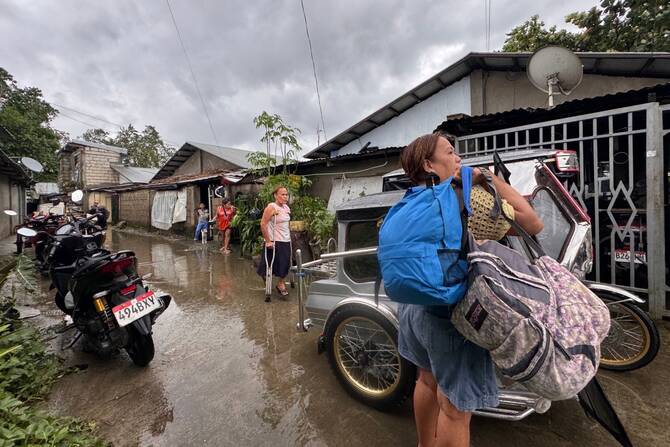
Residents carrying their belongings evacuate their homes ahead of the arrival of Super Typhoon Fung-wong in Tuguegarao City, Cagayan province, on Nov. 9, 2025. (AFP)
Short Url
Updated 09 November 2025
Follow

Philippines braces for impact of Super Typhoon Fung-wong, strongest storm of 2025

  • Storm arrives days after Typhoon Kalmaegi killed 204 people
  • It is the 21st tropical cyclone to hit the Philippines this year

MANILA: Filipinos on Sunday braced for the impact of Super Typhoon Fung-wong, the most powerful storm to hit the country this year, forcing the evacuation of more than a million people.

Called “Uwan” locally, Fung-wong has intensified into a super typhoon in the Western Pacific, with gusts up to 230 kph.

Office of Civil Defense deputy administrator Bernardo Rafaelito Alejandro IV told reporters that more than 315,000 families, nearly 1.1 million people, were under evacuation orders in northern half of the country, including the capital Manila.

“We appeal to everyone to prepare your families, yourselves, and your belongings — be ready and stay safe from the hazards brought by Super Typhoon Uwan,” he said.

“The main threats from this typhoon are flooding, storm surges, and landslides. We are urging everyone to take these seriously and move to safe areas immediately if you are located in places designated as high-risk or known to be prone to these hazards.”

The worst affected and expecting the greatest damage is the Bicol Region at the southeastern tip of Luzon, the largest island in the Philippines, but the capital region is also on alert for its impact.

“We’re making sure that all our gadgets and emergency lights are fully charged, and that we have candles ready in case there’s a power outage. We’ve already done our grocery shopping in advance,” said Bernadette Garcia, who was preparing her family to stay indoors for the next two days at their home in Quezon City.

“What really worries me during typhoons are the trees. The trees around our area are tall, and it’s frightening to think that one could fall and hit the house. I’m praying nothing like that happens.”

Paloma Arrieta in Paranaque was taking precautions not only against the typhoon’s landfall but also against the expected aftermath, as floodwaters are likely to inundate the city.

“They say this typhoon is strong, so we really need to get ready. Our house is built on slightly higher ground — if the water inside reaches knee level, it means it’s already waist-deep outside,” she told Arab News,

“What really scares me during floods is the flooding itself. I’ve developed a phobia of it because I’ve fallen into a manhole twice before.”

Super Typhoon Fung-wong is hitting the country days after Typhoon Kalmaegi left at least 224 people dead.

Fung-wong arrives while many areas devastated by Kalmaegi are still in recovery, which heightens the risk of severe damage given the country’s limited capacity to respond.

This is the 21st tropical cyclone to arrive in the Philippines this year, and with the largest circulation — a diameter of between 1,400 and 1,600 km — its effects could cover huge portions of the country. Even areas not directly under the storm’s eye are likely to experience severe outcomes.


More than half the US threatened with ice, snow and cold in massive winter storm

Updated 6 sec ago
Follow

More than half the US threatened with ice, snow and cold in massive winter storm

Forecasters warned that the damage, especially in areas pounded by ice, could rival a hurricane
At least 177 million people were under watches or warnings for ice and snow and more than 200 million were under cold weather adviseries or warnings

WASHINGTON: It was too cold for school in Chicago and other Midwestern cities Friday as a huge, dayslong winter storm began to crank up that could bring snow, sleet, ice and bone-chilling temperatures as well as extensive power outages to about half the US population from Texas to New England.
Forecasters warned that the damage, especially in areas pounded by ice, could rival a hurricane. Airlines canceled thousands of flights, churches moved Sunday services online and the Grand Ole Opry in Nashville, Tennessee, decided to hold its Saturday night radio performance without fans. Carnival parades in Louisiana were canceled or rescheduled.
At least 177 million people were under watches or warnings for ice and snow and more than 200 million were under cold weather adviseries or warnings. In many places, those overlapped. Utility companies braced for power outages because ice-coated trees and power lines can keep falling long after a storm has passed.
“It’s going to be a big storm,” Maricela Resendiz said as she picked up chicken, eggs and pizzas at a Dallas store to get her, her 5-year-old son and her boyfriend through the weekend. Her plans: “Staying in, just being out of the way.”
Ice, snow and sleet could begin falling later Friday in Texas and Oklahoma. The storm was expected to slide into the South with freezing rain and sleet. Then it will move into the Northeast, dumping about a foot (30 centimeters) of snow from Washington, D.C., through New York and Boston, the National Weather Service predicted.
Arctic air is the first piece to fall in place

Arctic air that spilled down from Canada prompted schools throughout the Midwest to cancel classes Friday. With wind chills predicted to be as low as minus 40 degrees Fahrenheit (minus 40 Celsius) frostbite could set in within 10 minutes, making it too dangerous to walk to school or wait for the bus.
In Bismarck, North Dakota, where the wind chill was minus 41 Fahrenheit (minus 41 Celsius), Colin Cross cleaned out an empty unit for the apartment complex where he works.
“I’ve been here awhile and my brain stopped working,” said Cross, bundled up in long johns, two long-sleeved shirts, a jacket, hat, hood, gloves and boots.
Nationwide, more than 1,000 flights were delayed or canceled Friday, with well over half of them in Dallas, according to the flight tracking website FlightAware. About 2,300 Saturday flights were canceled.
In Oklahoma, Department of Transportation workers pretreated roads with salt brine while the Highway Patrol canceled troopers’ days off.
The federal government put nearly 30 search and rescue teams on standby. Officials have more than 7 million meals, 600,000 blankets and 300 generators placed throughout the area the storm was expected to cross, according to the Federal Emergency Management Agency.
Ice could take down power line
s and pipes could freeze

Once ice and snow end, the frigid air from the north will head south and east. It will take a while to thaw out, an especially dangerous prospect because ice can add hundreds of pounds to power lines and branches and make them more susceptible to snapping, especially if it’s windy.
In at least 11 Southern states from Texas to Virginia, a majority of homes are heated by electricity, according to the US Census Bureau.
A severe cold snap five years ago took down much of the power grid in Texas, leaving millions without power for days and resulting in hundreds of deaths. Gov. Greg Abbott said Thursday that won’t happen again, and utility companies were bringing in thousands of employees to help keep the power on.
Pipes are also at risk.
In Atlanta, where temperatures could dip to 10 degrees Fahrenheit (minus 12 Celsius) and stay below freezing for 36 hours, M. Cary & Daughters Plumbing co-owner Melissa Cary ordered all the pipe and repair supplies she could get. She said her daily calls could go from about 40 to several hundred.
“We’re out there; we can’t feel our fingers, our toes; we’re soaking wet,” Cary said. “I keep the hot chocolate and soup coming.”
Northeast prepares for heavy snow
The Northeast could see its heaviest snow in years.
Boston declared a cold emergency through the weekend, and Connecticut was working with neighboring New York and Massachusetts in case travel restrictions are needed on major highways.
Connecticut Gov. Ned Lamont urged people to go grocery shopping now and “stay home on Sunday.”
Philadelphia announced schools would be closed Monday. Superintendent Tony B. Watlington Sr. told students, “It’s also appropriate to have one or two very safe snowball fights.”
People are hunkering down
Stephen McDonald, who hasn’t had a home in three years, was hoping to get out of the cold in Jackson, Mississippi. But the Shower Power homeless shelter was adding spray foam insulation and ceiling heaters, keeping it closed until Saturday.
Friday night’s forecast called for lows near freezing. “Your hands get frozen solid, and they hurt real bad,” said McDonald,. “It’s not good.”
At the University of Georgia in Athens, sophomore Eden England was staying on campus to ride out the weather with her friends, even as the school encouraged students to leave dorms and go home because of concerns about losing power.
“I was texting my parents and we kind of just realized that whether I’m here or at home, it’s going to suck either way,” England said. “So I’d rather be with my friends, kind of struggling together if anything happens.”