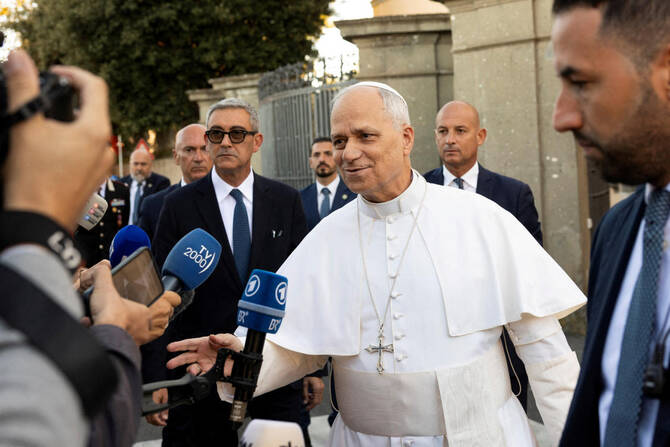
VATICAN CITY: That was Pope Leo XIV ‘s matter-of-fact response when King Charles III asked about the swarms of televisions cameras documenting his historic visit to the Vatican last month.
Charles is no stranger to paparazzi, so Leo wasn’t telling the monarch anything he didn’t already know. But Leo’s blasé comment seemed to confirm what Vatican observers have noticed recently: that Leo has indeed gotten used to being pope, and is finding his footing six months into the job.
After his shock election in May and sharp learning curve over the summer, Leo’s key priorities are coming into focus, especially where he dovetails with his predecessor, Pope Francis, and where he diverges.
As his pontificate’s six-month mark arrives on Nov. 8, here’s a rundown of what we’ve learned about the first American pope, his style, substance and where he might take the Catholic Church.
Continuity with Francis on key social justice issues
Leo showed himself in perfect lockstep with Francis when he published his first major teaching document last month, on the church’s non-negotiable “preferential option for the poor.” Francis began writing the text before he died; Leo took it over and made it his own.
In it, Leo criticized how the wealthy live in a “bubble of comfort and luxury” while poor people suffer on the margins. He urged a renewed commitment to fixing the structural causes of poverty.
Leo has also embraced Francis’ ecological legacy, presiding over the first Mass using a new prayer formula “for the care of creation.” He has given the go-ahead to Francis’ ambitious plan to turn a Vatican-owned property north of Rome into a massive solar farm that could make Vatican City the world’s first carbon-neutral state.
Perhaps nowhere was Leo more Francis-like than on Oct. 23, when he met at the Vatican with Indigenous groups and representatives of popular movements who had been championed by the Argentine Jesuit.
Francis had prioritized people on the margins, and exhorted the church to accompany them as they demanded the basic human necessities of “tierra, techo, trabajo,” – land, housing and work.
Leo repeated Francis’ mantra during his audience and put his own spin on it, noting that his namesake, Pope Leo XIII, took up the issue of workers rights at the dawn of the Industrial Revolution.
“Echoing Francis’ words, I say today: land, housing and work are sacred rights. It is worthwhile to fight for them, and I would like you to hear me say, ‘I am here, I am with you!’” Leo said.
Cardinal Michael Czerny, a top adviser to both popes, said Leo is in perfect continuity with Francis, implementing processes that Francis set in motion.
“The transition from one Holy Father to another is not primarily a transition in policies,” Czerny said in an interview. While a change in governments from one party to the next can signal a break, “here it would be a mistake to look for that.”
“The stylistic differences are in the person, not in the teaching,” he said.
Leo’s honeymoon with conservatives continues
On style, it’s now clear that Leo is happy to pope the old fashioned way, wearing the red mozzetta cape and embroidered stole for all but the most mundane occasions.
He sticks to the script of his prepared texts, shows discipline in his liturgical observance and doesn’t ad-lib with wisecracks the way Francis sometimes did.
That has endeared him to many of the Catholic conservatives who bristled at Francis’ informality. Even though Leo is echoing many of Francis’ Gospel-mandated social justice preaching points, his style and gestures have generally won them over so far.
“What I’m hearing and sensing is a real joy in the maturity, the discipline and the tradition that he brings back to the papacy,” said Patrick Reilly, founder and head of the conservative Cardinal Newman Society, which ranks Catholic colleges in the US on upholding traditional doctrine.
“I don’t know of anyone who has any concerns or is disturbed or anything like we saw,” with Francis, he said.
The Latin Mass returns to St. Peter’s
Many credit Leo for allowing a traditional Latin Mass to be celebrated at the back altar of St. Peter’s Basilica, presided over by none other than the figurehead of the American Catholic right, Cardinal Raymond Burke.
Francis in 2021 cracked down on the spread of the ancient liturgy, saying it had become a source of division in dioceses. The crackdown fueled conservative and traditionalist opposition to Francis, leading to a new impasse in the age-old liturgical wars.
But Leo has expressed a willingness to engage in dialogue with traditionalists, suggesting a detente is possible.
“We love our pope, we pray for him,” said Christina Tignot, who attended the Latin Mass service during the traditionalists’ annual pilgrimage. With her was her husband and homeschooled daughter, who joined her mother in wearing a lace veil over her head.
A willingness to chart a new path
For all his continuity with Francis, Leo has charted his own path and even corrected Francis when necessary.
In one case of a reversal, Leo abrogated a 2022 law issued by Francis that concentrated financial power in the Vatican bank. Leo issued his own law allowing the Holy See’s investment committee to use other banks, outside the Vatican, if it made better financial sense.
Leo has also met with a group of activist survivors of clergy sexual abuse, who said he promised to engage in dialogue as they press the Vatican to adopt a zero-tolerance for abuse policy worldwide. Francis had met regularly with individual abuse survivors, but kept advocacy and activist groups at an arm’s length.
A new routine elicits a comment about abortion
At the six-month mark, Leo’s personal routine is also showing a break from that of the workaholic homebody Francis.
Leo has taken to spending Monday afternoons and Tuesdays at the papal country house in Castel Gandolfo, where he can take time off and get in a tennis game in the estate’s court. (He plays with his secretary).
To the news media’s delight, Leo has agreed to field some questions each Tuesday evening as he leaves from a gaggle of reporters gathered outside, weighing in on everything from the Gaza ceasefire to immigration enforcement raids in Chicago. his hometown.
His initially timid responses were noticed. They led to a biting television skit by Italian political satirist Maurizio Crozza, who suggested that the name “Leo” was perhaps a mismatch for a pope seemingly afraid of his own shadow.
But with the passage of time, Leo seems to be getting into his groove. He sparked a brief but seemingly temporary alarm in conservative circles when, during one recent Tuesday evening Q&A, he chimed in on the US abortion debate by challenging abortion opponents about what it really means to be pro-life.
In a more formal setting, he also showed some chutzpah when Queen Rania of Jordan asked him if it was really safe to travel to Lebanon. Leo plans to visit Lebanon and Turkiye on his first foreign trip at the end of the month.
They were posing for a formal photo in Leo’s library after an official state audience. Rania’s question was picked up by the Vatican camera’s hot mic, as was Leo’s response.
“Well, we’re going,” Leo said matter-of-factly, while smiling for the cameras.


![]()

At the 6-months mark, Pope Leo finds his footing and starts charting his own path and style
Short Url
https://arab.news/gvyb8
At the 6-months mark, Pope Leo finds his footing and starts charting his own path and style
- Leo’s key priorities are coming into focus, especially where he dovetails with his predecessor
- Leo has also embraced Francis’ ecological legacy, presiding over the first Mass using a new prayer formula “for the care of creation”


Latest updates





© 2026 SAUDI RESEARCH & PUBLISHING COMPANY, All Rights Reserved And subject to Terms of Use Agreement.