

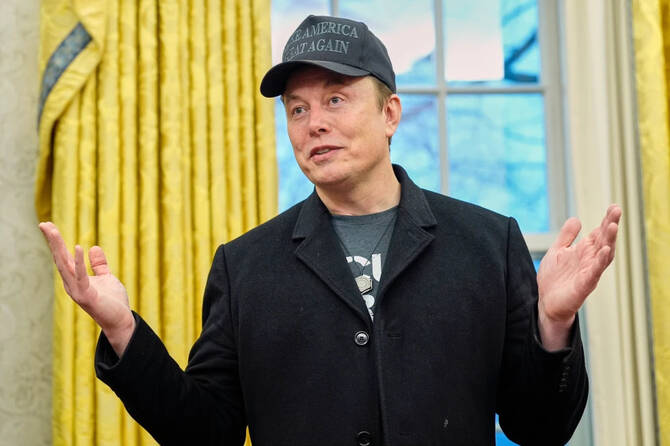

NEW YORK: The world’s richest man was just handed a chance to become history’s first trillionaire.
Elon Musk won a shareholder vote on Thursday that would give the Tesla CEO stock worth $1 trillion if he hits certain performance targets over the next decade. The vote followed weeks of debate over his management record at the electric car maker and whether anyone deserved such unprecedented pay, drawing heated commentary from small investors to giant pension funds and even the pope.
In the end, more than 75% of voters approved the plan as shareholders gathered in Austin, Texas, for their annual meeting.
“Fantastic group of shareholders,” Musk said after the final vote was tallied, adding “Hang on to your Tesla stock.”
The vote is a resounding victory for Musk showing investors still have faith in him as Tesla struggles with plunging sales, market share and profits in no small part due to Musk himself. Car buyers fled the company this year as he has ventured into politics both in the US and Europe, and trafficked in conspiracy theories.
The vote came just three days after a report from Europe showing Tesla car sales plunged again last month, including a 50% collapse in Germany.
Still, many Tesla investors consider Musk as a sort of miracle man capable of stunning business feats, such as when he pulled Tesla from the brink of bankruptcy a half-dozen years ago to turn it into one of the world’s most valuable companies.
The vote clears a path for Musk to become a trillionaire by granting him new shares, but it won’t be easy. The board of directors that designed the pay package require him to hit several ambitious financial and operational targets, including increasing the value of the company on the stock market nearly six times its current level.
Musk also has to deliver 20 million Tesla electric vehicles to the market over 10 years amid new, stiff competition, more than double the number since the founding of the company. He also has to deploy 1 million of his human-like robots that he has promised will transform work and home — he calls it a “robot army” — from zero today.
Musk could add billions to his wealth in a few years by partly delivering these goals, according to various intermediate steps that will hand him newly created stock in the company as he nears the ultimate targets.
That could help him eventually top what is now considered America’s all-time richest man, John D. Rockefeller. The railroad titan is estimated by Guinness World Records to have been worth $630 billion, in current dollars, at his peak wealth more than 110 years ago. Musk is worth $493 billion, as estimated by Forbes magazine.
Musk’s win came despite opposition from several large funds, including CalPERS, the biggest US public pension, and Norway’s sovereign wealth fund. Two corporate watchdogs, Institutional Shareholder Services and Glass Lewis, also blasted the package, which so angered Musk he took to calling them “corporate terrorists” at a recent investor meeting.
Critics argued that the board of directors was too beholden to Musk, his behavior too reckless lately and the riches offered too much.
“He has hundreds of billions of dollars already in the company and to say that he won’t stay without a trillion is ridiculous,” said Sam Abuelsamid, an analyst at research firm Telemetry who has been covering Tesla for nearly two decades. “It’s absurd that shareholders think he is worth this much.”
Supporters said that Musk needed to be incentivized to focus on the company as he works to transform it into an AI powerhouse using software to operate hundreds of thousands of self-driving Tesla cars — many without steering wheels — and Tesla robots deployed in offices, factories and homes doing many tasks now handled by humans.
“This AI chapter needs one person to lead it and that’s Musk,” said financial analyst Dan Ives of Wedbush Securities. “It’s a huge win for shareholders.”
Investors voting for the pay had to consider not only this Musk promise of a bold, new tomorrow, but whether he could ruin things today: He had threatened to walk away from the company, which investors feared would tank the stock.
Tesla shares, already up 80% in the past year, rose on news of the vote in after-hours trading but then flattened basically unchanged to $445.44.
For his part, Musk says the vote wasn’t really about the money but getting a higher Tesla stake — it will double to nearly 30% — so he could have more power over the company. He said that was a pressing concern given Tesla’s future “robot army” that he suggested he didn’t trust anyone else to control given the possible danger to humanity.
Other issues up for a vote at the annual meeting turned out wins for Musk, too.
Shareholders approved allowing Tesla to invest in one of Musk’s other ventures, xAI. They also shot down a proposal to make it easier for shareholders to sue the company by lowering the size of ownership needed to file. The current rule requires at least a 3% stake.


