

Pakistan dismisses Indian media reports of denying entry to Hindus on religious grounds

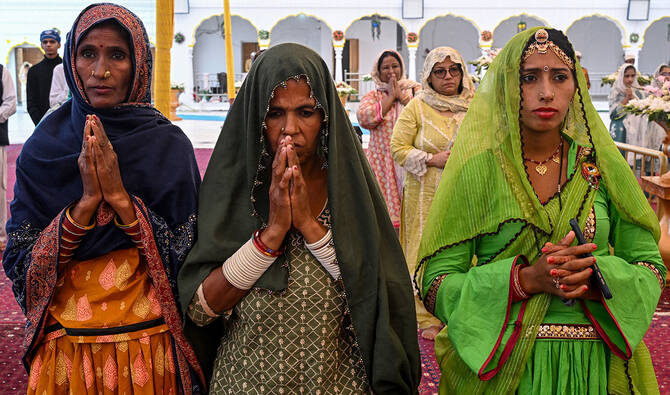
Sikh pilgrims pay respects on the occasion of the birth anniversary of Guru Nanak Dev, the founder of Sikhism, in Nankana Sahib, in the Punjab province of Pakistan, on November 5, 2025. (AFP)
Short Url
Updated 06 November 2025
Follow

Pakistan dismisses Indian media reports of denying entry to Hindus on religious grounds

  • Over 2,400 Indian pilgrims were granted visas to attend 10-day festival marking 556th birth anniversary of Sikhism founder in Pakistan
  • FO says “a very small number” of Indian nationals were not allowed to enter Pakistan due to incomplete documentation, unsatisfactory responses

ISLAMABAD: Pakistan’s Foreign Office Spokesperson Tahir Andrabi on Thursday rejected Indian media reports that Islamabad had recently denied entry to Hindus from across the border on religious grounds, describing them as “completely incorrect and mischievous.”

The foreign office’s clarification came in response to reports published in Indian news websites this week claiming Pakistani officials told Hindus from India that they could not travel with Sikh pilgrims to Pakistan, as they were not followers of the Sikh faith. 

More than 2,400 pilgrims from India were granted visas to attend a 10-day festival from Nov. 4-13 to mark 556 years since the birth of Guru Nanak, founder of the Sikh faith, Pakistan’s High Commission in New Delhi said. 

“Pakistan categorically rejects the unfounded and misleading allegations that members of the Hindu community were denied entry into its territory,” the foreign office spokesperson said.

“These claims are entirely baseless and represent yet another attempt to distort facts and politicize a matter that was purely administrative in nature.”

Andrabi said around 1,932 pilgrims successfully crossed into Pakistan through the Attari-Wagah border on Tuesday. He said approximately 300 visa holders were prevented by the Indian authorities from crossing over into Pakistan. 

He said the immigration process on the Pakistani side was “smooth, orderly, and free of any hindrance.” The foreign office spokesperson said “a very small number” of Indian nationals were found to possess incomplete documentation and were unable to provide satisfactory responses to immigration authorities.

“Consequently, they were requested to return to the Indian side in accordance with standard procedures,” Andrabi said. 

“To suggest that these individuals were denied entry on religious grounds is completely incorrect and mischievous,” he added. 

The spokesperson said Pakistan has always welcomed pilgrims from all faiths to visit religious sites in its territory. He added that the move to stop some Indian nationals was “administrative, consistent with Pakistan’s sovereign right to regulate entry into its territory.”

“Any attempt to give this issue a communal or political color is not only regrettable but also reflective of the prejudiced mindset that increasingly dominates the Indian government and media narratives,” the statement concluded. 

Pakistan is home to more than 15,000 Sikhs and every year thousands of Sikh pilgrims visit the country to pay their respects in Nankana Sahib, the birthplace of Baba Guru Nanak. 

They also visit other sacred sites in Pakistan including Kartarpur, where Guru Nanak is buried. The Kartarpur Corridor, a visa-free route opened in 2019, allows Indian Sikhs to visit the temple without crossing the main border.



Pakistan says defense pact with Saudi Arabia elevated brotherly ties to ‘new heights’

Updated 25 February 2026
Follow

Pakistan says defense pact with Saudi Arabia elevated brotherly ties to ‘new heights’

  • Pakistan, Saudi Arabia signed strategic defense pact last year pledging aggression against one will be treated as attack on both
  • Deputy PM Ishaq Dar says enduring bonds with Islamic and Arab nations form vital pillar of Pakistan’s foreign policy 

ISLAMABAD: Deputy Prime Minister Ishaq Dar said on Wednesday that Pakistan’s defense pact with Saudi Arabia elevated its brotherly ties with the Kingdom to “new heights,” stressing that close ties with Arab and Islamic nations form a key pillar of Islamabad’s foreign policy. 

Pakistan and Saudi Arabia signed a Strategic Mutual Defense Agreement on Sept. 17 last year, pledging that aggression against one country would be treated as an attack on both, enhancing joint deterrence and formalizing decades of military and security cooperation.

Both nations agreed in October 2025 to launch an economic cooperation framework to strengthen trade and investment ties. 

“In the Middle East, our landmark Strategic Mutual Defense Agreement with Saudi Arabia has elevated our brotherly ties to new heights,” Dar said while speaking at the Pakistan Governance Forum 2026 event in Islamabad. 

The Pakistani deputy prime minister was speaking on the topic “Navigating International Relations Amidst Changing Geo-Politics.”

Dar noted that Pakistan has reinforced partnerships with other Middle Eastern nations such as the UAE, Qatar, Jordan, Oman, Egypt and Bahrain. He said these partnerships have yielded “concrete agreements” in investment, agriculture, infrastructure, and energy sectors. 

“Our enduring bonds with Islamic and Arab nations form a vital pillar of our foreign policy, and we will continue to expand our partnerships across Asia, Latin America, and Africa,” he said. 

Dar pointed out that the presidents of Kazakhstan, Uzbekistan and Kyrgyzstan have undertaken visits to Pakistan in recent months, reflecting Central Asian nations’ desire to boost cooperation with Islamabad.

On South Asia, the Pakistani deputy PM said Pakistan has successfully transformed its fraternal ties with Bangladesh into “a substantive partnership.”

“Similarly, the trilateral mechanism involving China, Pakistan, and Bangladesh has been launched with a view to expanding and deepening regional cooperation and synergy,” the Pakistani minister said. 

He said Islamabad has strengthened its “all-weather” partnership with China via the second phase of the multi-billion-dollar China-Pakistan Economic Corridor agreement and “unwavering support” from both sides for each other’s core interests. 

Dar said Pakistan had also reinvigorated its partnership with the US, advancing cooperation in trade, technology, investment, and regional stability. 

“This calibrated approach has enhanced our ability to navigate complexity with skill and confidence, ensuring that our national interests are served without compromising our core foreign policy principles,” he said.