

Kurdish leader Barzani pushes for leverage with Baghdad in Iraq vote

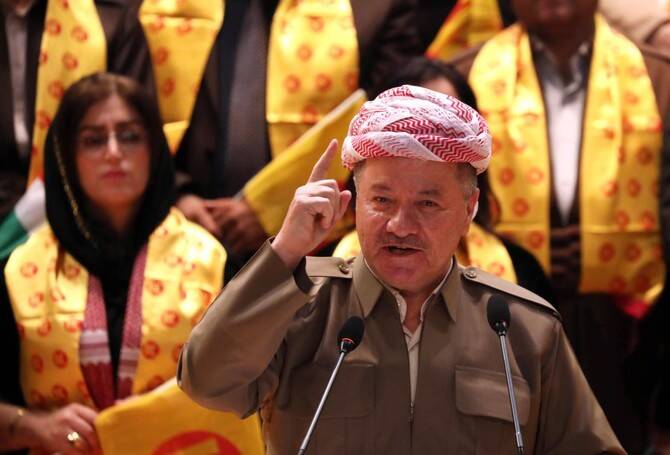
Masoud Barzani, the Iraqi Kurdish leader who first took up arms against Saddam Hussein as a teenage guerrilla, remains a towering figure in Kurdish politics as Iraq heads into its November 11 election. (AFP/File)
Short Url
Updated 06 November 2025
Follow

Kurdish leader Barzani pushes for leverage with Baghdad in Iraq vote

  • Veteran Kurdish leader still shapes politicsBarzani’s political journey has been shaped by decades of rebellion, betrayal, and uneasy truces with successive Iraqi governments
  • His legacy looms large over the race for seats in the national parliament in Baghdad

BAGHDAD: Masoud Barzani, the Iraqi Kurdish leader who first took up arms against Saddam Hussein as a teenage guerrilla, remains a towering figure in Kurdish politics as Iraq heads into its November 11 election.
Though he no longer holds an official post, Barzani’s Kurdistan Democratic Party (KDP) is urging a strong Kurdish turnout to safeguard regional interests and strengthen its hand in fraught negotiations with Baghdad.
Barzani’s political journey has been shaped by decades of rebellion, betrayal, and uneasy truces with successive Iraqi governments. Now in his late 70s, he continues to wield influence behind the scenes, often referred to as “President” in Kurdish media and diplomatic circles.
His legacy looms large over the race for seats in the national parliament in Baghdad, a contest that could either reinforce Kurdish autonomy or expose deepening fractures within the Kurdish political landscape.
A strong KDP performance would give Barzani’s camp more leverage in disputes with the central government over oil revenues and budget allocations — issues that have sharply escalated tensions between Irbil and Baghdad in 2025.
A weak showing, however, could embolden rival Kurdish factions and strengthen the central government’s position.

FROM MOUNTAIN FIGHTER TO POLITICAL POWER BROKER
Barzani’s long career has been marked by cunning and patience, qualities that helped the Kurds in northern Iraq to survive brutality under Saddam.
Following the 1991 Gulf war, the Kurds rose up against Saddam’s dictatorship, and Barzani and his peshmerga fighters came down from the mountains and captured several cities.
But the victorious US-led allies balked at the prospect of a Kurdish split from Baghdad and initially gave Saddam’s troops a free hand to put down the uprising.
Facing strategic defeat, the quietly spoken Barzani was forced to do the unthinkable and negotiate with Saddam, who had gassed the Kurds and buried them in mass graves years before.
Barzani was saved by a US and British no-fly zone over the north which allowed him and his Kurdish rival Jalal Talabani to retake the area. The longest period of Kurdish autonomy in modern history followed, but the experience was scarred by war between Barzani and Talabani’s Patriotic Union of Kurdistan.
Barzani invited Iraqi government tanks into the enclave in 1996 to seize the regional capital Irbil, sending not only Talabani but CIA agents and their local employees fleeing.

GAMBLE ON INDEPENDENCE ENDS IN FAILURE
After decades of struggle, and Saddam’s overthrow in a 2003 US-led invasion, critics say Barzani made one of his biggest errors by seeking a referendum on Kurdish independence in 2017.
The Baghdad government rejected it as illegal and sent troops to seize the oil city of Kirkuk, which the Kurds regard as the heart of any future homeland. A bitter Barzani stepped down as president of the regional government.
“I am the same Masoud Barzani, I am a Peshmerga and will continue to help my people in their struggle for independence,” Barzani said in a televised address.
“Nobody stood up with us, other than our mountains.”
Barzani was born in 1946, soon after his legendary father, Mulla Mustafa Barzani, known as the Lion of Kurdistan, founded a party to fight for the rights of Iraqi Kurds.
Masoud Barzani became a guerrilla as a teenager, and over time he would become familiar with an abiding theme in Kurdish history — betrayal by regional and Western powers.
Exiled and dying of cancer in a US hospital in 1976, Mulla Mustafa lamented that he had ever trusted the United States.
A year earlier, Mulla Mustafa had been fighting a guerrilla war against Baghdad backed by Iran’s pro-Western shah, but he was cut adrift when then-US Secretary of State Henry Kissinger brokered a deal that allowed Saddam to crush the Kurds.
During the 1980-88 Iran-Iraq war, Barzani allied the KDP with Tehran once more. As a result, some 8,000 Barzani tribesmen were rounded up and paraded through Baghdad before being executed. In Saddam’s words: “They went to hell.”
In March 1988 Saddam’s warplanes bombed the Kurdish town of Halabja with poison gas killing up to 5,000 people.
Despite the massacres, Barzani retained enough of a fighting force to respond to President George Bush’s appeal for an uprising during the 1991 Gulf War, when a US-led coalition routed Saddam’s army in Kuwait.
After Saddam’s fall, Barzani became a central figure in the drive to create an autonomous Kurdish state in northern Iraq. Kurdish leaders kept their territory relatively free of the sectarian bloodshed that plagued most of Iraq. Western oil executives flocked to the region seeking deals.

STRAINS WITH BAGHDAD OVER OIL RESURFACE
Kurds showed their military capability by joining Iraqi government troops and Iranian-backed paramilitary forces to drive Daesh militants out of Mosul.
Confident that the time was right for an independent homeland, Barzani pursued the disastrous referendum. A day after the vote he recalled the Kurds’ seemingly endless suffering.
“I’ve been fighting for half a century. With my people I have been through mass killings, deportations, gassings. I remember times when we thought we were done for, headed for extermination,” he told the Kurdish Rudaw news agency.
“I remember times, as in 1991 after the first war against Saddam, when the democracies came to our rescue but left the dictatorship in place, thus casting us back into the shadows.”
Barzani’s arch-enemy Saddam was executed in 2007. But tensions persist between the Kurds and Baghdad authorities.
Relations soured once again in February 2022 when Iraq’s federal court deemed an oil and gas law regulating the oil industry in Iraqi Kurdistan unconstitutional and demanded that Kurdish authorities hand over their crude oil supplies.
Barzani criticized the move as a “completely political decision” aimed at opposing the Kurdistan region.
Barzani has kept a hand in politics through his KDP. The party swept the Kurdish vote in a 2021 election after forming an alliance with Shiite cleric Moqtada Al-Sadr.

Palestinians in the West Bank struggle to get by as Israel severely limits work permits

Updated 6 sec ago
Follow

Palestinians in the West Bank struggle to get by as Israel severely limits work permits

  • Many Palestinians in the occupied West Bank are struggling to get by after losing their permits to work inside Israel
  • Israel revoked around 100,000 permits after Hamas’ Oct. 7, 2023, attack ignited the war in the Gaza Strip
TULKAREM, West Bank: Hanadi Abu Zant hasn’t been able to pay rent on her apartment in the occupied West Bank for nearly a year after losing her permit to work inside Israel. When her landlord calls the police on her, she hides in a mosque.
“My biggest fear is being kicked out of my home. Where will we sleep, on the street?” she said, wiping tears from her cheeks.
She is among some 100,000 Palestinians whose work permits were revoked after Hamas’ Oct. 7, 2023, attack ignited the war in the Gaza Strip. Confined to the occupied territory, where jobs are scarce and wages far lower, they face dwindling and dangerous options as the economic crisis deepens.
Some have sold their belongings or gone into debt as they try to pay for food, electricity and school expenses for their children. Others have paid steep fees for black-market permits or tried to sneak into Israel, risking arrest or worse if they are mistaken for militants.
Israel, which has controlled the West Bank for nearly six decades, says it is under no obligation to allow Palestinians to enter for work and makes such decisions based on security considerations. Thousands of Palestinians are still allowed to work in scores of Jewish settlements across the West Bank, built on land they want for a future state.
Risk of collapse
The World Bank has warned that the West Bank economy is at risk of collapse because of Israel’s restrictions. By the end of last year, unemployment had surged to nearly 30 percent compared with around 12 percent before the war, according to the Palestinian Central Bureau of Statistics.
Before the war, tens of thousands of Palestinians worked inside Israel, mainly in construction and service jobs. Wages can be more than double those in the landlocked West Bank, where decades of Israeli checkpoints, land seizures and other restrictions have weighed heavily on the economy. Palestinians also blame the Palestinian Authority, which exercises limited self-rule in parts of the territory, for not doing enough to create jobs.
About 100,000 Palestinians had work permits that were revoked after the outbreak of the war. Israel has since reinstated fewer than 10,000, according to Gisha, an Israeli group advocating for Palestinian freedom of movement.
Wages earned in Israel injected some $4 billion into the Palestinian economy in 2022, according to the Institute for National Security Studies, an Israeli think tank. That’s equivalent to about two-thirds of the Palestinian Authority’s budget that year.
An Israeli official said Palestinians do not have an inherent right to enter Israel, and that permits are subject to security considerations. The official spoke on condition of anonymity in line with regulations.
Israel seized the West Bank, Gaza and east Jerusalem in the 1967 Mideast war, territories the Palestinians want for a future state. Some 3 million Palestinians live in the West Bank, along with over 500,000 Israeli settlers who can come and go freely.
The war in Gaza has brought a spike in Palestinian attacks on Israelis as well as settler violence. Military operations that Israel says are aimed at dismantling militant groups have caused heavy damage in the West Bank and displaced tens of thousands of Palestinians.
‘My refrigerator, it’s empty’
After her husband left her five years ago, Abu Zant secured a job at a food-packing plant in Israel that paid around $1,400 a month, enough to support her four children. When the war erupted, she thought the ban would only last a few months. She baked pastries for friends to scrape by.
Hasan Joma, who ran a business in Tulkarem before the war helping people find work in Israel, said Palestinian brokers are charging more than triple the price for a permit.
While there are no definite figures, tens of thousands of Palestinians are believed to be working illegally in Israel, according to Esteban Klor, professor of economics at Israel’s Hebrew University and a senior researcher at the INSS. Some risk their lives trying to cross Israel’s separation barrier, which consists of 9-meter high (30-foot) concrete walls, fences and closed military roads.
Shuhrat Barghouthi’s husband has spent five months in prison for trying to climb the barrier to enter Israel for work, she said. Before the war, the couple worked in Israel earning a combined $5,700 a month. Now they are both unemployed and around $14,000 in debt.
“Come and see my refrigerator, it’s empty, there’s nothing to feed my children,” she said. She can’t afford to heat her apartment, where she hasn’t paid rent in two years. She says her children are often sick and frequently go to bed hungry.
Sometimes she returns home to see her belongings strewn in the street by the landlord, who has been trying to evict them.
Forced to work in settlements
Of the roughly 48,000 Palestinians who worked in Israeli settlements before the war, more than 65 percent have kept their permits, according to Gisha. The Palestinians and most of the international community view the settlements, which have rapidly expanded in recent years, as illegal.
Israeli officials did not respond to questions about why more Palestinians are permitted to work in the settlements.
Palestinians employed in the settlements, speaking on condition of anonymity for fear of retribution, say their employers have beefed up security since the start of the war and are far more willing to fire anyone stepping out of line, knowing there are plenty more desperate for work.
Two Palestinians working in the Mishor Adumim settlement said security guards look through workers’ phones and revoke their permits arbitrarily.
Israelis have turned to foreign workers to fill jobs held by Palestinians, but some say it’s a poor substitute because they cost more and do not know the language. Palestinians speak Arabic, but those who work in Israel are often fluent in Hebrew.
Raphael Dadush, an Israeli developer, said the permit crackdown has resulted in costly delays.
Before the war, Palestinians made up more than half his workforce. He’s tried to replace them with Chinese workers but says it’s not exactly the same. He understands the government’s decision, but says it’s time to find a way for Palestinians to return that ensures Israel’s security.
Assaf Adiv, the executive director of an Israeli group advocating for Palestinian labor rights, says there has to be some economic integration or there will be “chaos.”
“The alternative to work in Israel is starvation and desperation,” he said.