

FIFA vice president pledges support for rebuilding football in Pakistan after years-long suspension

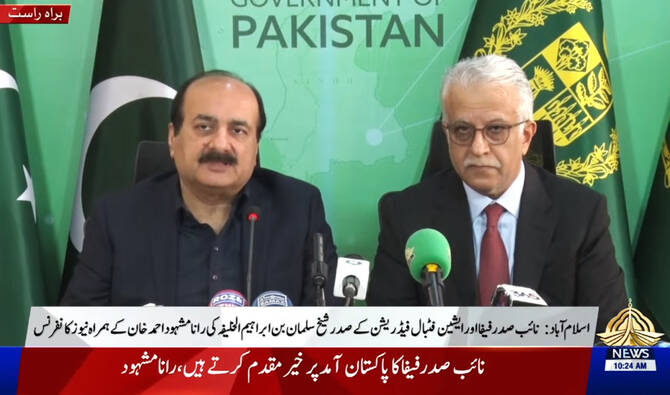
Chairman Prime Minister’s Youth Programme, Rana Mashhood Ahmad Khan and FIFA Vice President Sheikh Salman bin Ibrahim Al Khalifa (right), address a media briefing in Islamabad, Pakistan, on November 6, 2025. (Screengrab/PTV News)
Short Url
Updated 06 November 2025
Follow

FIFA vice president pledges support for rebuilding football in Pakistan after years-long suspension

  • Al Khalifa says Pakistan has huge potential, vows to help develop football infrastructure and training programs
  • Government says it is targeting 23 sports, including gymnastics, to nurture stronger athletes across disciplines

ISLAMABAD: FIFA Vice President Sheikh Salman bin Ibrahim Al Khalifa on Thursday pledged the world football body’s full support to revive the sport in Pakistan, promising to work with the national federation to develop infrastructure and create new opportunities after years of administrative turmoil.

A member of Bahrain’s royal family, Al Khalifa’s visit comes at a time when Pakistan has stepped up participation in international football tournaments across the Middle East and beyond.

However, the sport’s development has been held back by repeated crises within the Pakistan Football Federation (PFF), which has been suspended multiple times by FIFA in recent years for “third-party interference,” a term used when external actors influence or take control of a federation’s internal affairs, breaching FIFA’s independence rules.

The PFF’s most recent suspension, imposed in February 2025 for failing to adopt a FIFA-approved constitution ensuring fair elections, was lifted a month later after it endorsed the document and elected Syed Mohsen Gilani as its 17th president in May.

“I think the last [high-profile FIFA] visit was back in 2017, but I think I’ve come at the right time,” Al Khalifa said while addressing a news conference. “It’s the right time when we have an elected body at the PFF, led by President Syed Gilani, and of course ... the support of the government for sports in general, and in football in particular.”

He said he did not want to talk about the past.

“I think what matters is the present and what we can do,” he continued. “We have a clear roadmap of what needs to be done in football, because we all feel that Pakistan has a huge potential in this game. Since it’s been at standstill for so many years, I think it’s time that we start to kick off this program.”

He said FIFA and the Asian Football Confederation (AFC) would help Pakistan rebuild facilities and programs neglected during the suspension.

“We are here to help,” he said. “We are here to find the right solutions in most of the problems that we face.”

Al Khalifa said bringing in experts to guide the local federation was among FIFA’s top priorities.

Rana Mashhood Ahmad Khan, Chairman of the Prime Minister’s Youth Program, thanked him for visiting and said Pakistan’s new sports initiatives aimed to identify and train young talent nationwide.

“Football has enormous potential in Pakistan,” he said. “Together with the Pakistan Football Federation, we will identify that talent, bring it forward and groom it.”

He said the government was targeting 23 games, hoping to produce better athletes in each one of them.

“Apart from cricket, hockey and football, the games that are very popular in the world right now, we are also bringing in gymnastics and athletics, and we are working on that,” he added.


Pakistan disburses record $9.2 billion agricultural loans in FY25, central bank says

Updated 5 sec ago
Follow

Pakistan disburses record $9.2 billion agricultural loans in FY25, central bank says

  • State Bank says farm lending rose 16 percent year-on-year to Rs2.58 trillion
  • Inflation eased to 5.8 percent in January as GDP growth hits 3.7 percent in Q1 FY26

KARACHI: Pakistan disbursed a record Rs2.58 trillion ($9.2 billion) in agricultural loans during fiscal year 2024–25, a 16 percent increase from the previous year, State Bank of Pakistan (SBP) Governor Jameel Ahmad said on Thursday while chairing a meeting of the Agricultural Credit Advisory Committee (ACAC).

Agricultural financing is considered critical to Pakistan’s rural economy, where farming contributes nearly one-fifth of GDP and employs a large share of the workforce. The government has repeatedly emphasized expanding credit access to small farmers as part of broader efforts to boost productivity, stabilize food supply and support economic recovery under an IMF-backed reform program.

According to official data shared at the meeting, agricultural credit disbursement reached Rs2.58 trillion in FY25, marking a record high. In the first half of FY26 alone, banks disbursed Rs1,412 billion in agricultural loans, while the number of borrowers increased to 2.97 million.

“During fiscal year 2025, record agricultural loans of Rs2.58 trillion were disbursed, reflecting an annual growth of 16 percent,” the State Bank governor said, according to a statement issued after the meeting.

He added that Pakistan had regained macroeconomic stability and that the economy was moving toward sustainable growth.

The governor said GDP growth in the first quarter of FY26 stood at 3.7 percent, while full-year growth was projected between 3.75 percent and 4.75 percent.

He also noted that headline inflation had declined to 5.8 percent in January 2026.

The committee reviewed measures to further expand credit access, including greater use of the central bank’s Zarkhez-e scheme to facilitate agricultural lending. Members also discussed promoting electronic warehouse receipt financing to enhance post-harvest liquidity and reduce distress sales of crops.

The statement said the purpose of electronic warehouse receipt financing was to “reduce forced sales of crops and strengthen linkages within the agricultural market.”

Agricultural lending has been a focus of Pakistan’s financial inclusion strategy, particularly as policymakers seek to improve rural incomes, stabilize food prices and strengthen export-oriented crop production amid broader economic reforms.