Pakistan, Germany to deepen climate, energy partnership with new $122 million support

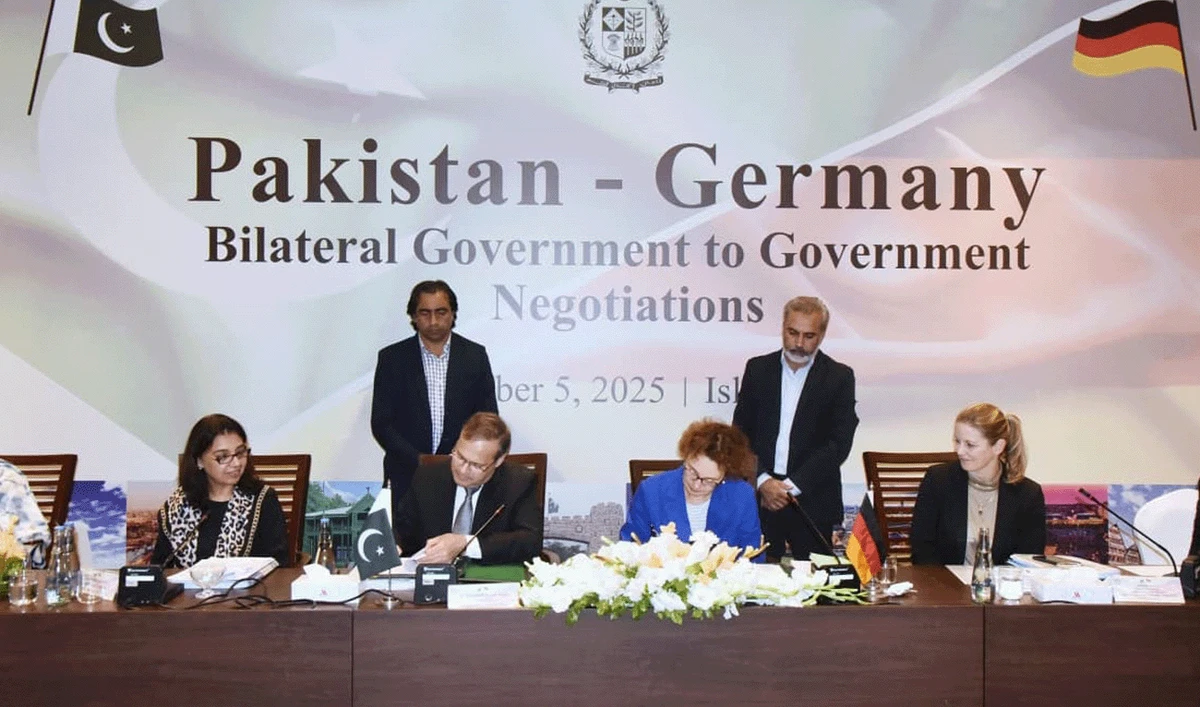
Pakistan's Secretary of the Ministry of Economic Affairs Muhammad Humair Karim (second-left) and Christine Toetzke, Director-General at Germany’s Federal Ministry for Economic Cooperation and Development.(second-right) signing ceremony records after a meeting in Islamabad, Pakistan, on November 5, 2025. (PID)
Short Url
Updated 06 November 2025
Follow

Pakistan, Germany to deepen climate, energy partnership with new $122 million support

  • Berlin announces €114 million in financial and technical assistance for Pakistan
  • Cooperation to expand in climate resilience, vocational training and social protection

ISLAMABAD: Pakistan and Germany have agreed to deepen cooperation under the Pakistan-Germany Climate and Energy Partnership, with Berlin committing €114 million ($122 million) in new financial and technical support for the current fiscal year, Radio Pakistan reported this week. 

Pakistan has identified climate resilience, clean energy transition and social protection as key national priorities as the country recovers from successive climate shocks, including the devastating 2022 floods that affected over 33 million people and floods this year that killed over 1,000 people and devastated millions of acres of farmland. The country is ranked among the world’s most climate-vulnerable nations despite contributing less than one percent to global greenhouse gas emissions.

The new commitment was announced during delegation-level talks in Islamabad between Secretary of the Ministry of Economic Affairs Muhammad Humair Karim and Christine Toetzke, Director-General at Germany’s Federal Ministry for Economic Cooperation and Development.

The German delegation “announced a new financial and technical commitment to the tune of 114 million Euros for current fiscal year,” according to a summary of the discussions published by state broadcaster Radio Pakistan.

Both sides also agreed to strengthen coordination on vocational training and youth employment, and to continue collaboration on social protection and disaster resilience, sectors seen as critical to improving climate readiness and supporting vulnerable communities.

Christine Toetzke “appreciated Pakistan’s reform measures and reaffirmed Germany’s commitment to supporting Pakistan in addressing the challenges of climate change, economic transformation, and social inclusion,” the Radio Pakistan report said.

Germany and Pakistan established their Climate and Energy Partnership in 2021, aimed at expanding renewable energy supply, improving grid efficiency and supporting community-level climate adaptation.

The latest assistance is expected to reinforce ongoing climate resilience programs and job-linked technical training for young workers in green industry and clean energy sectors.

Last month, Pakistan said it had moved to the implementation phase of its national carbon market under a German-funded initiative as the country seeks to strengthen its climate governance and attract international investment for low-carbon development.

The partnership, under the Supporting Preparedness for Article 6 Cooperation (SPAR6C) program funded by the German Federal Government, aims to help Pakistan transition from policy readiness to practical implementation of market-based climate mechanisms in line with global standards.

Carbon markets allow countries and companies to buy and sell credits that represent reductions in greenhouse gas emissions, creating a financial incentive to cut carbon output. Under Article 6 of the Paris Agreement, nations can trade these credits internationally to help meet their climate targets while funding low-carbon projects in developing countries.
IMF board to approve Pakistan reviews today ‘if all goes well,’ say officials

Updated 4 sec ago
Follow

IMF board to approve Pakistan reviews today ‘if all goes well,’ say officials

  • IMF’s executive board is scheduled to meet today to discuss the disbursement of $1.2 billion
  • Economists say the money will boost Pakistan’s forex reserves, send positive signals to investors

KARACHI: The International Monetary Fund’s (IMF) executive board is scheduled to meet today, Monday, to approve the release of about $1.2 billion for Pakistan under the lender’s two loan facilities, said IMF officials who requested not to be named.

The IMF officials confirmed the executive board was going to decide on the Fund’s second review under the $7 billion Extended Fund Facility (EFF) and first review under the $1.4 billion Resilience and Sustainability Facility (RSF), a financing tool that provides long-term, low-cost loans to help countries address climate risks.

“The board meeting will be taking place as planned,” an IMF official told Arab News.

“The board is on today yes as per the calendar,” said another.

A well-placed official at Pakistan’s finance ministry also confirmed the board meeting was scheduled today to discuss the next tranche for Pakistan.

The IMF executive board’s meeting comes nearly two months after a staff-level agreement (SLA) was signed between the two sides in October.

Procedurally, the SLAs are subject to approval by the executive board, though it is largely viewed as a formality.

“If all goes well, the reviews should pass,” said the second IMF official.

On approval, Pakistan will have access to about $1 billion under the EFF and about $200 million under the RSF, the IMF said in a statement in October after the SLA.

The fresh transfer will bring total disbursements under the two arrangements to about $3.3 billion, it added.

Experts see smooth sailing for Pakistan in terms of the passing of the two reviews, saying the IMF disbursements will help the cash-strapped nation to strengthen its balance of payments position.

Samiullah Tariq, group head of research at Pakistan Kuwait Investment Company Limited, said the IMF board’s approval will show that Pakistan’s economy is on the right path.

“It obviously will help strengthen [the country’s] external sector, the balance of payments,” he told Arab News.

Until recently, Pakistan grappled with a macroeconomic crisis that drained its financial resources and triggered a balance of payments crisis.

Pakistan has reported financial gains since 2022, recording current account surpluses and taming inflation that touched unprecedented levels in mid-2023.

Economists also viewed the IMF’s bailout packages as crucial for cash-strapped Pakistan, which has relied heavily on financing from bilateral partners such as Saudi Arabia, China and the United Arab Emirates, as well as multilateral lenders.

Saudi Arabia, through the Saudi Fund for Development, last week extended the term of its $3 billion deposit for another year to help Pakistan boost its foreign exchange reserves, which stood at $14.5 billion as of November 28, according to State Bank of Pakistan statements.

“In our view this [IMF tranche] will be approved,” said Shankar Talreja, head of research at Karachi-based brokerage Topline Securities Limited.

“This will help strengthen reserves and will eventually help a rating upgrade going forward,” he said.

The IMF board’s nod, Talreja said, would also send a signal to the international and local investors regarding the continuation of the reform agenda by Pakistan’s government.