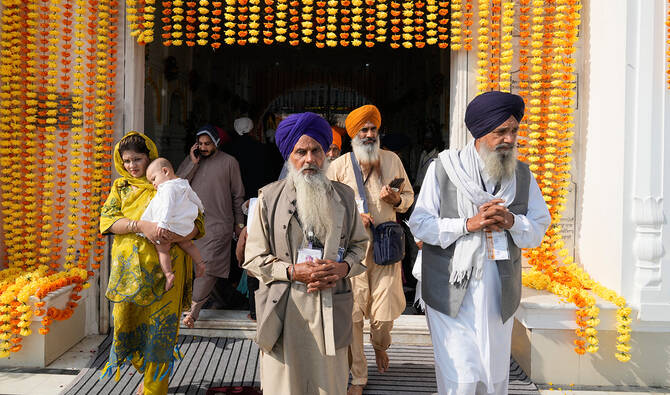

NANKANA SAHIB: The streets were scrubbed clean and banners fluttered, welcoming Sikh pilgrims on Wednesday to the Pakistani city where the founder of their faith was born 556 years ago, now brimming with devotion and hope.
Many have come from neighboring India in the first major pilgrimage to cross into Pakistan since deadly clashes in May closed the land border between the nuclear-armed neighbors.
“We were worried about what the environment would be like on the Pakistan side and how people would treat us,” 46-year-old Inderjit Kaur told AFP.
“But it has been lovely. We were given a warm welcome.”
Officials say around 40,000 worshippers gathered at the shrine to Sikhism founder Guru Nanak in Nankana Sahib to mark the anniversary of his birth in the city in 1469.
Inside the shrine complex, marigold flowers adorned the walls and the air filled with religious hymns.
Men and women prayed passionately, some performing ritual dips in a pond.
“There is no fear here,” said Harjinder Pal Singh, 66, a retired banker from India.
“The way we celebrate Guru Nanak’s birthday in Delhi, it is being celebrated with the same passion here.”
Tensions, however, remain raw between Islamabad and New Delhi.
The fighting in May — the worst bout of violence between the two countries since 1999 — killed more than 70 people in missile, drone and artillery exchanges.
Yet inside the shrine, Sikhs from both sides embraced warmly, exchanged small gifts and snapped selfies together.
At the main gate, young Muslims and Hindus danced alongside Sikh pilgrims to the beat of the dhol drum.
“There is only a border that separates us, but there are no differences in our hearts,” Harjinder said.
‘BEYOND WORDS’
Outside the shrine, a 90-year-old Muslim man waited with his grandsons, scanning the crowds anxiously.
Muhammad Bashir was looking for someone he had never met: Sharda Singh, a Sikh whose family fled Pakistan during partition in 1947.
Both their fathers were close friends, and the two men had stayed in touch across the decades but never met again.
When Singh finally emerged from the crowd, the two men locked eyes, rushed toward each other and embraced, both breaking down in tears.
“I thought I would die without meeting you,” Bashir said, his voice shaking.
“But at last you are here. Now I can die in peace.”
Singh said he had dreamt of this moment for years.
“It feels as if we have reunited after ages,” he told AFP.
“The love we received here is beyond words. People care for each other deeply, but it is the governments that have differences.”
RETALS AND PRAYERS
The devotees, many barefoot, waved saffron flags as they processed through the shrine, singing hymns and reciting poetry.
Women volunteers chopped vegetables in giant communal kitchens as men stirred massive cauldrons of rice, chickpeas, lentils and sweets.
The food is then served to everyone, regardless of their faith.
As the procession spilled into the city streets, Muslims came out onto rooftops, showering the pilgrims below with rose petals.
Above, an aircraft circled, releasing more petals that drifted down.
“We are in love with the sacred soil of Pakistan,” said Giani Kuldeep Singh, an Indian pilgrim.
“This is the land of our Guru. Our message is one of peace and brotherhood.”
Sardar Muhammad Yousaf, the religious affairs minister in Muslim-majority Pakistan, told the crowd that “religion is individual, but humanity is shared.”
The festival continues through November, including events in the border town of Kartarpur where Guru Nanak is buried.
A corridor opened there in 2019 remains closed from the Indian side since May.