

70th anniversary of Japan-Saudi Arabia diplomatic relations celebrated in Jeddah

1 / 8
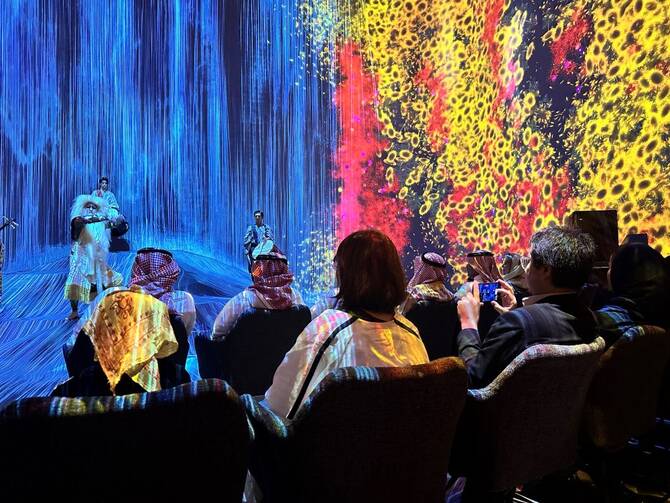
The Consulate-General of Japan in Jeddah commemorated the 70th anniversary of Japan-Saudi Arabia diplomatic relations with an authentic Japanese cultural experience featuring a traditional Kabuki performance. (AN Photo/Nada Hameed)
2 / 8
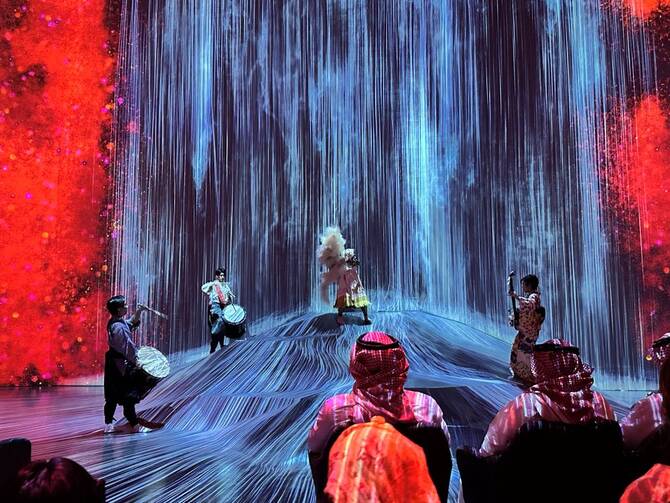
Drummers Taisei Otoma and Hikaru Ishii added depth to the performance with the powerful rhythms of traditional wadaiko drums. (AN Photo/Nada Hameed)
3 / 8
The Consulate-General of Japan in Jeddah commemorated the 70th anniversary of Japan-Saudi Arabia diplomatic relations on Wednesday with an authentic Japanese cultural experience featuring a traditional Kabuki performance.
4 / 8
The Consulate-General of Japan in Jeddah commemorated the 70th anniversary of Japan-Saudi Arabia diplomatic relations on Wednesday with an authentic Japanese cultural experience featuring a traditional Kabuki performance.
5 / 8
The Consulate-General of Japan in Jeddah commemorated the 70th anniversary of Japan-Saudi Arabia diplomatic relations on Wednesday with an authentic Japanese cultural experience featuring a traditional Kabuki performance.
6 / 8
The Consulate-General of Japan in Jeddah commemorated the 70th anniversary of Japan-Saudi Arabia diplomatic relations on Wednesday with an authentic Japanese cultural experience featuring a traditional Kabuki performance.
7 / 8
The Consulate-General of Japan in Jeddah commemorated the 70th anniversary of Japan-Saudi Arabia diplomatic relations on Wednesday with an authentic Japanese cultural experience featuring a traditional Kabuki performance.
8 / 8
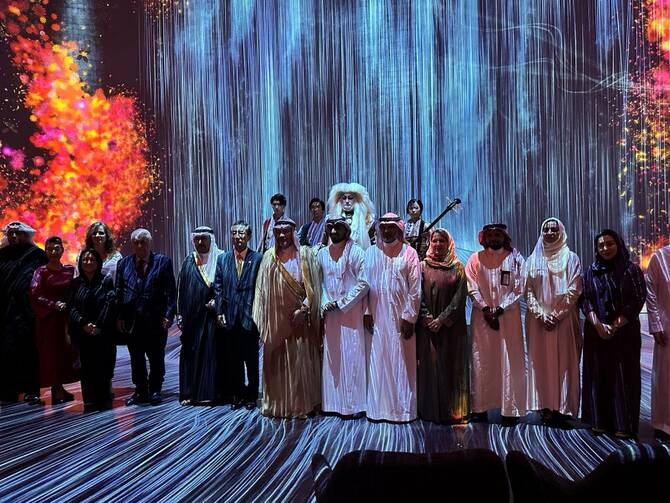
Hayato Nakamura, a rising star from a distinguished Kabuki family next to Japan’s Consul-General in Jeddah, Daisuke Yamamoto. (AN Photo/Nada Hameed)
Short Url
Updated 05 November 2025
Follow

70th anniversary of Japan-Saudi Arabia diplomatic relations celebrated in Jeddah

  • Daisuke Yamamoto: In the past, the relationship mainly revolved around trade in oil and gas. However, it has now become much more diverse
  • Yamamoto: We have brought a classical Japanese performance group — Kabuki — to Saudi Arabia for the first time

JEDDAH: The Consulate-General of Japan in Jeddah commemorated the 70th anniversary of Japan-Saudi Arabia diplomatic relations on Wednesday with an authentic Japanese cultural experience featuring a traditional Kabuki performance.

The event took place at the innovative teamLab Borderless museum in Jeddah’s Historic Area.

In an interview with Arab News, Japan’s Consul-General in Jeddah Daisuke Yamamoto, said that the relationship between Japan and Saudi Arabia was in a dynamic phase of development. While historically rooted in the trade of oil and gas, he noted that the partnership had evolved significantly.

“In the past, the relationship mainly revolved around trade in oil and gas. However, it has now become much more diverse,” Yamamoto said.

“Our cooperation includes areas such as petrochemicals, automobiles and car manufacturing, medical equipment and power plant construction — where Japanese companies contribute significantly across Saudi Arabia. Japanese companies are also involved in power plant maintenance and water desalination projects.”

He added: “We are expecting even more diversification, particularly in the cultural field.”

This year marks the 70th anniversary of diplomatic ties between Japan and Saudi Arabia, established in 1955. To celebrate this milestone, a traditional Japanese performance group was brought to the Kingdom for the first time.

Yamamoto explained: “We have brought a classical Japanese performance group — Kabuki — to Saudi Arabia for the first time. We chose the teamLab Borderless as the venue because it symbolizes the collaboration between Japan and Saudi Arabia. The museum itself is one of the most technologically advanced, using lighting and projection to create art. It’s a wonderful place to showcase a traditional Japanese performance using modern visual effects.”

The ceremony was attended by a select audience of consul generals, friends of the Japanese consulate and media representatives.

The performance took place in the museum’s grand “Waterfall Hall,” where immersive digital art installations flowed in harmony with music. During the show, the background came alive with visuals of flying birds, cascading waterfalls and blooming sunflowers.

Kento Watanabe, the show’s producer, addressed the audience before the performance: “We flew from Tokyo, Japan for 20 hours to come to Jeddah. Thank you for inviting us for this very special day. What you are about to see is one of Japan’s most celebrated traditional performing arts.”

The Kabuki performance was led by Hayato Nakamura, a rising star from a distinguished Kabuki family. Known for his expressive acting and elegant stage presence, Nakamura brought both classical rigor and modern appeal to the stage.

He embodied the legendary lion spirit in “Shakkyo” (The Stone Bridge), captivating the audience with dynamic movements, elaborate costumes and striking facial expressions, his vigorous mane swinging as he portrayed strength and fury. Nakamura greeted the audience, expressing his excitement at performing in Saudi Arabia for such a momentous occasion.

The musical crew featured Mitsuyoshi Sasaki II, who masterfully played the tsugaru shamisen, a three-stringed lute from northern Japan. Drummers Taisei Otoma and Hikaru Ishii added depth to the performance with the powerful rhythms of traditional wadaiko drums. On stage, Nakamura applied the iconic white Kabuki makeup, accentuating dramatic eyes and features.

What is Kabuki?

Kabuki is a classical Japanese theatrical art form dating back more than 400 years. Renowned for its vivid storytelling, stylized gestures, ornate costumes and bold makeup, Kabuki emerged during Japan’s Edo period (1603-1868) as a form of popular entertainment. Today, it stands as a sophisticated performance tradition blending drama, dance and music.

In 2008, UNESCO inscribed Kabuki on its List of Intangible Cultural Heritage of Humanity, recognizing its cultural and artistic importance.

Despite its deep historical roots, Kabuki continues to evolve, incorporating modern elements — including contemporary music and advanced stage technologies — ensuring the art form remains relevant to new generations while preserving its classical essence.

The Kabuki show in Jeddah was presented privately to diplomats and invited guests, but will continue to run for the public until Nov. 6, between 2 p.m. and 3 p.m. at teamLab Borderless Jeddah.


Jeddah Book Fair 2025 opens with expanded cultural program

Updated 6 sec ago
Follow

Jeddah Book Fair 2025 opens with expanded cultural program

  • Bassam Al-Bassam: Since the Literature, Publishing, and Translation Commission began organizing Saudi book fairs in 2021, we have witnessed a significant increase in visitor numbers, as well as a noticeable rise in publishing-house sales
  • Al-Bassam: The commission provides a package of supportive initiatives across literature, publishing, and translation to support the sector, improve quality, and elevate outcomes

JEDDAH: Under the slogan “Jeddah Reads,” the Literature, Publishing, and Translation Commission inaugurated the Jeddah Book Fair 2025 on Thursday at the Jeddah Superdome, launching one of the city’s largest annual cultural gatherings. 

This year’s edition brings together more than 1,000 local and international publishing houses and agencies from 24 countries, spread across 400 booths, reinforcing the fair’s position as a major regional hub for creativity, knowledge exchange, and cultural engagement. 

Bassam Al-Bassam, general manager of the Publishing General Department, praised the steady development of the fair since the commission assumed responsibility for organising Saudi book fairs in 2021. 

“Since the Literature, Publishing, and Translation Commission began organizing Saudi book fairs in 2021, we have witnessed a significant increase in visitor numbers, as well as a noticeable rise in publishing-house sales,” he told Arab News. 

Commenting on the broader publishing landscape in the Kingdom, Al-Bassam said the sector is undergoing structural improvements. 

“The commission provides a package of supportive initiatives across literature, publishing, and translation to support the sector, improve quality, and elevate outcomes.” 

He also highlighted the commission’s work on regulatory reforms. “We are currently developing the sector’s core regulations and policies to facilitate the publishing process in Saudi Arabia … and enhance the sector’s overall value.” 

Regarding international partnerships, Al-Bassam said: “We provide proper infrastructure and host book fairs across various regions of the Kingdom ... opening doors for Saudi publishers to pursue international cooperation and partnerships, ultimately exporting Saudi culture abroad.” 

He added that the commission’s participation in leading global book fairs further supports the global presence of Saudi publications. 

For the first time, the fair is hosting a dedicated program for local film production, featuring daily screenings of acclaimed Saudi films supported by the “Dhaw” Film Support Program and organized in collaboration with the Film Commission. 

The initiative highlights the rise of Saudi visual storytelling and strengthens the integration between cultural and artistic sectors. 

With more than 170 cultural events, including panel discussions, lectures, poetry evenings, and specialized workshops, the fair continues to expand its role as a full-spectrum cultural platform. 

A dedicated children’s area offers interactive activities that nurture creativity and foster a love of reading among young visitors. 

Cultural institutions, universities, and community organizations are also showcasing their latest publications and initiatives during the fair. 

Other features include a manga and anime zone, a discounted books section, and a Handicrafts Corner celebrating the 2025 Year of Handicrafts by introducing visitors to traditional crafts and supporting Saudi artisans. 

Among participating publishing houses is Kadi and Ramadi, a Saudi specialist in children's books, which celebrates its 20th anniversary this year. 

Founder Thuraya Batarji expressed her joy at returning to the fair during such a milestone. 

She said the publishing house has released special anniversary editions of key titles, noting their continued commitment to both the Jeddah and Riyadh book fairs. 

As a prominent figure in children’s literature, Batarji emphasized the importance of reading from infancy. “The secret to instilling the value of reading in children is to start at a very early age, even from three to six months.” 

She added that shared reading sessions between parents and children strengthen their bond with books and foster critical-thinking skills as young readers grow. 

The opening day also drew young visitors who had grown up attending the Jeddah Book Fair. 

Sara Al-Malki, 16, from Jeddah, described the event as an essential part of her life. 

“I’ve been coming to this fair since I was a little girl,” she said. “Starting the weekend here feels special. The atmosphere, the books, the publishers I love, it all brings back memories and makes me excited for what’s new.” 

She said that visiting her favourite publishing houses on opening day has become a personal tradition, adding that the fair has influenced her love of reading and her dream of becoming a writer. 

“This fair feels like home,” she said. “Every year it grows, and every year I grow with it.”